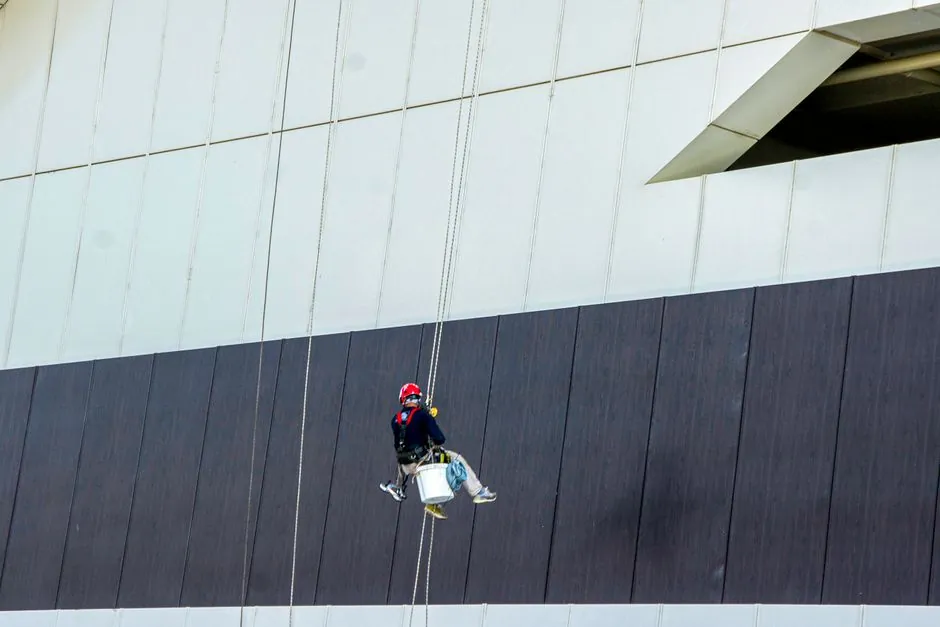
Type 4 / SIL3 / PLe safety light curtains with 30 to 50 mm optical resolution and protective heights of 500 to 1827 mm are the dominant specification for platforms, mezzanines, and scissor-lift cells where fall-from-height is the primary hazard [S1][S2].
Work-at-height guarding is governed by the same IEC 61496 electro-sensitive protective equipment (ESPE) framework as fixed machinery, but the mounting geometry, access frequency, and downward drop risk change the selection trade-off compared with press or robot cells [S2][S4].
Why Type 4 / PLe Is the Default for Elevated Workstations
IEC 61496-1/-2 splits light curtains into Type 2 (SIL1 / PLc, periodic self-test) and Type 4 (SIL3 / PLe, continuous internal cross-checking with a ±2.5° effective aperture angle versus ±5° for Type 2) [S1]. Fall-from-height events are routinely classified as serious-injury risk in ISO 12100 risk assessments, which is why work-at-height builds default to Type 4 rather than Type 2 [S2][S4].
Type 2 devices are limited to PLc (some high-performance models reach PLd) and rely on periodic test pulses rather than dual-channel cross-check, so they are usually reserved for low-risk perimeter access where the worst credible outcome is a bruise, not a 4-metre fall [S4]. Selecting Type 2 to save cost on a rooftop maintenance platform is a documented false-economy pattern in safety engineering reviews, because the same beam that misses a finger can also miss a boot heel at the wrong angle [S1][S2].
Resolution, Protective Height, and the Reach-Around Problem
Resolution is the smallest opaque object the curtain reliably detects, and it cascades into protective height selection: 14 mm for finger detection close to the hazard, 20 to 30 mm for palm/hand at the work surface, and 40 to 50 mm or more for whole-body perimeter guarding where workers are typically standing back from the edge [S1][S2][S4].
For work-at-height, the protective-height dimension is not just the curtain length, it is the vertical span needed to defeat reach-around and reach-over: the lowest beam must sit below the platform toe-board (typically 100 mm above floor) and the highest beam must be at or above 1800 mm so a 1.8 m-tall worker cannot duck under or lean over into the hazard [S1][S4]. Standard column heights run 500 mm (2-beam), 800 mm (3-beam), 900 mm (4-beam), 1330 mm, and up to 1827 mm (QJKH ENT series) or 2020 mm (Contrinex) on the upper end, which lets you match the array to the platform edge rather than oversizing and paying for inactive beams [S2][S8][S9].
Safety Distance per ISO 13855, Not Catalogue Range
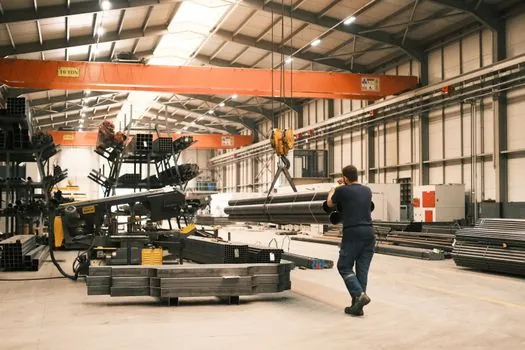
ISO 13855 governs how far the curtain sits from the fall edge, and the formula is S = K × T + C, where K is approach speed (typically 1600 mm/s for hand, 2000 mm/s for whole-body), T is the total stop time (curtain response plus machine stop), and C is intrusion allowance based on resolution (typically 8 × (d - 14) mm for d ≥ 14 mm) [S2][S4]. Curtain response time of 5 to 14 ms is small in this equation, but a 20 ms response on a 250 ms hydraulic stop time still adds 10%, which on a 4 m fall edge can shift the required standoff by 32 mm at K = 1600 [S1][S2].
Working at height amplifies this: the installer must measure the worst-case stop time at the actual hydraulic pressure and temperature, not the nameplate value, and then re-verify after every valve or seal change. A common audit finding is a curtain that meets 1385 on day one but drifts out of compliance once the hydraulic pack warms up and stop time stretches by 30 to 60 ms [S2]. For platforms taller than 2 m, many specifiers also add a top-mounted horizontal curtain or a safety mat to defeat the reach-over path that a single vertical array cannot physically block.
IP65 / IP67 Housings, Temperature, and Outdoor Roof Work
Rooftop and exposed-elevation installations need IP65 minimum, with IP67 selected where wash-down, rain drift, or condensation is present, and IP69K where high-pressure hot cleaning is part of the maintenance cycle (Omron's industrial line, for example, is rated to -30 °C with IP69K and IP67G oil resistance) [S1][S2][S5]. Operating temperature of -10 °C to +55 °C covers most outdoor work; cold-store and arctic roof work drop the lower bound to -25 or -30 °C and require conformal-coated PCBs [S2][S5].
For outdoor work at height, also check the effective aperture angle (±2.5° for Type 4) against the sun's path: a Type 4 array tolerates about half the misalignment of a Type 2 (±5°), which on a long roof run between 5 m and 19 m operating range directly determines whether morning sun causes nuisance trips [S1]. Specifiers frequently forget that the listed operating range is a function of the receiver optics, not the protective height, so a 19 m range model is mandatory whenever the array cannot sit within 6 to 8 m of the opposite column.
Muting, Blanking, EDM, and Restart Interlock for Material-In/Out at Height
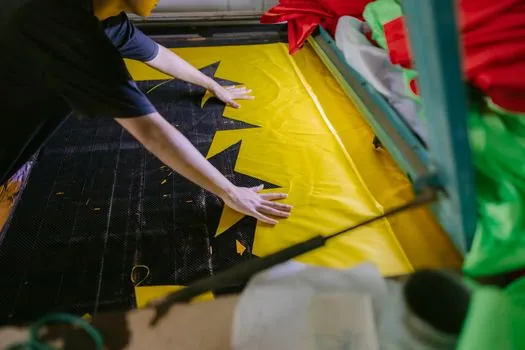
Work-at-height cells usually need to pass parts, tools, or pallets through the curtain without stopping production, which is where muting (temporary suspension via override sensors), floating blanking (allow one or two beams to be ignored), and EDM (external device monitoring of the downstream contactors) become mandatory rather than optional [S2][S5]. The standard wiring is a safety relay or safety PLC that monitors both OSSDs (output signal switching devices), with a manual reset that forces the operator to walk to the curtain, see the field, and re-arm the machine [S2][S6].
Skip muting on a rooftop cell and you have a curtain that nuisance-trips every time a tool cart rolls through, and operators will defeat it with cardboard or tape within a week. Include EDM and a restart interlock, however, and the same curtain becomes Category 4 / PLe under ISO 13849-1, which is what an OSHA or HSE inspector will look for on the validation report [S1][S2]. Banner, Keyence, Schmersal, SICK, and ReeR all ship variants that integrate EDM and restart interlock in the receiver, eliminating a separate safety relay and shrinking the panel footprint by roughly 40% [S3][S6][S8].
Decision Matrix: When a Curtain Beats a Hard Guard at Height
Use a safety light curtain when operators need frequent, line-of-sight access to the fall edge, when visibility of the work is required, and when the hazard can be stopped on demand, and choose a fixed hard guard when access is rare, when ejected parts or sparks are present (curtains do not stop projectiles), or when the stop time is too long to clear ISO 13855 at any practical mounting distance [S2].
For perimeter guarding around a rooftop service yard, a 2, 3, or 4-beam safety light grid (500 / 800 / 900 mm column heights) is the cost-effective pick; for guarding the operator's hands on a scissor-lift work platform, a Type 4 30 mm-resolution array at 300 to 600 mm standoff is the typical selection; for reach-in to a mezzanine gate, a single-beam AOPD paired with an interlocked gate is usually the right answer [S1][S2][S8]. Compared with mechanical interlocks, light curtains cut the average cycle-time loss from 6 to 10 seconds per access down to near zero, which on a frequently accessed roof cell pays back the hardware premium in weeks rather than years [S2][S5].
Spec Validation Checklist Before Sign-Off
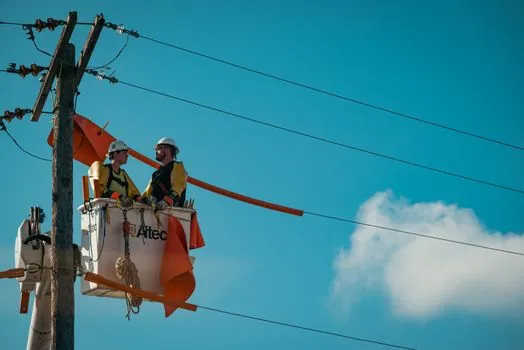
Before approving a light curtain for an elevated workstation, the engineer should verify the following against the project risk assessment: Type 4 / SIL3 / PLe certification to IEC 61496-1/-2; protective height covering the full reach envelope from below the toe-board to at least 1800 mm; resolution matched to the closest approach point (14 mm finger, 30 mm hand, 40 to 50 mm body); safety distance calculated per ISO 13855 with measured worst-case stop time; IP65 / IP67 / IP69K rating matched to the local wash-down and weather profile; EDM, restart interlock, and either muting or blanking documented on the schematic; and a validation plan that re-measures stop time at 6-month intervals [S1][S2][S5].
Two trackable signals to watch in the next quarter: revised IEC 61496-1/-2 guidance clarifying Type 4 corner-configurations and reach-over distances, and broader adoption of IO-Link safety (CIP Safety) interfaces on light curtains that will let a single cable carry the OSSD signals plus diagnostic data on which beam tripped, an improvement that will shorten root-cause analysis on nuisance stop events at height. A related reference for laboratory cells is covered in this 2026 light-curtain selection guide, while a parallel breakdown of Type 4 / IP67 / ATEX Zone 2 spec for mining extraction zones sits in this selection guide, and for welding stations with arc-eye risk the trade-offs differ in this welding-focused spec guide.
For component-level specifications, see safety light curtain, height gauge, and aerial work platform.