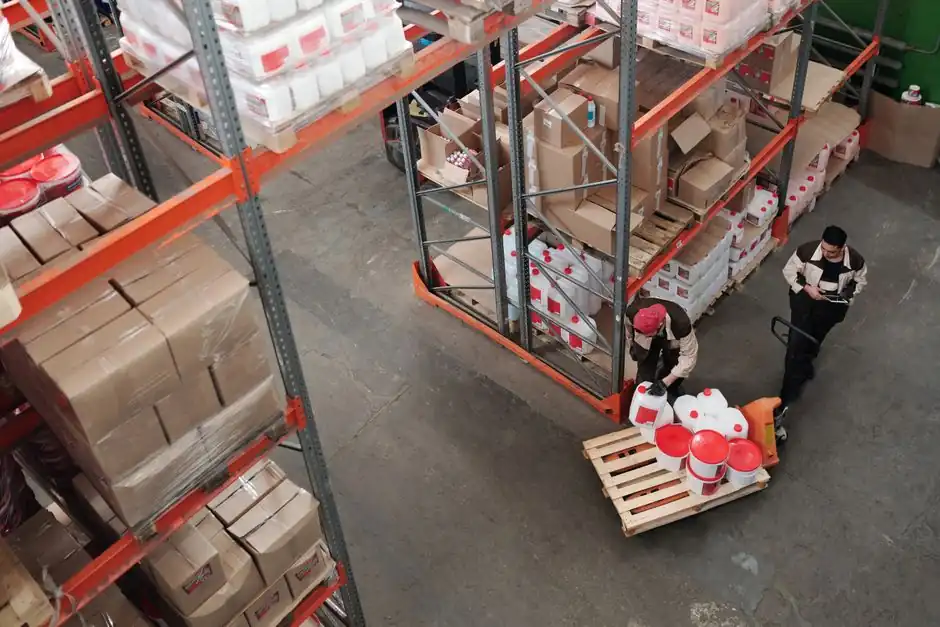
An electric pallet truck specified for cold chain must combine a low-temperature-tolerant battery (Li-ion chemistry preferred, cold-room lead-acid acceptable), corrosion-resistant frame finishing (galvanized or stainless), food-grade H1 lubricant across all pivot and drive points, and a documented derating of at least 20% above the maximum freezer load, as a 6,000 lb-rated pallet jack should not carry more than 4,800 lb into a -20°C or colder room [S6].
Standard walkie electric pallet jacks for general warehouse duty span roughly 3,000–8,000 lb capacity at 24V or 48V across mainstream OEM lines, with heavy-duty walkie pallet trucks extending the range from 6,000 to 30,000 lb for manufacturing and steel-handling environments [S2][S3]. Cold storage sits between these two regimes: lighter than steel-mill duty, but harder on batteries, seals, and surface coatings than ambient dry goods warehousing.
Cold Chain Duty Profile and Equipment Category Fit
Cold chain logistics split into three temperature bands that drive different equipment decisions: chilled storage at 2–8°C, frozen storage at -18 to -25°C, and blast freezers at -35°C or lower, each imposing distinct stress on electric pallet truck components [S1]. The U.S. pallet jack market recorded sustained demand for both manual and electric units in 2026, with electric walkie and rider pallet jacks absorbing the high-throughput share in distribution centers and temperature-controlled warehouses [S1].
For dock-to-freezer moves, the electric pallet truck category covers walkie (operator walks behind), rider (stand-on platform), and end-rider configurations, with walkie units being the dominant cold-chain choice because their short wheelbase turns inside typical 8–9 ft freezer aisles without requiring right-angle stacking geometry. End-rider pallet jacks, with their longer fixed forks and longer chassis, suit longer dock-to-room runs where the operator stands on a folding platform, but their footprint typically rules them out inside freezers under 12 ft aisle width.
Battery Chemistry Selection at Sub-Zero Temperatures
Lithium iron phosphate (LFP) batteries retain roughly 80% of rated capacity at -20°C when equipped with self-heating modules, while standard lead-acid batteries lose 30–50% of capacity below -10°C and require insulated battery compartments with periodic equalization charges [S5]. Mainstream electric walkie pallet jacks ship in 24V (typical for 2,200–4,500 lb class) and 48V (typical for 4,000–8,000 lb class) configurations, and the same voltage envelope applies to cold-chain units, with the difference being the battery box insulation and the charging bay ventilation [S2].
For facilities running multi-shift operations, LFP with integrated cold-weather heating and opportunity charging at -20°C outperforms flooded lead-acid on both throughput and total cost of ownership over a 7-year service life, but requires a higher upfront capital of roughly 1.8–2.2x the lead-acid equivalent [S5]. Facilities with single-shift duty in chilled (not frozen) rooms can still use AGM lead-acid at 2–8°C with acceptable runtime, provided the battery is not discharged below 50% state of charge before recharge, which would accelerate sulfation in cold conditions.
Frame, Finish, and Component Materials for Freezer Duty
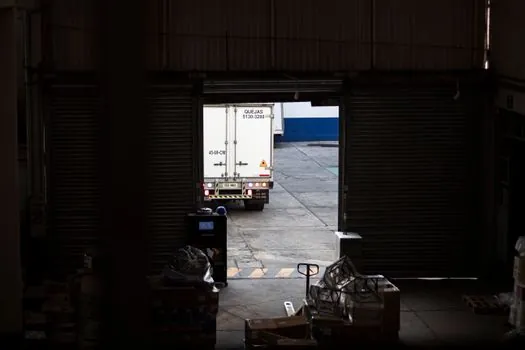
Cold-chain electric pallet trucks require hot-dip galvanized steel, zinc-nickel plated fasteners, and stainless steel hydraulic fittings, because standard powder-coated frames experience coating micro-cracking below -25°C and accelerated creep corrosion in the humidity swings between dock and freezer [S3]. Heavy-duty walkie pallet trucks in the 6,000–30,000 lb class are typically built with AC traction drives and regenerative braking, both of which are well-suited to cold-chain duty because regenerative braking recovers energy on descents and reduces mechanical brake wear, a frequent failure point in cold rooms where condensation freezes on exposed linkages.
Polyurethane wheels, the standard fit on most walkie electric pallet trucks, harden below -20°C and lose traction on frosted concrete; cold-chain-specific builds substitute polyurethane compounds rated to -30°C, or use rubber-tread drive wheels with crowned polyurethane load wheels to balance grip and floor marking. Hydraulic fluid must be a low-temperature synthetic (ISO VG 32 with pour point below -35°C), as standard mineral oil thickens past usable viscosity at -15°C and slows lift speeds to the point of throughput loss.
Lubrication, Seals, and Food Safety Compliance
Food-grade H1 lubricants, registered for incidental food contact, are required on all grease points (mast chains, fork pivot pins, wheel bearings, hydraulic cylinder seals) for cold-chain electric pallet trucks operating in cold storage areas adjacent to unpackaged food, with H2 lubricants permitted only in non-food-contact zones such as the motor compartment [S3]. Elastomer seals on hydraulic cylinders typically ship as NBR (nitrile), which stiffens below -20°C; cold-chain builds should specify HNBR or fluorocarbon (FKM) seals for the lift cylinder, with documented low-temperature flexibility per the seal supplier's cold-flex data sheet.
NSF/ANSI 169 certified equipment is increasingly specified for cold-chain buyers in the U.S. and EU, particularly for facilities handling meat, dairy, and ready-to-eat products, and this standard establishes hygiene design criteria for mobile equipment that complement, but do not replace, the OSHA 1910.178 operator training requirements and the ANSI/ITSDF B56.1 safety standard for low-lift and high-lift trucks [S2]. Buyers should confirm that the OEM's cold-chain option list explicitly includes H1 lubrication, stainless or zinc-nickel hardware, and NSF/ANSI 169 readiness rather than assuming a standard warehouse jack can be retrofitted.
Capacity Derating, Load Center, and Fork Sizing
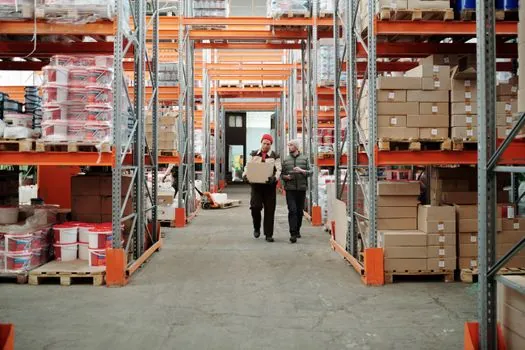
Standard warehouse guidance calls for an electric pallet jack rated at least 20% above the maximum expected load, which for a 6,000 lb nominal application means selecting a unit rated for 7,200 lb or higher, and the same margin should be preserved for cold-chain duty [S6]. Beyond capacity, the load center (the distance from the fork face to the load's center of gravity, standardized at 24 in. for most pallet jacks) shifts in cold rooms because cold pallet wrap contracts and ice accumulation on the load face adds forward weight, both of which increase the effective load moment.
For frozen pallet moves of 4,000 lb or more into -25°C rooms, a 6,000 lb-rated heavy-duty walkie unit with optional 48 in. or longer forks (rather than the standard 36–48 in.) handles standard GMA pallets plus half-pallet and slip-sheet loads common in meat and seafood operations [S3]. Standard GMA 48 in. x 40 in. pallets still dominate U.S. cold-chain receiving, so fork length of 48 in. and fork width of 27 in. outer-to-outer remain the default spec; deviations from these dimensions are usually tied to specialty racking rather than pallet standardization.
Comparison: Cold-Chain Build vs Standard Warehouse vs Heavy-Duty
Three electric pallet truck configurations compete for cold-chain duty, and the table below lines them up against four decision criteria: temperature rating, capacity range, food-safety readiness, and battery cost over a 7-year service life. Standard warehouse walkie units (typified by the 3,300 lb WPL33, 4,000 lb WPL40, and 4,500 lb WPX45 in the 24V/48V class) cover ambient and chilled (2–8°C) duty, but lack the seal packages, lubrication certifications, and battery thermal management for sustained -20°C work [S2].
Heavy-duty walkie pallet trucks in the 6,000–30,000 lb range ship with AC traction drives, regenerative braking, and the structural headroom for cold-chain option packages, but their larger footprint and longer chassis often exceed freezer aisle dimensions below 10 ft [S3]. Cold-chain-specific electric pallet trucks, built on the standard warehouse chassis but with low-temp LFP batteries, galvanized frames, H1 lubrication, and HNBR/FKM seals, occupy the middle ground: they cost roughly 30–50% more than the standard warehouse equivalent, 25–40% less than a heavy-duty walkie, and they handle the 2,200–6,000 lb range that covers the majority of cold-chain SKU movement.
For Whom This Equipment Fits, and Where It Does Not
Electric pallet trucks configured for cold chain fit distribution centers handling 50 or more pallet positions per shift into frozen storage, multi-temperature grocery warehouses, meat and seafood processors, dairy cold-storage operators, and pharmaceutical 2–8°C facilities, where standard warehouse units would fail on battery runtime and seal integrity [S1]. They do not fit blast-freezer operations at -35°C or colder, where battery self-heating systems cannot keep up with heat loss, and where specialized freezer-rated reach trucks or fixed-aisle automated guided vehicles typically replace walkie pallet jacks. They also do not fit narrow-aisle high-rack freezer storage above 3 m lift, which requires electric reach trucks or stackers instead [S5].
For a complete treatment of electric pallet truck selection in a different but adjacent logistics environment, the e-commerce fulfillment spec guide covers 24V/48V capacity tiers, battery cycle life, and throughput modeling, and complements the cold-chain build list above with ambient-warehouse configuration details. The two specs together give a fleet manager a complete procurement matrix across ambient, chilled, and frozen conditions.
Procurement Signals and Trackable Items
Two signals will move cold-chain pallet truck specs in the next 6–12 months. First, U.S. pallet jack market growth through 2034 is forecast at a CAGR well above general material-handling equipment, driven by cold-chain expansion and e-commerce grocery, with electric units capturing the high-throughput share [S1]. Second, Chinese OEM stacker and pallet jack lines have moved decisively toward 24V/48V LFP batteries with cold-weather option packages at price points 25–40% below U.S.-built equivalents, putting pressure on domestic cold-chain buyers to confirm whether NSF/ANSI 169 certification, food-grade lubrication, and U.S. service coverage are bundled into the import price or available only as upgrades [S5]. Track cold-chain pallet truck RFQ responses for: battery chemistry and self-heating spec, frame finish type, seal elastomer grade, and whether H1 lubrication is standard or a costed option.
Detailed specification references: cold chamber machine, and cold milling machine.