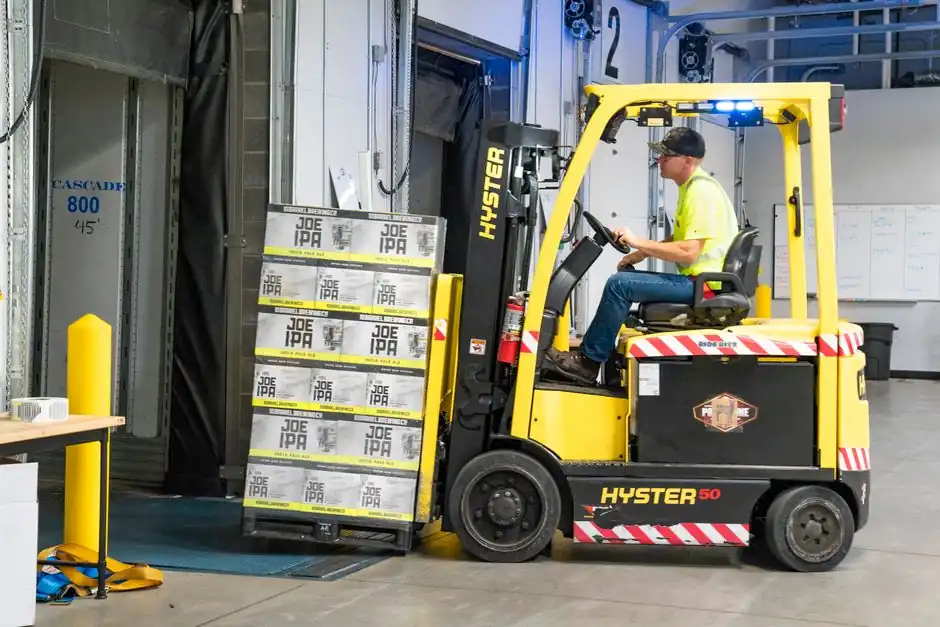
Food and beverage buyers of electric pallet truck units most commonly specify load capacities between 3,000 lb and 8,000 lb, matching the GMA pallet population of 2,000 to 4,500 lb gross weight across packaged goods, dairy, beverage, and bakery operations [S1][S2][S7].
Standard walkie pallet jacks from CLARK, Hyster, and Toyota sit in the 3,000 to 4,500 lb range at 24V or 36V; heavy-duty walkies from Sroka push the upper end from 6,000 to 30,000 lb with AC traction drives and regenerative braking [S1][S2][S10]. The right spec for a bakery line is rarely the same as the right spec for a beverage distribution center, so capacity, voltage, and hygienic build are decided independently.
Capacity, Voltage, and Drive Layout for Food and Beverage Duty
Standard warehouse walkie electric pallet trucks are commonly rated 3,000 to 6,000 lb at 24V, with travel speeds around 3 mph and operators walking the unit rather than riding it [S3]. CLARK lists the WPL33 at 3,300 lb, WPL40 at 4,000 lb on 48V, and WPX45 at 4,500 lb on 24V, while the Hyster DW33ALZ nested walkie is rated 3,300 lb for grocery and beverage backroom unloading [S1][S10].
For beverage and food distribution centers where pallet loads are heavier, the spec climbs to the 4,500 to 8,000 lb tier: CLARK's HWXE-PWXE hits 8,000 lb at 24V [S1]. Indian-market BOPT (battery operated pallet truck) configurations used in FMCG and food warehouses cluster at 1.5, 2, 2.5, and 3.0 tonne (3,300 to 6,600 lb) [S5]. When pallet gross weight plus forklift tare exceeds 6,000 lb, an AC traction drive with regenerative braking is the spec to insist on, as Sroka fits across its LWP series [S2].
Hygienic Build, Washdown, and Corrosion Resistance
Food and beverage environments subject equipment to high-pressure hot wash, chlorinated sanitizers, and condensate from cold rooms, so a hygienic build spec has to be itemized separately from capacity [S8]. Diding's industry guide for electric stackers (the lift-only cousin of the walkie) lists zero-emission electric operation, customizable corrosion-resistant surfaces, and food-grade sealing as core food and beverage requirements, and the same logic applies to walkie pallet jacks on bottling, dairy, and bakery lines [S8].
Sroka runs a dedicated washdown and corrosion-resistant category in its walkie product line and explicitly lists food processing, beverage, pharmaceutical, and personal care among the industries that need it, alongside paper, packaging, and steel [S2]. For cold storage and refrigerated dock duty, condensation-driven corrosion means hydraulic fittings, fasteners, and battery compartment seams should be specified 304 or 316 stainless, with electrical enclosures at IP65 minimum. Battery chemistry also matters: lithium-ion (LiFePO4) drops the open lead-acid cell count, eliminating the acid-spill risk that a flooded battery introduces on a wet plant floor, and CLARK's S25XE Renagade lithium line is a current example in the same product family [S1].
Battery Chemistry and Charging: Lead-Acid vs Lithium-Ion
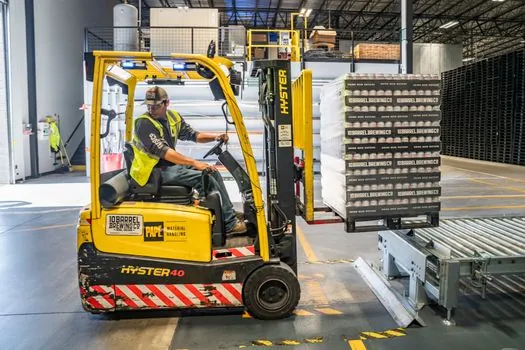
Flooded lead-acid at 24V or 36V remains the default spec for the food-grade walkie segment, with capacities around 200 to 224 Ah on entry-level models such as the CLARK WSTX30/35 (3,500 lb, 224Ah) and the WSRX30 (3,000 lb, 24V) [S1]. Lithium-ion is gaining in beverage distribution because opportunity charging between shifts fits double-coverage beverage operations without battery swap rooms.
Toyota's 2026 electric product guide frames lithium-ion as part of the broader electrification message for material handling, alongside its SEnS+ Smart Environment Sensor and MyInsights telematics [S4]. For a refrigerated warehouse at 0 to 5 degrees C, lithium-ion also holds usable capacity better than lead-acid, which loses roughly 20 percent of rated Ah at low temperature. The trade-off is unit cost: a lithium walkie at 4,000 to 5,000 lb capacity typically carries a price premium over an equivalent 24V lead-acid unit, so the ROI case leans on multi-shift utilization and the elimination of a battery room. For related warehouse storage hardware that the same walkie feeds, see the pallet rack selection reference.
Operator Environment, Noise, and Cold Storage Suitability
Food and beverage plants run cold rooms at 0 to 5 degrees C for fresh dairy, produce, and meat, and freezers at minus 18 to minus 25 degrees C for frozen goods; a walkie spec for these zones needs low-temperature rated hydraulic fluid, cold-room lubricants, and heated battery compartments on lead-acid units [S2]. Electric operation is intrinsically lower noise than IC/LPG, which matters in open bakery and packaging halls where 75 dBA ambient targets are common, and zero tailpipe emissions are required indoors regardless of ventilation.
For worker-paced picking at the pallet-position level, an electric pallet stacker with 2,200 to 3,500 lb capacity is often paired with a 4,000 to 5,000 lb walkie to cover both ground-level transport and low-level put-away, and the two share battery platforms on common 24V/36V chassis (e.g. CLARK WS22M, WSTX22 at 2,200 lb; WSTX30/35 at 3,500 lb) [S1]. Operator controls on current walkies (tiller-arm ergonomics, electric steering on higher-end models, and Curtis or similar AC controllers) are now standard enough that brand differentiation at this tier is more about dealer network than electronics.
Selection Criteria: How to Spec a Walkie for Your Plant
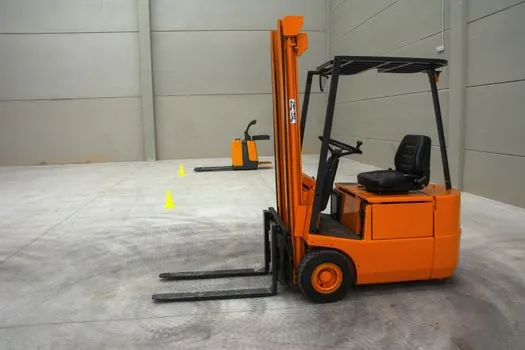
Five criteria decide the spec, and they should be set independently rather than bundled. (1) Load: pick the maximum gross pallet weight your operation moves plus a 25 percent margin, then match to a 3,000 to 8,000 lb walkie [S1][S2][S7]. (2) Environment: dry warehouse, washdown, cold room, or freezer each force different sealing, lubrication, and battery chemistry. (3) Battery: 24V lead-acid for single-shift dry; 36V or lithium for multi-shift wet, cold, or opportunity-charged fleets. (4) Power steering and tiller: electric-assist steering becomes worth the upcharge above 4,000 lb capacity, especially on ramps and in 9 to 10 ft aisles. (5) Telematics and safety: SEnS+ pedestrian-detection sensors and MyInsights fleet data are available on the Toyota line and are increasingly demanded by beverage and food safety audits [S4].
For unit comparison, three common configurations line up as follows on the food and beverage decision axes:
Entry 24V lead-acid walkie at 3,000 to 3,300 lb (e.g. CLARK WPL33, Hyster DW33ALZ): cheapest, fits single-shift dry grocery backroom, no washdown rating, lead-acid battery, manual tiller [S1][S10].
Mid-tier 24V/48V walkie at 4,000 to 4,500 lb (e.g. CLARK WPL40 at 48V, WPX45 at 24V): the common beverage DC and food distribution spec, faster travel at higher voltage, suited to two-shift duty with battery swap [S1].
Heavy-duty washdown walkie at 6,000 to 8,000 lb (e.g. CLARK HWXE-PWXE at 8,000 lb; Sroka LWP series at 6,000 to 30,000 lb): needed for meat, dairy, and beverage where high-pressure wash is daily, with AC traction, regen braking, and stainless or corrosion-resistant hardware [S1][S2].
Use Cases Across Food and Beverage Segments
Beverage distribution: high-throughput DCs with 2,000 to 4,000 lb pallet loads of bottled water, soft drinks, and beer favor the 4,000 to 4,500 lb 24V/48V walkie class with electric steering and telematics; lift-truck suppliers interviewed for beverage trade press cite distribution-network redesign and SKU proliferation as the operational drivers in 2026 [S1][S4][S9].
Dairy, meat, and fresh produce: 3,000 to 4,500 lb washdown-spec walkies with stainless hardware, IP65+ enclosures, and corrosion-resistant coatings are the typical procurement spec, paired with refrigerated dock duty at 0 to 5 degrees C [S2][S8].
Bakery and packaged food: the lighter 1.5 to 2.0 tonne (3,300 to 4,400 lb) BOPT class covers FMCG-style pallet flow on 24V lead-acid, with emphasis on low noise and zero emissions indoors [S5]. For plants that also need low-level put-away, the related pallet stacker selection criteria feed the same battery and sealing decisions.
Failure Modes, Sourcing, and Trackable Signals
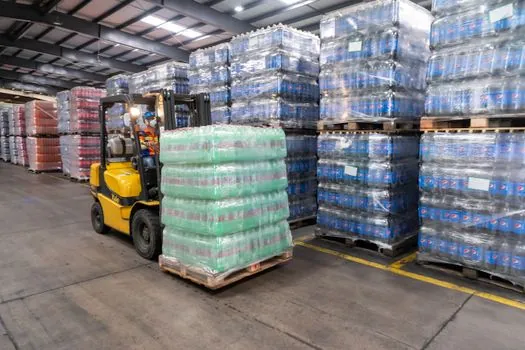
The most common spec mismatches in food and beverage walkie fleets are (a) underspeccing voltage, where 24V units are pushed into 4,000+ lb multi-shift duty and overheat traction motors; (b) wrong battery chemistry for cold rooms, with flooded lead-acid losing usable capacity and freezing risk below 0 degrees C if not fully charged; (c) specifying a standard paint system where washdown eats hydraulic cylinder rods within 12 months; and (d) ignoring ingress protection, where IP54 electronics fail under high-pressure cleaning cycles [S2][S8]. On the warehouse automation side, an AS/RS selection guide covers the upstream storage automation that walkies feed.
For procurement, track the 2026 Q3/Q4 dealer bulletins from CLARK, Hyster, and Toyota on lithium-ion entry-level walkies, the FDA Food Safety Modernization Act (FSMA) sanitary equipment design expectations, and the IEEE 1683 / UL 583 forklift electrical standard revisions as they apply to indoor food and beverage use; cross-check the beverage industry trade press on lift-truck solutions for distribution redesign projects through 2026 [S1][S4][S9]. These three signals are the ones to watch before locking in a multi-unit 2026 fleet order.