An electronic scale quantifies mass by countering gravitational weight on a load cell, while a force gauge — also called a push-pull gauge or dynamometer — directly measures applied tension or compression force independent of gravity direction. The two instrument families overlap in hardware (both rely on strain-gauge load cells) but diverge sharply in calibration target, units (kg/g vs N/lbf), and sampling architecture, with industrial force gauges commonly sampling at 1000 Hz versus the 1–10 Hz typical of bench scales [S2][S7].
Practical ranges also separate the categories: electronic scales span microgram precision balances through 100 t truck weighbridges [S10], whereas portable digital force gauges typically cover 1 N to 50,000 N (0.5 lb to 200 lb) full scale, with high-accuracy industrial units rated at ±0.2% FS [S2][S4]. Picking the wrong instrument class — for example, weighing a clamped workpiece on a scale to "verify clamping force" — discards the directional load information the application actually needs.
What Each Instrument Actually Measures
Electronic scales convert a vertical gravitational load into a mass reading through a calibrated load cell, with the displayed unit (kg, g, lb) traceable to a reference mass. Industrial electronic truck weighbridges (电子汽车衡器) replaced mechanical lever designs in the mid-1980s once strain-gauge load cell accuracy stabilised, and today handle bulk-goods weighing for factories, mines, and trading operations [S10].
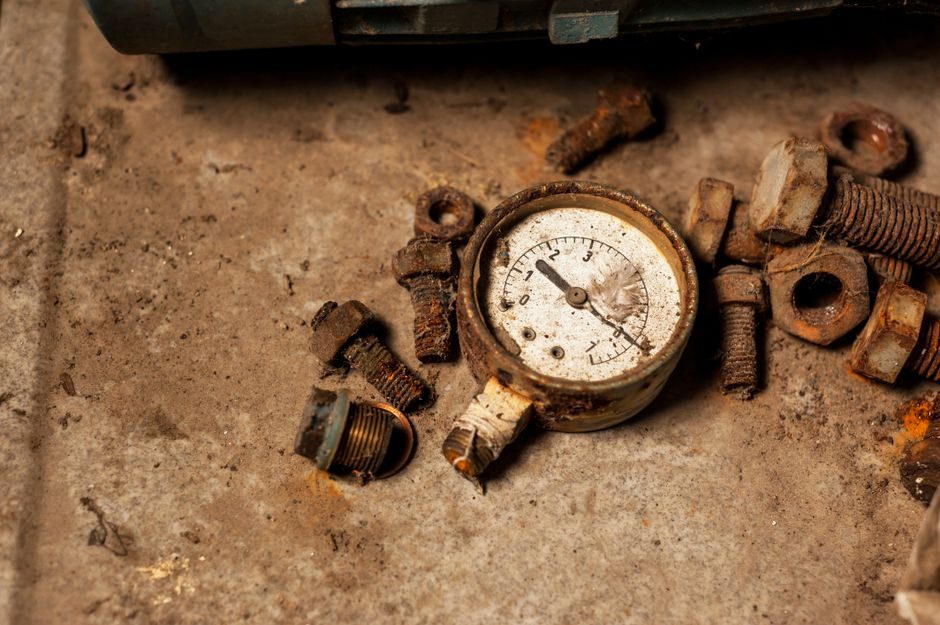
Force gauges transduce a uniaxial push or pull load into a force reading whose calibration is independent of orientation, with the same gauge readable in Newtons, kilograms-force, or pounds-force at the press of a button. The SEALS USA FGE-XY series, for instance, switches units and reads peak hold with a single button, and the 180° reversible display allows operation mounted upside-down on a test stand [S2]. Mechanical force gauges use a calibrated spring and pointer to provide the same tension/compression readout without electronics, suited to field service where batteries are inconvenient [S8].
Selection Criteria: Mass vs Force Decision
The first decision node is traceability: if the deliverable is a mass value for commerce, inventory, batching, or legal-for-trade use, the electronic scale is the only correct instrument. If the deliverable is a force or load value for process control — clamping force on a hydraulic chuck, electrode force on a spot welder, pull-off strength of a crimp, or trigger pull on a tool — the force gauge is the correct tool. [S1]
Second is sampling and peak behaviour: industrial force gauges such as the FGE-XY sample at 1000 Hz to capture transient peaks (crimp pull, peel break, syringe plunger break-loose) and offer dedicated peak-hold modes, while a bench scale running at 5–10 Hz will average those events into a meaningless number [S2]. Third is accuracy class: a typical industrial digital force gauge specifies ±0.2% FS, while a general-purpose industrial platform scale commonly quotes 0.05–0.1% of reading — better in absolute terms, but in the wrong unit for force applications. Fourth is overload margin: spot-welding gauges like the AMADA MM-601B are built rugged for shop-floor electrode set-and-verify cycles, with HOLD, ZERO, and one-touch tare for repeatable in-line use [S3].
Comparison Matrix: Electronic Scale vs Force Gauge
The following matrix lines up the main options against the criteria that drive wrong-instrument failures. Values are drawn directly from cited product data and should be treated as typical industrial ranges, not universal limits. [S2]
Three configuration classes are commonly specified side by side: platform electronic scales (including truck and crane scale variants), handheld digital force gauges, and mechanical push-pull gauges. Platform scales deliver the best mass accuracy in a fixed installation, handheld digital gauges deliver the best force accuracy and peak capture in a portable form factor, and mechanical gauges trade accuracy for zero-power operation. Rated capacity, sampling, accuracy, units, and typical application for each class are summarised below.
Configuration — Rated capacity — Sampling/response — Accuracy — Units — Typical use. Platform electronic scale (industrial / truck): 100 g to 100 t; 1–10 Hz; ±0.05% to ±0.1% of reading; kg / g / lb; bulk goods, batching, inventory [S10]. Handheld digital force gauge (industrial): 1 N to 50,000 N (0.5 lb to 200 lb); up to 1000 Hz; ±0.2% FS; N / kgf / lbf switchable; clamping force, weld electrode force, crimp pull, trigger pull [S2]. Handheld digital force gauge (lower-cost / spot-weld): 50 N to 500 N class; peak hold; not always stated; N; spot-welder set-and-verify [S3]. Mechanical push-pull gauge: 10 N to 500 N class; pointer, no electronics; depends on spring linearity; N / kgf; field service, battery-free QA spot checks [S8].
For hydraulic-chuck clamping force on a machining centre, the DINE HDG analogue gauge reads pressure-equivalent clamping force directly so a weakening chuck can be identified before a tool scrapes a workpiece — a use case where weighing the chuck on a platform scale would yield only a static mass number with no clamping information [S1]. For texture analysis on frozen surimi gel, the Imada FRTS-50N runs at 1000 samples per second with ±0.2% FS accuracy, well beyond what any weighing instrument can deliver for a force-versus-time curve [S7].
Where Force Gauges and Scales Quietly Converge
Stylus-force measurement for phono cartridges is the textbook boundary case: the operator wants a downward tracking force in grams, but the reading is a small compressive load on a cantilever, not a gravity-driven mass on a pan. Low-cost digital stylus scales resolve to 0.005 g on a 100 g full scale and read directly in grams to mimic scale output, while dedicated stylus force gauges add calibrated cantilever geometry [S9]. Using a kitchen scale to set VTF works at the gram level but fails on repeatability because most consumer scales sample far too slowly to read the stylus settle point.
For overhead weighing in a warehouse, a crane scale such as the Giropes CHS with remote readout is the correct hybrid — it is a force-measurement device calibrated to display mass, suspended from a hook rather than sitting on a platform. Calling a crane scale a "force gauge" or specifying a force gauge in its place is the most common procurement error in this category.
Common Misuse Patterns and Failure Modes
Trying to derive clamping force from mass: weighing a chuck and the workpiece separately on a platform scale, then subtracting, gives only the net gravitational load and not the radial gripping force a collet actually exerts. The DINE HDG exists precisely because that subtraction does not predict tool slippage or scrap [S1].
Trying to capture a peel or break event on a scale: a peel test releases energy in milliseconds; a bench scale low-pass filter will integrate that into a meaningless average. A 1000 Hz peak-hold force gauge is the only credible instrument here [S2][S7].
Specifying the wrong accuracy target: a ±0.2% FS force gauge on a 50,000 N range yields ±100 N absolute error, which is fine for a 30,000 N crimp pull but disastrous for a 50 N trigger-pull test where the same gauge is at the bottom of its range. Force-gauge accuracy is range-dependent, mass-scale accuracy is reading-dependent — a critical distinction for spec sheets.
Standards, Calibration, and Sourcing Signals
Calibration traceability for mass scales in commercial use typically follows OIML R76 (non-automatic weighing instruments) or NTEP Handbook 44, while force calibration in many industrial labs follows ISO 376 or ASTM E4 for the load-cell proving ring. Specifying a "calibrated" gauge without naming the standard, range, and uncertainty is the single most common documentation gap in force-gauge purchase orders. [S2]
Watch for two sourcing signals in 2026: portable digital force gauges continue to consolidate around 1000 Hz sampling and ±0.2% FS as the baseline industrial feature set, visible across SEALS USA FGE-XY, AMADA MM-601B, and SAUTER FC-series lineups [S2][S3][S4]; and texture/penetration testing on food gels and surimi is migrating from lab-only rheometers to handheld force gauges with registered test methods, with the Imada FRTS-50N explicitly shipping with pre-registered food texture recipes [S7]. For complementary engineering selection logic on related measurement equipment, see this torque wrench tester vs load cell decision map.