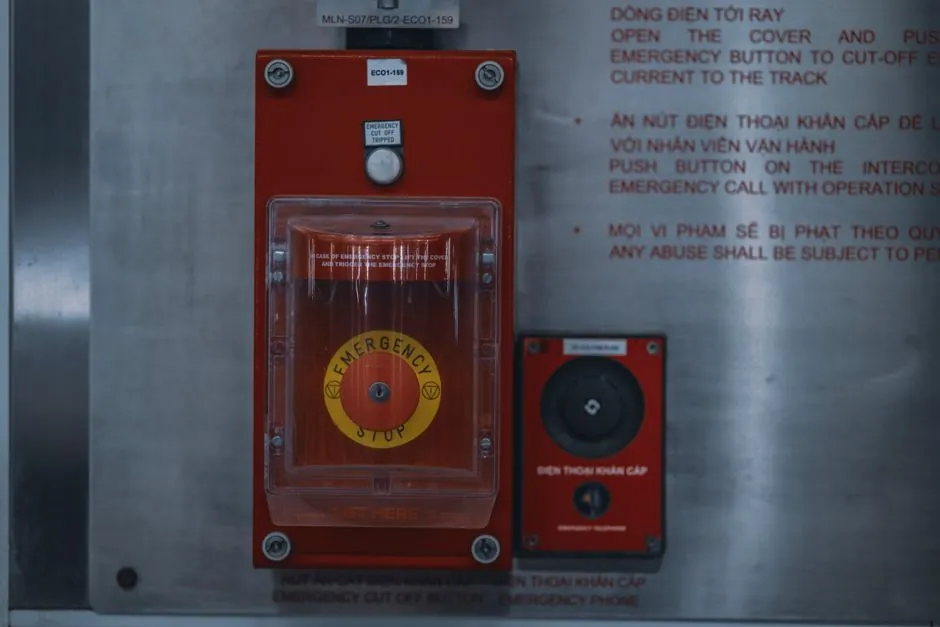
Emergency stop buttons provide a dedicated, highly visible shutdown action, generally using a large red mushroom actuator mounted within immediate reach. Their principal benefits are rapid access, straightforward recognition, and robust construction [S1][S3].
They are intended for emergencies rather than routine starting or stopping, so their value depends on correct placement, suitability for the environment, regular functional checks, and a controlled reset process [S2][S3].
Core Functions and Operating Behavior
Emergency stop buttons change the state of an electrical circuit when actuated and may either return automatically or remain latched until released. In safety service, the emergency-stop arrangement generally latches after operation, with reset by twisting, pulling, or using a keyed release, while ordinary control push buttons commonly provide momentary or maintained positions [S1][S2].
The distinction is functional, not cosmetic. An emergency stop is intended to halt hazardous machinery during an emergency, whereas a foot switch can control a routine machine function hands-free. A foot switch therefore cannot substitute for an emergency stop, and a machine may require both devices [S1].
Emergency-stop buttons are typically bright red and prominently placed for quick access. These devices should not be used as normal production controls because emergency-stop push buttons are specified for safety reasons rather than repeated routine operation [S2].
Advantages for Rapid Machine Shutdown
The strongest advantage is direct access to a shutdown action during a hazardous condition. Emergency stop buttons are typically bright red, prominently positioned, and recognizable without interpreting a display or navigating a control menu, which makes them faster to actuate than routine controls [S1][S3].
A large mushroom-shaped actuator improves visibility and makes the intended emergency action easier to identify. Emergency-stop push buttons are also generally designed as robust, fixed-mounted devices, and their solid mounting supports consistent operation during an emergency [S1][S2].
Unlike battery-dependent foot switches, emergency stop buttons do not generally rely on batteries for their primary shutdown function. This removes one power-supply consideration from a safety device whose mechanical action must remain dependable during abnormal conditions [S1].
Specification must still include the machine, electrical load, actuator arrangement, contact configuration, environmental condition, and reset method. A generic red button is not evidence of a complete emergency-stop function, and the selected assembly must withstand harsh environments and frequent use [S3].
Disadvantages and Failure Modes

Accidental operation is the principal disadvantage. A button located beside a busy walkway can be struck by a person, tool, or moving object, while vibration or inadequate guarding can also contribute to unintended activation [S1][S3]. Placement therefore determines whether quick access and accidental activation are balanced or one defeats the other.
Poor visibility creates a second failure mode. Placement beneath equipment, inside a poorly illuminated area, or near other red and yellow controls can delay recognition or cause confusion. Illuminated buttons can improve visibility where lighting is inadequate, but multiple devices may be needed along a conveyor or other extended operator route [S3].
Environmental exposure and contact wear create maintenance risks. Push button switches may suffer from mechanical wear, contact deterioration, electrical arcing, loose terminations, or overheating when installation and maintenance are inadequate. Routine inspection can identify worn contacts before total failure, while secure electrical connections reduce overheating and voltage drop [S2].
Reset practices also matter. A latched emergency stop should not be treated as a normal start button. Operators need to understand whether the machine requires a twist, pull, or key release and must remove the cause of the emergency before reset [S1].
Selection Criteria for Industrial Installations
Location is the first selection decision. The device should be within immediate reach, clearly visible, unobstructed, and separated from similar controls. Facilities where workers move along a conveyor may require several emergency-stop locations rather than one button at the central control station [S1][S3].
Actuator and reset design are the next criteria. A large mushroom actuator supports rapid recognition, while twist-to-release or key-release mechanisms can discourage casual reset. The reset arrangement should match the risk assessment and operating procedure rather than being selected only for operator convenience [S1][S3].
Environmental fit must be established before installation. The device must withstand harsh conditions and frequent use, and it should not be placed where vibration, impact, debris, or high-traffic movement can cause unintended operation. Protective covers can reduce exposure but must not obstruct rapid access [S3].
For the broader control-panel context, a pushbutton and pilot light handles routine control and indication, whereas the emergency-stop device addresses abnormal hazard response. Mixing those duties can create operator confusion and increase the chance that the safety function is used as a production control.
Emergency Stop Button Against Alternative Controls

Emergency stop button versus foot switch: the emergency stop offers quick access, clear visibility, robust mounting, and a single safety role, but it is vulnerable to accidental activation when badly positioned [S1]. The foot switch supports hands-free routine control and may use momentary or maintained pedal action, but it has greater misoperation risk and depends on design quality and, for some models, battery life [S1].
Emergency stop button versus ordinary push button: the emergency stop uses a conspicuous safety actuator, latches for shutdown, and normally requires a deliberate reset. An ordinary push button may be momentary or maintained and can start motors, stop machinery, activate signals, or control lighting as part of normal operation [S1][S2].
Emergency stop button versus foot switch on reach and purpose is decisive. The emergency stop belongs within immediate reach and visible on the machine or control station; the foot switch sits on the floor at the operator’s working position. The former stops for safety, while the latter is designed for normal hands-free operation [S1].
The correct choice therefore depends on the hazard, required stopping action, operator movement, exposure to impact, reset policy, and maintenance regime. A foot switch may be valuable where both hands must remain free, but it does not eliminate the need for a separately accessible emergency-stop function [S1].
Installation, Testing, and Maintenance
EN/IEC 60204-1 and IEC 60947-1 are identified as relevant safety standards for emergency stop push-button selection, while the device category is further associated with IEC 60947-5-5 and ISO 13850. The selected assembly must match the machine’s risk assessment and the applicable electrical and machine-safety requirements [S1][S3].
Before operation, functionality should be checked and the result recorded under the site procedure. Training should identify the red emergency-stop actuator, explain the need to remove the hazard, and clarify the reset sequence. Regular testing and maintenance are necessary to preserve confidence in the device [S3].
Inspection should cover actuator retention, reset movement, contact operation, terminal security, mounting stability, marking, and visibility. For complementary machine indication, an emergency light can make an active shutdown condition easier to diagnose, but it does not replace the physical emergency-stop action.
A sound operating record should show that each button remains unobstructed, is distinguishable from nearby controls, is not exposed to avoidable impact, and passes its prescribed functional test. If activation is frequent, the cause should be investigated rather than treating the event as ordinary wear.
The most trackable signals are the number of emergency-stop devices installed along operator routes, the frequency of pre-use functional checks, and the number of unintended activations or failed resets recorded per month. These figures expose placement, training, and maintenance weaknesses before a safety function becomes unreliable.