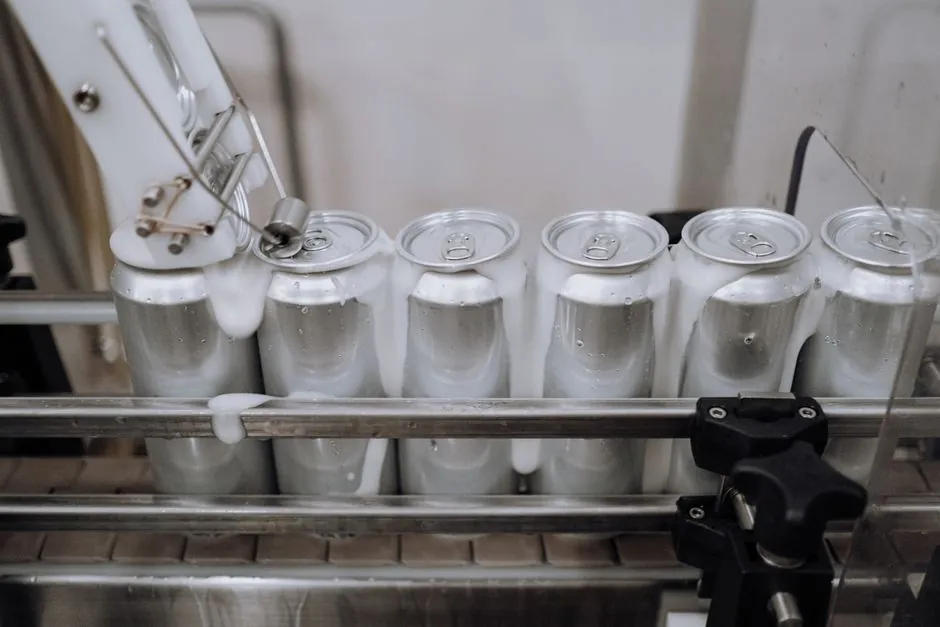
Three independent 2026 market sizing exercises bracket the EOL packaging automation opportunity between USD 5.92 B (machinery only, 2024 base) and USD 55.65 B (total EOL value chain), with the equipment-only market forecast to reach USD 10.53 B by 2035 at a 4.60% CAGR [S1][S2][S3].
That spread is not a contradiction; the three reports measure different scopes. Verified Market Reports tracks packaging machinery revenue (USD 5.92 B in 2024, 6.5% CAGR to USD 10.24 B by 2033) [S2]. Towards Packaging counts the narrower EOL equipment market (USD 7.02 B in 2026) [S1]. Future Market Insights includes services, integration, and consumables, reaching USD 55.65 B in 2026 with a 5.4% CAGR to USD 94.16 B by 2036 [S3]. Buyers, integrators, and OEM sales teams therefore need to confirm which definition a quote refers to before comparing growth rates.
Demand drivers: structural labour gaps, not cyclical hiring pain
Manual pallet wrapping, strapping, and case packing stations are physically demanding, repetitive, and concentrated in the transport and logistics sector, which the French recruitment survey (DARES/Pôle emploi, cited via Parlons Business) flags with a 57.4% share of "difficult-to-fill" hires in 2026 [S2].
Between 2023 and 2025 many operators treated automation as a hedge against short-term recruitment friction; in 2026 that framing has collapsed, and the Weldmaster industry guide describes the labour shortage as "structural rather than cyclical" [S5]. The consequence for specification writing is direct: ROI calculations on a packaging machine line can no longer assume labour cost will revert to a five-year historical mean, because the new floor is set by sustained vacancy rates in logistics-adjacent roles.
The PPWR 2025/40 trigger and what it changes at the pallet wrapper
Regulation (EU) 2025/40, the Packaging and Packaging Waste Regulation, was published in the EU Official Journal on 22 January 2025 and enters into force on 12 August 2026, replacing Directive 94/62/EC with a directly applicable instrument [S2].
PPWR's mechanical effect on EOL specification is the reuse and recyclability schedule for transport packaging: 40% reuse by 2030 and 70% by 2040, with material traceability obligations that extend down to stretch film lots used on a vacuum packaging machine downstream or a pallet wrapper upstream. That traceability requirement is the reason film-gauging, pre-stretch control, and per-pallet parameter logging have migrated from "nice to have" features to bid-qualification items on European RFPs in 2026 [S2].
Segment reading: palletizers lead, robotics spreads to mid-sized plants
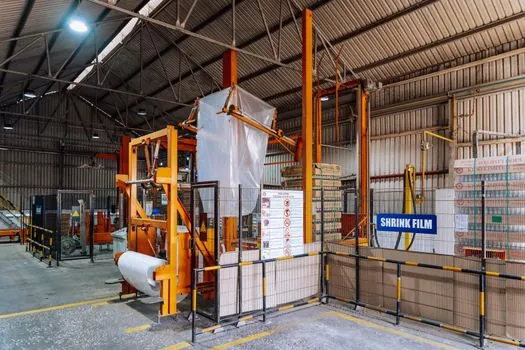
Palletizers are projected to lead 2026 EOL equipment demand with a 36.2% share, while primary packaging completion accounts for 28.5% of application demand, per Future Market Insights' segmentation [S3].
Three sub-segments are moving in parallel. First, top-load case packers with robotic pick-and-place are absorbing share from mechanical drop-packers in food, beverage, and pharma hygienic lines [S1]. Second, collaborative palletizing robots are opening automation to mid-sized plants that cannot dedicate a fenced cell to a six-axis arm, which is a key buying criterion in the USD 50-500k capex band [S3].
Regional split: Asia Pacific set the volume, North America set the price
North America held 29.84% of 2024 EOL equipment revenue, Asia Pacific is the fastest-growing region at a 6.32% CAGR through 2035, and the United States and China together are expected to account for roughly half of all packaging equipment sales growth through 2026 [S1][S5].
India is the fastest-growing country in FMI's dataset at an 8.6% CAGR, driven by organised retail build-out and food processing capex, while China's growth is concentrated in e-commerce fulfilment and food automation programmes [S3]. For a European or North American buyer, this regional map reads as a supply-side risk indicator: a high concentration of incremental unit demand in two countries means lead times for standard robotic palletizers and case packers will stay volatile through 2026, which is a stronger argument for locking in slot reservations than for chasing headline list prices.
Equipment type comparison: where each format wins on 4 criteria
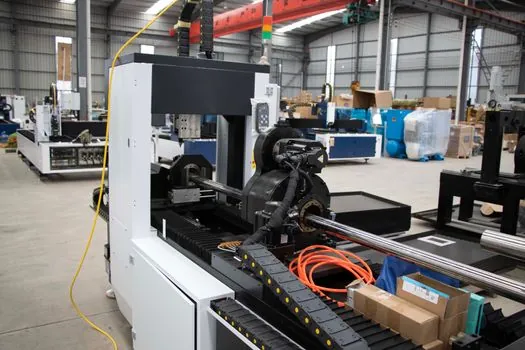
Four EOL equipment formats are competing for the same 2026 capex pool, and they separate cleanly on four decision criteria: footprint, changeover time, hygienic suitability, and capex band [S1][S3].
Top-load robotic case packers win on changeover time (typically under 15 minutes for SKU switches with vision-guided pick) and hygienic suitability (open-frame stainless for washdown), but lose on footprint and capex. Mechanical drop case packers win on capex and footprint but lose on changeover and SKU mix flexibility. Collaborative palletizing cells win on footprint and capex (no fencing, redeployable) but lose on throughput above roughly 10 cycles per minute. Conventional automatic stretch wrappers win on capex and PPWR data capture when equipped with film-usage sensors, and lose only on labour substitution depth [S3][S5]. The choice rule: high SKU mix and hygienic duty push toward robotic top-load; constrained floor space and uncertain demand push toward cobot palletizing; PPWR compliance on a tight budget pushes toward sensor-equipped stretch wrappers.
What does not change: food and beverage still anchors the order book
Food and beverage remains the leading end-user segment for packaging machinery in 2026, with pharmaceuticals, chemicals, and consumer goods contributing the marginal growth, and the automation sub-segment alone accounting for USD 21.6 B of the USD 50.5 B 2025 global packaging machinery market [S2].
The takeaway for specifiers is conservative: a 2026 RFP should weight hygienic-design evidence (IP ratings on packaging material contact zones, EHEDG or 3-A documentation where applicable) and validated OEE data from comparable food or pharma installs above headline cycle-time numbers, because the order book is anchored in regulated industries where the qualification cost of a wrong choice is large. Trackable signals to watch through the rest of 2026: PPWR secondary legislation drafts, India and China quarterly capex prints from packaging machinery vendors, and any revision to the Weldmaster-cited 5.8% packaging machinery growth assumption as the 71.1 B USD 2026 benchmark ages [S5].
Background reading: 125 kHz vs 13.56 MHz Card Reader Compatibility: Spec Decision.