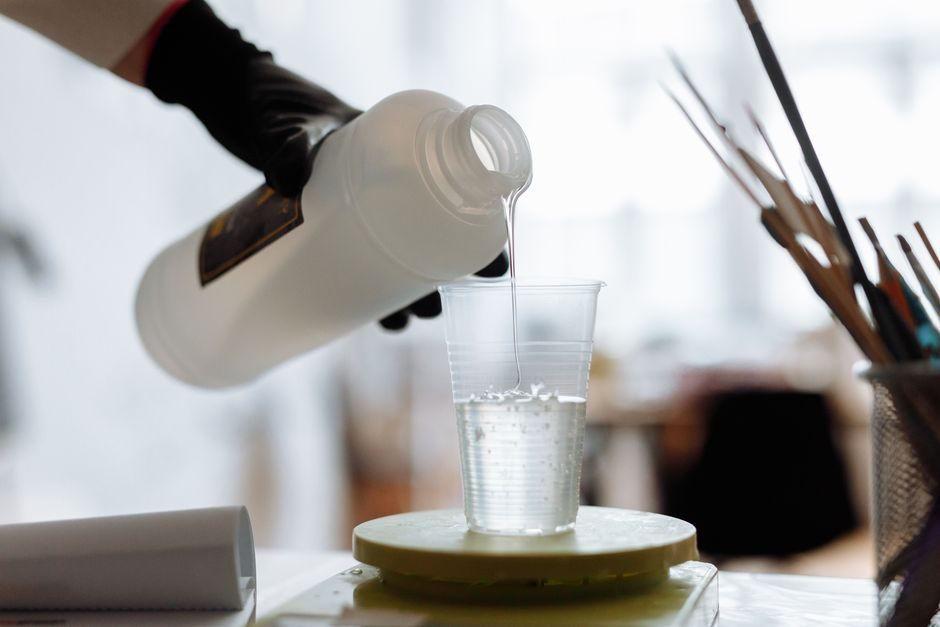
Epoxy resins are produced by condensation of bisphenol A and epichlorohydrin, with the resulting oligomer carrying terminal oxirane groups that react with curing agents at typical resin-to-hardener weight ratios between 3:1 and 10:1, while catalysts such as tertiary amines or Lewis acids are dosed below 1% of the resin weight [S1].
The cured thermoset is a three-dimensional polyether network that forms without volatile by-products, which is why epoxy systems can be moulded and filament-wound into coherent, void-free structures without applied pressure [S1]. The same chemistry underpins synthetic resin feedstocks for adhesives, electronics encapsulation, PCB laminates, and aerospace composite matrices, so process parameters that look like a bench-chemist's concern (mix ratio, gel time, exotherm) directly drive laminate tolerance, residual stress, and tool life downstream.
Resin synthesis: bisphenol A + epichlorohydrin condensation
Commercial epoxy resins were first patented in Europe by P. Schlack in 1939 and entered US production in the late 1940s under the ethoxyline name; the synthesis is a condensation of bisphenol A with epichlorohydrin that builds up oligomers terminating in epoxy (oxirane) groups, with the concentration of pendant hydroxyl groups rising as molecular weight increases [S1].
Two reactive handles — the terminal epoxide and the internal hydroxyl — give formulators the design knobs they need: the epoxide drives the crosslinking reaction, while hydroxyls influence adhesion and reactivity with subsequent hardeners [S1]. Because the reaction is step-growth and releases no volatiles, moulded or laminated parts cure into dimensionally faithful shapes without the porosity that plagues condensation polymers such as phenolics, which is one of the key reasons epoxies dominate high-tolerance composite layups in additive manufacturing material workflows that pair resin infusion with printed or woven preforms.
Cure chemistry: catalysts, hardeners and the 3:1–10:1 mix band
Curing agents fall into two functional classes — catalysts (tertiary amines, Lewis acids) that initiate ionic polymerisation at less than 1% loading, and hardeners (aliphatic and aromatic amines, carboxylic anhydrides) that stoichiometrically react with the epoxy and hydroxyl groups and so define the network architecture [S1]. Manufacturer datasheets typically quote resin:hardener ratios between 3:1 and 10:1 by weight, with the precise value depending on epoxy equivalent weight, hardener active-hydrogen equivalent, and required Tg or service temperature [S1].
The exothermic cure may be triggered at room temperature, at elevated temperature, or — when a suitable photoinitiator package is added — by UV light, so a single resin platform covers everything from field-applied coatings to autoclave-cured aerospace prepreg [S1]. This versatility is also why the same chemistry appears in resin sand line foundry tooling, where ambient-cure furanic/epoxy binders cure sand into dimensionally stable cores without oven dwell.
Composite layup: residual stress, chemical shrinkage and cure kinetics
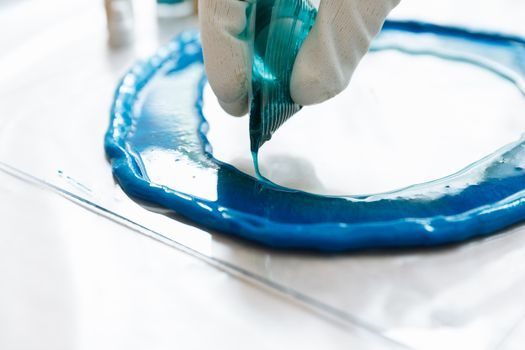
During cure of fibre-reinforced laminates, anisotropic chemical shrinkage of the matrix combines with tool-part thermal mismatch to lock in residual stresses; the residual-stress state is best modelled when the cure-dependent resin yield stress, effective modulus and anisotropic chemical-shrinkage coefficients are all known as functions of degree of cure [S2]. The standard modelling chain pulls in cure-dependent thermal and rheological characterisation, self-consistent homogenisation (Eshelby–Kröner-type) for effective ply properties, and a finite-element cure simulation that resolves gelation and vitrification events.
Empirically validated reference cases — AS4/3501-6 and similar aeronautic-grade systems — show that neglecting the cure-dependent resin yield stress under-predicts spring-in and warpage in thick laminates, while a self-consistent anisotropic shrinkage model captures the through-thickness vs in-plane shrinkage split that classical linear models miss [S2]. For process engineers, the practical rule is straightforward: any simulation that ignores cure-dependent yield stress on the resin side should not be used to sign off a tool compensation on parts thicker than about 6 mm.
Application examples: gypsum reinforcement and natural-fibre composites
A 2024 study on lightened gypsum reinforced with hemp-fabric/epoxy composites demonstrated the full resin-manufacturing chain in a non-aerospace setting: hemp fabric was impregnated with epoxy, laminated, and bonded to a gypsum matrix to lift flexural, impact and bearing strength over plain gypsum, with the curing cycle tuned to the thermal sensitivity of the natural fibre [S3]. Gypsum alone fails in brittle mode at low energy, so the resin-impregnated fabric layer functions as a crack-bridging reinforcement, and the epoxy's low cure shrinkage is essential — high-shrinkage systems would crack the gypsum substrate during cooldown.
The same study reinforced a point that any process engineer already knows but is worth restating: when the substrate (gypsum, foam, 3D-printed polymer) is more thermally or mechanically sensitive than the reinforcement, the resin's cure window — not its ultimate strength — decides whether the laminate is buildable at all [S3]. This is also the rationale behind specifying a low-exotherm hardener schedule for thick V-process line castings where resin-bonded sand moulds are buried in unbonded sand and cannot shed heat quickly.
Process selection: who epoxy fits, and where it does not
Epoxy is the right pick when the part needs (a) void-free cure without applied pressure, (b) low shrinkage and tight dimensional tolerance, (c) good adhesion to substrates ranging from aluminium to natural fibre, and (d) thermal, electrical and chemical resistance that phenolics, polyesters and vinyl esters cannot match in the same part [S1]. It is the wrong pick when the part is exposed to very high continuous service temperature (above the Tg ceiling of ~180–200 °C for standard bisphenol-A systems), requires high fracture toughness beyond what rubber-toughening delivers at reasonable cost, or must be produced in a process that depends on a volatile by-product (it does not — step-growth epoxy releases none) or in a wet layup with high ambient humidity that the amine hardener cannot tolerate [S1].
Selection should be scored against four decision criteria: mix-ratio tolerance (3:1–10:1 by weight is forgiving; stoichiometric anhydrides are not), cure temperature window (RT, mid-temp 60–120 °C, or high-temp 150–180 °C for Tg above 150 °C), exotherm control (laminate thickness governs whether a room-temp hardener is mandatory), and post-cure accessibility (large parts often cannot reach the autoclave temperatures needed for full Tg development on a bisphenol-A/anhydride system).
Standards, sourcing and traceability
For aerospace-grade prepreg, the relevant material pedigree is set by system-specific AMS or EN specifications and the cure recipe published in the resin supplier's technical data sheet; the chemistry itself — bisphenol A + epichlorohydrin — is the same platform described in the foundational ScienceDirect overview [S1]. Adhesives and coatings are typically qualified against ISO 2409 (cross-cut adhesion), ISO 2812 (resistance to liquids) and ASTM D638/D790 (tensile/flexural) for the cured laminate, while electronics-grade encapsulants are evaluated to UL 94 for flammability and IPC-CC-830 for insulation resistance [S1].
For process engineers, the audit trail that matters most is the cure record: mix ratio deviation, pot life, time above gel point, peak exotherm, ramp/cool rates, and any dwell above the recommended post-cure temperature. These six data points are the only ones that let you correlate a dimensionally drifting production batch back to either a contaminated hardener, a miscalibrated oven, or the resin lot itself.
For comparison shopping, the resin-side options to score against the four selection criteria above are: bisphenol-A liquid (DGEBA, low viscosity, RT-cure, general purpose), bisphenol-A solid (higher molecular weight, powder coatings, electrical laminates), bisphenol-F (lower viscosity, better chemical resistance, food-contact), and novolac / multifunctional (higher crosslink density, Tg above 170 °C, aerospace and high-temperature PCB). For hardener families: aliphatic amines (fast RT cure, irritating), polyamides (flexible, long pot life, marine coatings), aromatic amines (high Tg, latent, powder coatings) and anhydrides (low exotherm, long pot life, electronics and filament winding) — the same four-criteria scorecard applies, with the choice pivoting on whether RT cure is non-negotiable or Tg above 150 °C is non-negotiable. Trackable signals for the next quarter: any shift in epichlorohydrin supply (a major precursor) will move bisphenol-A liquid pricing within one to two months, and any new multifunctional epoxy datasheet that pushes Tg above 200 °C will reset the spec ceiling for high-temperature PCB and aerospace prepreg.
For related coverage, see Top Fuel Cell Stack Companies 2026: Specs, Supply Lines and Selection Criteria.