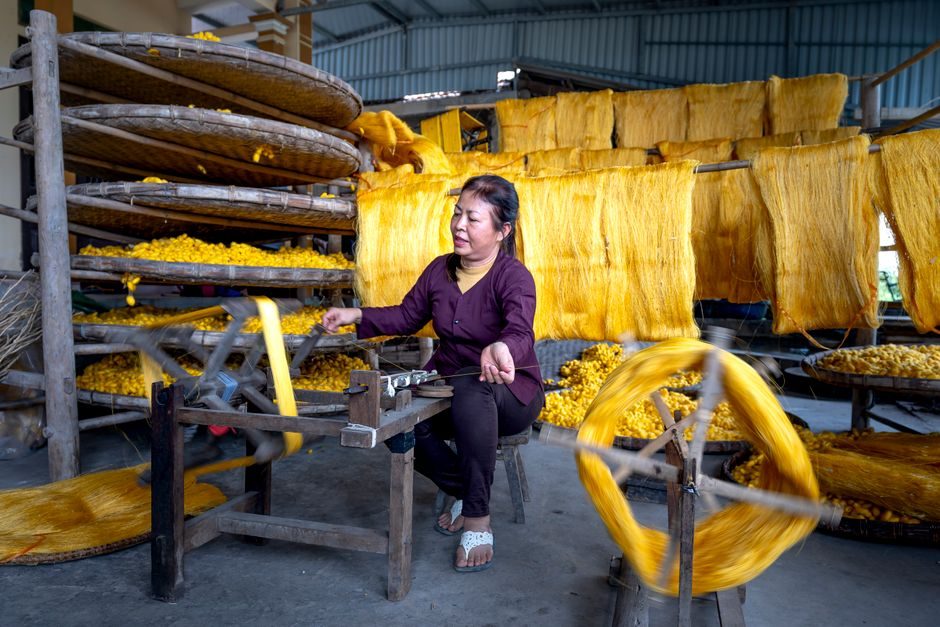
Continuous filament glass fiber is produced by drawing a molten silicate melt (SiO₂ + Al₂O₃, CaO, MgO, B₂O₃, Na₂O/K₂O) through multi-hole platinum-rhodium bushings, attenuating the filaments to typical reinforcement diameters of 14–24 μm (some up to 27 μm) before a chemical size is applied and the strands are gathered, chopped, or wound [S2]. The process chain — batching, melting, fiberizing, sizing, and conversion — determines every downstream property: tensile strength, resin wet-out, hydrolysis resistance, and laminate mechanical performance under impact [S2].
Two reinforcing families dominate the supply chain: E-glass (alkali-free, calcium-alumino-borosilicate, low electrical conductivity, the workhorse for FRP) and C-glass (calcium-borosilicate with higher acid/alkali resistance for surface tissue and chemical-resistant laminates) [S2][S5]. A reference woven (W-GF/PP) and long-fiber thermoplastic study confirms that filament architecture — woven roving versus commingled chopped mat versus unidirectional roving — drives high-strain-rate composite response as much as the glass recipe itself.
Raw Materials and Glass Composition Windows
Glass fiber is a silicate-type amorphous ion structure; SiO₂ forms the network backbone while metal oxides (Al₂O₃, CaO, MgO, B₂O₃, Na₂O/K₂O) tune the melting behavior and final properties [S2]. Alkali oxides lower melt viscosity and bubble-removal difficulty (the "flux oxide" function) but degrade chemical resistance and electrical performance, which is why alkali-free E-glass dominates electrical/electronic and aerospace grades while a controlled alkali content defines A-glass for general purpose [S2]. The E-glass "window" used in standard FRP chopped strand mat production keeps alkali (Na₂O+K₂O) below roughly 1% by weight, whereas C-glass surfacing tissue uses higher CaO/B₂O₃ ratios to deliver the corrosion resistance required in chemical-tank surface layers [S2][S5].
Commercial continuous fibers fall into more than 5,000 differentiated grades across 30+ producing countries, and a finished roving product is sold against an area weight, a binder chemistry, and a width — for example, a 300 gsm e-glass chopped strand mat at 2900 mm width with polyester emulsion binder, roll weight of 145 kg, and a mill capacity quoted at 10,000 m²/month per line [S3]. C-glass surface tissue from the same conversion ecosystem is supplied at standard widths 1000/1040/1270 mm, standard length 300 m, with container loadings around 75 189 000 m² per 40-foot container [S5].
Direct-Melt Drawing and Bushing Fiberizing
Direct-melt drawing replaced earlier remelt crucibles in the 1960s–70s and remains the standard fiberizing route: the molten glass stream is conditioned in a forehearth and pulled through heated multi-hole bushings (typically 200, 400, 800, 1200, 2000 or 4000 holes per plate depending on target tex) at a high, controlled draw-down to reach reinforcement filament diameters of 14–24 μm [S2]. The attenuation step is what gives the fiber its high tensile strength — the freshly drawn filament is flaw-free at the surface scale, so the smaller the diameter, the higher the specific strength; this is also why downstream composite impact performance is so sensitive to filament integrity (broken filaments = stress concentrators in the laminate) [S2].
Bushing throughput is set by the combination of melt viscosity, hole count, and draw speed; modern lines run in the 30–80 m/s attenuation range, with the cooled filament then passing over a sizing applicator where a chemical coating is laid down onto the filament bundle [S2][S4]. The aprons and belts that transport the freshly sized strand to the gathering shoe are themselves a critical consumable: more than 40 years of Accotex field data show that homogeneous surface roughness, controlled wetting, and chemical resistance on these aprons directly affect the consistency of the size pick-up and, by extension, the strand's processability on downstream chopper, winder, and weaving equipment [S4].
Sizing Chemistry: The Hidden Spec Sheet
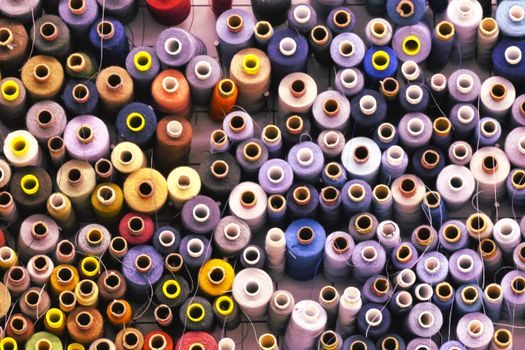
Sizing is the single most consequential "invisible" process step: an aqueous emulsion/solution of film former, coupling agent (silane, typically), lubricant, antistatic, and binder is applied at 0.3–2.0% dry weight on the strand, and its composition is tuned to the target composite process — polyester, vinyl ester, epoxy, or polypropylene [S2][S3][S4]. For chopped strand mat used in hand lay-up and filament winding, a polyester binder in powder or emulsion form bonds the 50 mm chopped strands; the wet-out speed claimed by the mat producer depends entirely on the size chemistry being compatible with the chosen resin system [S3].
For long-fiber thermoplastic (LFT) pellets and woven roving polypropylene (W-GF/PP) laminates, the size must deliver a stable fiber-matrix interface above 200 °C, and the Springer study shows that manufacturing process choice — compression molding of woven preforms versus extrusion-compression of LFT — shifts both the failure mode and the specific energy absorption under high-strain-rate loading, even at the same glass loading. This is why the same nominal "E-glass roving" is sold under multiple size variants (e.g., 411, 414, 920, 940, 945) for polyester, epoxy, and PP matrices, and why sourcing agents must spec the size code on the RFQ, not just "E-glass."
Conversion to Rovings, Mats, Tissues and Fabrics
After fiberizing and sizing, the continuous strand is routed into one of several conversion paths: wound as direct roving (single-end or multi-end) for filament winding, pultrusion, and weaving; chopped to 3–25 mm for short-fiber reinforcement; chopped to 50 mm and deposited on a belt with a powder or emulsion binder to form chopped strand mat (CSM) at 100–900 gsm [S3]; or further split and needled into continuous filament mat for thermoplastic and roofing applications. Surfacing tissue — typically C-glass, 20–50 gsm — is the outer veil layer in chemical-resistant FRP laminates, providing a resin-rich, corrosion-resistant surface that protects the structural CSM behind it from acid or alkali attack [S5].
Downstream fabric forms include woven roving (WR), combination mat (WR + CSM stitched together), multiaxial fabrics, and unidirectional tapes. The Hebei Yuniu fiberglass supply footprint illustrates the breadth of these conversion products from a single Chinese hub: rovings, chopped strands, mat, woven roving, tissue, and fabric grades sold into construction, transportation, electrical, and chemical-tank end uses. For buyers running a continuous production line, supplier capability and dispatch reliability — not just nominal tex — are the gating metrics, and listed capacity figures such as 10,000 m²/month of CSM per dedicated line, or 15-day lead time on tissue orders against 30% T/T deposit and 70% before shipment (LC accepted), are the kind of operational facts that determine whether a mill is a strategic source or a spot source [S3][S5].
Process Control, Standards and Quality Gates

Quality gates in a glass fiber plant run in three layers: (1) glass composition — checked by XRF on each batch; (2) filament forming — bushing temperature, throughput, filament diameter via laser, and tex measured continuously on each position of the bushing; (3) size pick-up and strand integrity — measured as loss-on-ignition (LOI, typically 0.3–2.0%) and strand tensile on a statistical basis [S2][S4]. ISO 9001:2015 quality management is the baseline certification carried by the major Chinese OEM/ODM fiberglass factories, and the silicone-glassfiber category on Made-in-China also lists ANSI/ES51-1000 alongside ISO 9001:2015 as gating credentials for electrical/electronic grade supply [S1].
Process choice has a first-order effect on end-use performance: the same E-glass roving, depending on whether it is converted to woven fabric, CSM, or LFT pellet feedstock, yields different high-strain-rate composite response — a fact the Springer high-strain-rate study quantifies for W-GF/PP and comparable systems. Process control defects propagate downstream: an under-applied size on the apron creates dry strands that fuzz and break in weaving; an out-of-spec bushing temperature raises filament diameter and drops specific strength; a contaminated glass batch raises devitrification risk and kills throughput. The reference oven quote on chopped strand mat of 50 mm strand length, 300 gsm area weight, emulsion binder, 145 kg roll weight, and 2900 mm width is the kind of full data set a process engineer should pin on the RFQ [S3]. For buyers cross-referencing the glass fiber encyclopedia page against the additive manufacturing material reference, note that continuous glass fiber is a substrate feedstock rather than a 3D-printed part material, and that the sizing and conversion steps described here are the gates that determine whether a roving is fit for filament winding, pultrusion, or LFT compression molding [S2][S3][S4].
Operational Sourcing Signals and Limitations
Sourcing signals worth tracking into the second half of 2026: (1) capacity additions at Chinese integrated hubs (Hebei, Anhui, Chongqing, Guangdong) continue to push CSM and tissue tonnage onto the global market, with a 15-day standard dispatch on stocked tissue SKUs and LC-accepted payment terms now standard at export-oriented mills [S3][S5]; (2) silane-coupling-agent supply (a key size raw material) and the platinum-rhodium bushing alloy remain the two upstream constraints that historically cap throughput, and any Q3 2026 disruption in either would propagate into roving lead times within 6–10 weeks; (3) high-strain-rate composite data on woven roving and LFT systems are now mature enough that automotive and aerospace structural-part qualification is shifting from coupon testing to full-architecture impact simulation, which in turn raises the bar on size consistency batch-to-batch. The limit on what this overview can confirm: the research material does not pin specific boric-oxide or alkali percentages by weight for individual E-glass or C-glass grades, nor does it list named standards (ASTM D578, ISO 2078, JIS R3410) for tex measurement — these need to be pulled from a dedicated spec sheet or the optical glass reference before locking a procurement decision. For plants running FRP pipe or tank lines, the sight glass page is the natural adjacent read when the application shifts from fiber production to process-window observation downstream of the laminate cure.
For related coverage, see Motor Protector vs Linear Motor: Spec Boundaries and Selection Gates.