An expansion anchor certification package for a steam line is the audit-ready bundle that proves every anchor, guide, expansion joint, support, and weld can survive the rated steam pressure and temperature plus the hydrostatic test, with welder qualifications and inspection records on file.
The package is built around four design anchors: the pipe design code (commonly ASME B31.1 Power Piping, also referenced as ANSI B31.1), the boiler code where it bounds (ASME Section IV for low-pressure steam at 15 psi maximum allowable working pressure), the operating envelope (commonly 75 psig at 450°F steam and 200°F condensate on campus distribution), and the project specification (CSI 33 6311 or 33 6313 for underground distribution). Any expansion anchor that cannot be traced to all four fails the audit, regardless of the supplier's marketing claims.
Code Basis and Design Conditions That Bound the Checklist
Each campus or industrial steam system carries a published maximum operating pressure and temperature; the University of Missouri design baseline, for example, is 75 psig at 450°F for steam mains and 75 psig at 200°F for condensate returns, with maximum stresses in pipes calculated to ASME B31.1 [S4]. Low-pressure steam boilers covered by ASME Section IV are capped at 15 psi maximum allowable working pressure, and Ohio's pre-inspection checklist explicitly requires construction, inspection, stamping, and installation in conformity with Section IV, with the ASME rating tag physically attached before the unit can be operated [S1].
Conduit and routing rules layer on top of the pipe code. Underground distribution at University of North Carolina requires reinforced concrete chases, walk tunnels, and manholes, with all piping and structures designed and installed to provide drainage of any water introduced into the system and ventilation by natural or powered means [S3]. Buried carbon steel carrier pipes are typically bedded on coarse gravel or broken rock to keep the FOAMGLAS or equivalent cellular glass insulation dry, since water ingress collapses thermal performance and accelerates external corrosion [S2].
Anchor, Guide, and Support Force Path
Anchor certification starts with the force path, not the anchor catalog. Every pipe anchor must be fully designed to withstand all forces and moments at the anchor location, including hydrostatic test forces, with the calculation referenced in the submittal package [S4]. In walk-through tunnel systems, every component of the steam and condensate system from anchors through supports and guides falls under the expansion joint section, meaning the joint cannot be approved in isolation from the surrounding force path [S3].
Underground steam and condensate work in the CSI 33 6313 family adds three inspection checkpoints the anchor package must close out: inspection of concrete anchors and thrust blocks, cold springing (the pre-set that puts the joint near its neutral position at operating temperature), and field joint closure with initial instruction to the owner's crew [S6]. Cold springing in particular is a verification step, not a procurement step, and the as-built cold spring dimension belongs on the same drawing sheet as the expansion joint travel table.
Expansion Joint and Bellows Documentation
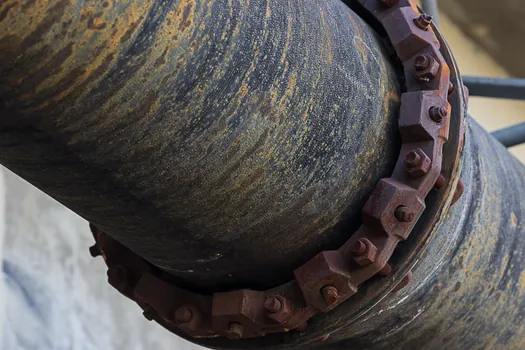
Expansion joint documentation has to show four items: design temperature and pressure match the line class, full bellows travel matches the calculated pipe growth at the design temperature delta, anchor and guide forces on each side of the joint are capable of restraining the bellows from over-travel, and the material is compatible with the steam chemistry. On campus steam at 75 psig / 450°F, stainless steel bellows with carbon steel end connections is the common pairing; compatibility with cleaning chemicals and condensate pH is a separate review item [S4][S3].
Field inspection of the same joint is a recurring, checklist-driven activity: visual scan for surface blistering, cracking, or bulging on the bellows, measurement of fixed anchor and guide bolt torque, check that guides on both sides of the joint are within free travel and not binding, and a leak check at the operating temperature [S5]. An steam trap upstream of the joint must be verified, since water hammer from a failed trap is one of the documented failure modes that overloads the joint and its anchors.
Welder Qualification, Weld Record, and Weld Examination
Steam distribution welding falls under ASME B31.1, and the qualification trail is built from three documents: the Welding Procedure Specification (WPS), the Procedure Qualification Record (PQR) that proves the WPS, and each welder's qualification record for the WPS [S3]. The WPS has to match the base material (typically A106 Grade B or A53 for carbon steel steam mains), the wall thickness range, the joint geometry, and the position.
The weld record captures the welder, the WPS used, the date, the location by station number, and the NDE result. Weld examination under ASME B31.1 is typically 100% radiographic on butt welds in the high-pressure steam main, with magnetic particle on fillet welds at socket branches; the project specification overrides the code default only when written, and the override belongs in the submittal package, not the field trailer [S3].
Pressure Test, Acceptance, and Recurring Inspection
The hydrostatic test is the proof step. Steam and condensate mains are filled with water, vented, and raised to a test pressure held for a defined duration, with all anchors, joints, and supports observed under load. Anchor certification is not complete until the as-built anchor location, type, embedment depth, and the test pressure hold-time are recorded against the isometric drawing [S4].
After handover, recurring inspection keeps the certification current. A typical campus or plant inspection of an expansion joint walks visual condition, anchor and guide bolt torque, free travel of the guides, and any sign of external corrosion on the end connections, with frequency set by the operating temperature, cycle count, and consequence of failure [S5]. The same checklist applied to pipe anchors adds grout condition, base plate bearing, and bolt elongation checks, since anchor failure typically shows as bolt stretch or grout crushing long before the anchor itself moves. Records of these inspections are the evidence an auditor will ask for when the safety certification is renewed.
What a Supplier Submittal Must Contain to Be Accepted
A compliant anchor and joint submittal on a steam distribution project carries: design pressure and temperature matching the line class (commonly 75 psig / 450°F steam, 75 psig / 200°F condensate), material certificates for the anchor body and any bellows, force and moment calculations referencing the relevant code, installation drawing showing cold spring dimensions, weld and NDE records per ASME B31.1, and a hydrostatic test certificate [S3][S4][S6]. Missing any one item, and the submittal returns for revision before the anchor or joint is released to site.
Specifying engineers who want a working template can compare the project specification against the published pre-inspection checklist for low-pressure steam boilers, which is openly available and lists the violations inspectors most often find, including missing permits, missing clearances, missing rating tags, and missing or undersized gage and water-column piping [S1]. For high-pressure distribution, the same discipline applies but the line class, weld examination, and pressure test thresholds step up to match the higher design pressure and temperature. For an overview of how anchors and joints interact with the rest of the steam system, the chemical anchor reference page covers adhesive-type anchors used where welding to existing structures is not permitted, and the steam separator page covers the equipment package that protects the downstream joint from slug flow.
Trackable signals for the next 6-12 months include updates to CSI 33 6311 and 33 6313 specification language from the major university systems, any revision activity around ASME B31.1, and the next round of state boiler division checklist publications following Ohio's 2022 release. Engineers maintaining an active submittal library should re-verify each anchor and joint certificate against the latest published CSI section before the next project letting.
This topic is covered further in Warning Tape for Work at Height: Spec Map and Selection Rules.