
Controlled startup heat-up helps remove moisture and allows the refractory lining to expand gradually and uniformly.
The relevant life is measured in furnace campaigns, thermal cycles, operating temperature, atmosphere, load chemistry, and installation quality, not a universal calendar date; refractory selection and the hot-face, backup, and insulation layers must be treated as one system [S2][S3][S7].
That interval is a maintenance-planning benchmark, not a warranty that every furnace will survive five years. Lindberg/MPH lists industrial box, pit, and integral quench heat-treat furnace products.
Material selection changes the inspection logic. Car-type heat-treatment furnaces can use fireclay brick, diatomite brick, calcium silicate board, refractory fiber insulation board, castable, ceramic fiber blanket, or ceramic fiber modules [S3]. A lower-temperature furnace may be adequately protected by mineral wool or low-temperature ceramic fiber blanket, while a higher-temperature or higher-stress chamber requires a lining architecture matched to its service condition [S7].
Campaign planning should therefore track four hard numbers: maximum working temperature, nominal operating temperature, weekly firing hours, and thermal-cycle count. If those values are not recorded, a 3–5 year calendar estimate is too coarse for maintenance control. The annual inspection should be scheduled as a condition-assessment event, with repair or relining triggered by measured deterioration rather than age alone [S1].
Compare Lining Systems by Decision Criteria
Ceramic fiber systems improve insulation and energy efficiency, and anchored folded modules are commonly used on the roof and walls of car-type furnaces. The refractory lining guide for car-type heating furnaces identifies ceramic fiber blankets and ceramic fiber modules among the lining materials used for heat-treatment furnaces. The comparison below is a screening tool, not a substitute for furnace-specific design.
Inspect the Failure Modes, Not Just the Surface
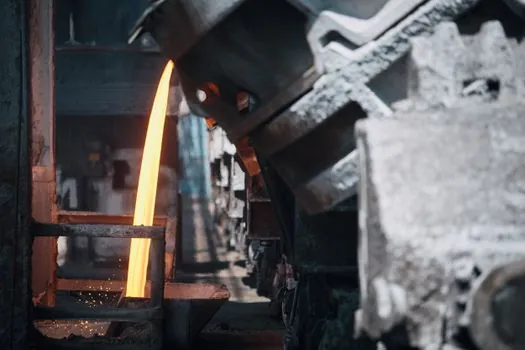
Refractory insulation supports the working lining, limits shell temperature, and cushions the furnace against expansion and contraction; failure can therefore produce hot-face sagging, cracking, shell overheating, or lining collapse [S2]. Inspection must connect visible damage to the mechanical function of the backup insulation rather than recording cracks alone.
Three warning patterns require engineering review. First, open joints can admit heat and process gases behind the hot face, accelerating deterioration of backup materials and the shell [S4]. Second, weak or crushed insulation creates voids and cracks that concentrate heat flow and destabilize the working layer [S2]. Third, spalling and fracture of the hot-face surface can indicate rapid moisture release, thermal shock, inadequate strength development, or erosion [S4][S5].
Measurement should include shell-surface temperature at mapped hot spots, depth and length of cracks, evidence of spalling, joint opening, anchor condition, and furnace atmosphere conditions. A thermal image can locate anomalies, but it does not establish material cause by itself. The inspection record should pair the image with the operating log, including temperature, load, cycle count, atmosphere, and any burner or fuel-gas changes [S5].
Control Drying Before the First Full-Temperature Fire
New or repaired refractory contains residual moisture from installation and chemically bound water that must leave gradually before full-temperature operation [S4][S5]. If steam pressure develops faster than it can escape, the lining can crack, spall, or fail catastrophically during the first firing cycle [S4][S5].
A controlled heat-up should remove moisture gradually and allow the refractory lining to expand gradually and uniformly. These figures describe the stated installation practice, not a universal schedule. The supplier and refractory contractor must define the actual ramp rates, holds, and operating temperature for the installed system [S4][S5].
Controlled heat-up also lets brick, mortar, castable, and precast sections expand at different rates without shearing joints, while castable and plastic refractory develop their ceramic bond [S4]. A useful commissioning record includes the heating curve, measured hold temperatures, hold durations, thermocouple locations, and the final operating-temperature condition. Refractory dry-outs are treated as controlled industrial heat-treatment processes that are planned, executed, and documented.
Install for Longevity, Then Fire Conservatively
A furnace reline can fail through installation geometry even when the material is suitable. Pre-construction checks include track elevation and gauge, embedded steel plate position, furnace centerline alignment, column verticality, wall-plate parallelism and perpendicularity, burner-brick elevation, burner-port dimensions, car-track alignment, car flatness and elevation, and seal-system height [S3].
Brick joints require compatible mortar, full joint filling, and no through joints. The cited construction method calls for expansion joints every 2.5 m, with 5–10 mm allowance per meter, and 116 mm side-laid brick on the car surface [S3]. Those dimensions belong to that installation method and should not be transferred without checking the approved design. At flue connections, the same method specifies dry straight joints without mortar [S3].
The operating team controls the campaign after commissioning. Avoid abrupt temperature changes, maintain the specified atmosphere, and record deviations that alter thermal cycling or chemical exposure. The structural advantage of denser, lower-porosity castables is their greater resistance to gas penetration, chemical attack, and erosion, but only an installation matched to the furnace design delivers that benefit [S2].
Define Relining Triggers and Escalation
A reline decision should use a trigger matrix rather than a single failed observation. Escalation is warranted when shell hot spots indicate loss of insulation, when cracks or joints admit process gases, when hot-face material has spalled, or when backup insulation has crept or crushed [S2][S4]. Repairs may be appropriate for localized damage, but structural instability of the working lining or loss of backup support requires a reline assessment covering the full affected zone.
Before authorizing work, separate preventive restoration from campaign-driven replacement. Preventive work addresses local cracking, damaged joints, erosion, or failed anchors. Campaign replacement is appropriate when accumulated thermal cycling, contamination, and mechanical wear make continued operation unreliable. The surrounding heat treatment furnace configuration determines which hot-face, backup, and insulation materials can be replaced without compromising the furnace shell or anchors [S2][S3].
Track the next inspection through two measurable signals: the annual condition-assessment date and the cumulative firing-hour and thermal-cycle count since the last reline. If shell-temperature mapping shows a rising hot-spot trend or the lining record shows rising crack and spall incidence, trigger an engineering review before the next full-temperature campaign [S1][S5].