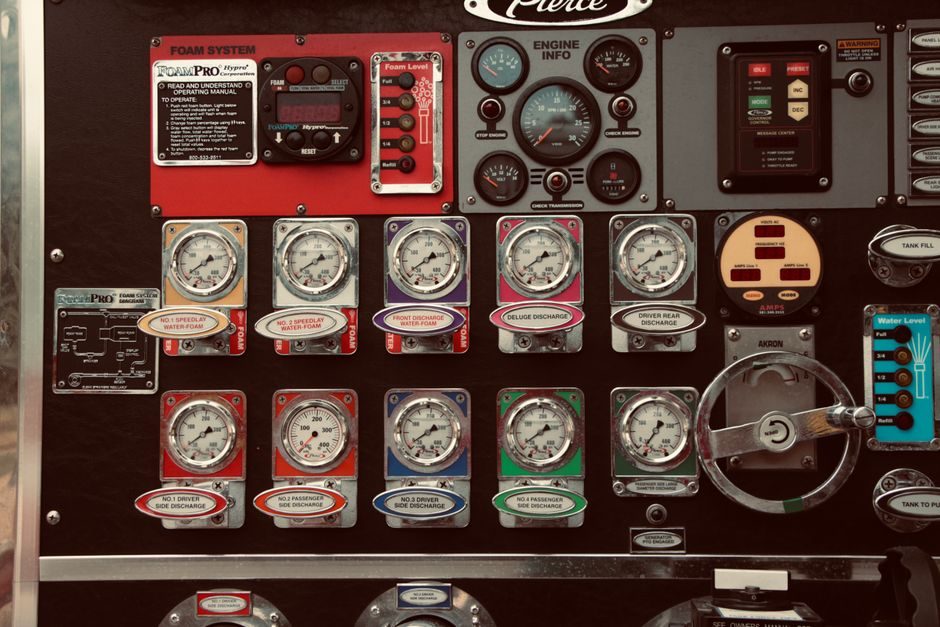
An addressable fire alarm control panel for a commercial or light-industrial site is normally specified to EN 54-2 / EN 54-4 with an IP30 enclosure, 1–4 detection loops handling up to 252 devices per loop, and 24 V DC operating rail backed by sealed lead-acid batteries sized for 24 h quiescent + 0.5 h alarm [S1][S2].
For diesel fire-pump rooms the picture is different: the Cutler-Hammer DFDAP-M is a remote alarm panel designed to NFPA 20, fed 110–240 V AC at 50–60 Hz, with automatic switchover to a customer-supplied supervisory (backup) source and an audible buzzer that latches until silenced [S3]. The two classes of panel share a "Fire Alarm Control Unit" (FACU) role but their installation logic diverges sharply — one terminates loops, the other repeats pump status.
Step 1 — Match the FACU class to the protected risk
Specifying the wrong category is the single most common cause of site rejection. A conventional FACU is appropriate for small, single-zone risks; an analogue-addressable FACU (e.g. Siemens FC2020 up to 252 addresses, Pertronic F220 with ARC2 agent release, TEKNIM TFP-121 series with up to 2.5 km per loop) is the default for anything above roughly 32 points or with mixed detection types [S1][S2].
Aim the wrong equipment and you trip a problem: pairing a non-networkable conventional panel on a site that needs peer-to-peer evacuation signalling will force early replacement. Conversely, an EN 54 panel with C-WEB/SAFEDLINK clustering (up to 32 panels per cluster, 64 across 14 fibre-linked clusters) on a 6-detector shop is over-spec and burns commissioning hours [S2]. When the protected risk is a diesel fire-pump room, install a dedicated remote alarm panel meeting NFPA 20 — a generic building FACU will not satisfy the authority having jurisdiction [S3].
Step 2 — Plan power, battery standby, and the 24 V rail
The Siemens FT724 datasheet quantifies exactly what an installer must design around: 21–28.6 V DC operating voltage, 125 mA quiescent current, optional 70 W PSU kit, batteries up to 2 × 12 V / 7 Ah, ambient -8 °C to +42 °C, ≤95 % RH non-condensing, IP30 cabinet at 430 × 398 × 103 mm [S2]. Multiply the panel's quiescent current by the loop device count, add the alarm current worst case, and size the battery to deliver 24 h standby plus 0.5 h alarm per the local code.
The DMP XR250F manual breaks the power section into its own chapter ("1.3 Power Specifications") with separate AC input, charging current, and standby calculations, signalling that battery sizing is a design exercise, not a parts-bin choice [S6]. For the NFPA 20 pump-room class, both Normal and Supervisory AC feeds must be field-wired by the customer at 110–240 V AC, 50–60 Hz, with the controller auto-switching when Normal drops out and switching back when it returns [S3].
Step 3 — Loop topology, cable type, and distance budget
Addressable loops on an FACP are not freeform — each leg has a published cable-distance budget. The TEKNIM TFP-121 series datasheet gives 2.5 km per loop, with up to 16 panels networked via RS-485 on a TFC-1209 module, displayed on a 240×64 graphic LCD [S1]. A 1 mm² screened fire-rated cable (e.g. FP200 Gold, MICC) on a Class A or Class B loop will hit most of that distance; exceeding it returns ghost alarms and intermittent communication faults that take days to chase.
Networked FACUs add a second discipline. On the Siemens C-WEB/SAFEDLINK ring you can wire up to 32 fire control panels and remote terminals per cluster, then chain up to 14 clusters over C-WEB/LAN fibre to reach 64 panels in a single EN 54-conform network — but only with a key switch, RS232, RS485, and networking module slots populated in the right order [S2]. For sites that terminate at an access-controlled lobby, route the fire network alongside — but physically separated from — the access control bus to keep immunity to surges intact.
Step 4 — Detection, notification, and ancillary circuit wiring
Each loop carries two logical layers: input devices (smoke/heat/multi detectors, manual call points, interface modules) and output devices (sounder bases, beacons, I/O modules driving door holders, gas shut-off, AHU shut-down). For a clean-agent release system the F220 + ARC2 combination from Pertronic integrates detection, agent release, and abort logic in a single panel, eliminating a parallel suppression controller [S1].
For dedicated audio evacuation the Fire-Lite ECC-50/100 command-input circuits let eight input triggers fire messages 1 to 8, integrated over an EIA-485 (ANN/ACS) bus to the host FACP [S1]. Pull the field cabling away from VFD-bearing tray by at least 300 mm and use screened, earthed cable; noisy lift-shafts and welding bays will inject common-mode noise that masquerades as device faults. In a small retail unit, conventional sounder circuits on the same FACU are still acceptable, but you must derate the standby calculation for the additional alarm current.
Step 5 — Cause-and-effect, cause-and-effect testing, and acceptance
Cause-and-effect (C&E) matrix is the contract between installer and client. Document every input → output pairing (e.g. "Level 3 smoke detector on Stair B → fire fan start, lift return, 60-second sounder ramp") and walk-test it point by point before energising the building. NFPA's FACU blog frames the panel as the brain of the system, with detection, notification, and off-premises signalling as the limbs — so the acceptance test exercises every limb, not just the panel's own LEDs [S5].
Acceptance criteria for an EN 54-conform install: every detector and call point addresses in under 5 s on power-up; no fault or earth-fault LED is lit; battery test passes the 24 h standby + 0.5 h alarm discharge; and the network ring self-heals within 30 s after a deliberate single-cable break. For an NFPA 20 pump-room remote panel (DFDAP-M), acceptance additionally requires: simulated loss of Normal power auto-switchover to Supervisory within the controller's specified time, audible buzzer latches on alarm, silence button acknowledges, and auto-restoration on Normal return [S3].
Step 6 — Commissioning paperwork, handover, and recurring test regime
Commissioning is a document set, not a button-press. Hand the client: as-installed loop drawings, device addressing schedule, C&E matrix, battery calculation, test certificates for every device, and the designer's EN 54 / NFPA compliance statement. The EasiCheck 2 emergency-lighting tester exemplifies the recurring-test discipline that should run alongside the FACP — EN 50172 monthly functional tests and full-duration annual discharge, with up to 63 panels networked for central reporting [S1].
Plan the recurring test regime on day one: weekly fire-test of one call-point per zone (rotational), monthly lamp/buzzer check, annual discharge, 4-yearly battery capacity test, and a full third-party audit every 5–10 years. For the Cheetah Xi suppression panel the manual reiterates the same lifecycle: clean agent, CO₂, watermist, and pre-action systems all require their own dedicated release logic and a documented proof-test interval, with Fike explicitly supporting the full suppression mix from one controller [S1]. If the cabinet is IP30 and sited in a wet plant room, the right call is to relocate, not to silicone-seal.
Common failure modes and when to replace, not repair
Symptom → cause → action matrix. Random single-device dropout: usually a cable nick or loose terminal — re-terminate and re-address, do not swap the panel. Whole-loop communication failure after a thunderstorm: suspect surge damage at the loop driver card; replace the card and fit a surge protector at the building entry. Battery fails the 24 h standby test under load but passes a voltmeter check: cell sulphation, replace the battery, not the charger. Repeated earth-fault alarms that chase around the loop: water ingress in a junction box — replace the box and re-gland, do not just dry it out. [S2]
Replace, do not repair, when the FACU is past its published service life, when firmware is no longer supported by the OEM, or when the failure mode is repeated after two service visits. The same logic applies to remote alarm panels on diesel fire-pump controllers: an Eaton DFDAP-M that fails to switch back to Normal after two supervised events should come out and a new unit wired in, because a controller that loses the auto-return path compromises the pump room's code compliance [S3]. For sites that also host perimeter alarm beams, route the fire loop through a separate junction infrastructure to keep fault-finding paths clean.
Next trackable signal: EN 54-13 compatibility assessment for new networked FACU clusters is being requested by more AHJs on retrofit jobs — confirm with the panel vendor that the installed cluster (e.g. Siemens C-WEB/SAFEDLINK with up to 32 panels per ring) has a current EN 54-13 assessment, not just component-level EN 54-2 / -4 certification [S2]. A second signal to watch: addressable-loop device counts above 200 per loop are now routine on new compact panels such as the FC2020, so re-evaluate loop-loading tools and cable-distance calculators before the next design refresh [S1].
See also our earlier report, Vision Light Source Buying Guide 2026: Spec Map, Variant Comparison, and Selection Logic.