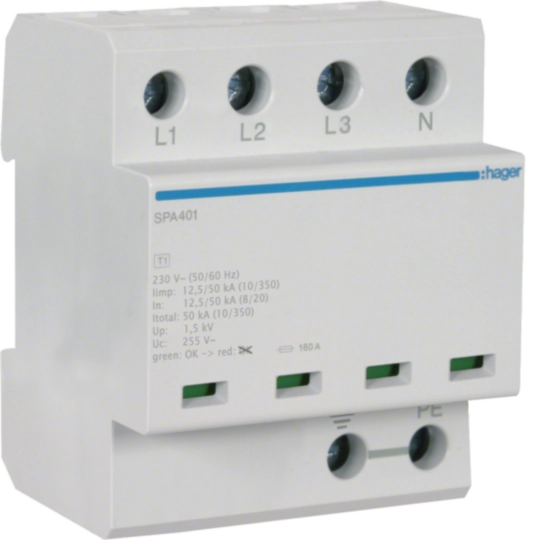
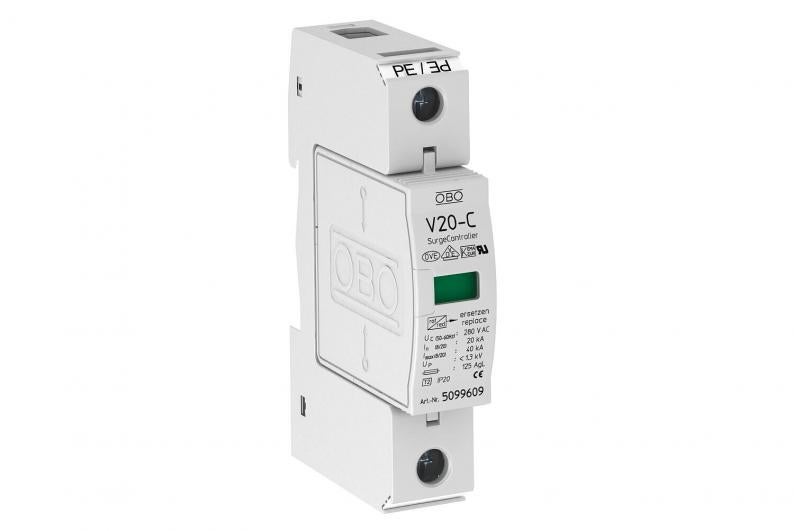
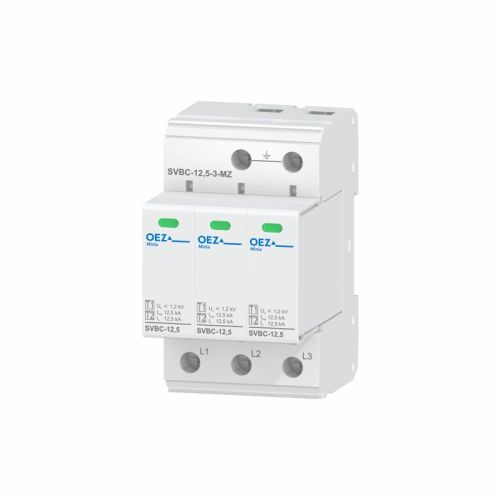
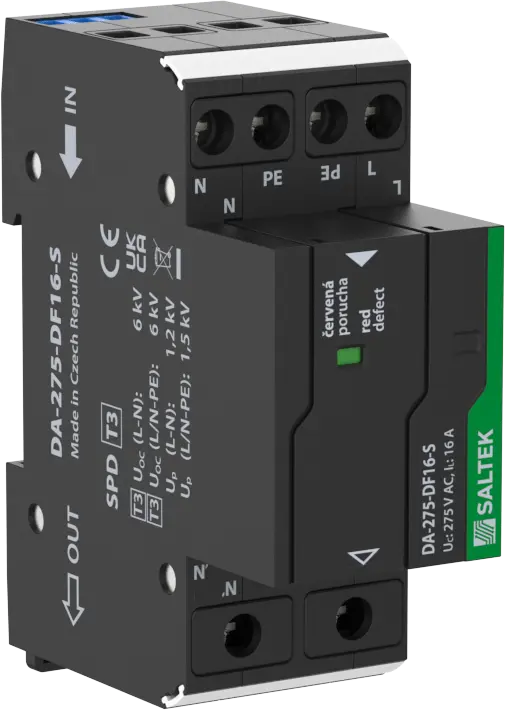
A surge protective device (SPD) is a low-voltage protection component that limits transient overvoltages and diverts surge current away from electrical and electronic equipment. When a lightning-induced or switching transient drives the line voltage thousands of volts above nominal for microseconds, the SPD changes from a near-open insulator into a near-short conductor in nanoseconds, shunting the surge current to the protective earth and clamping the residual voltage to a level the downstream equipment can survive.
SPDs are classified by installation location and energy capability into Type 1, Type 2, and Type 3 (IEC 61643-11 Class I, II, and III), and they are selected by a small set of ratings: maximum continuous operating voltage Uc, voltage protection level Up, nominal and maximum discharge current In and Imax, and for lightning-current devices the impulse current Iimp. This guide decodes each of those numbers and the standards behind them.
This guide is written for industrial purchasing engineers and design engineers. It covers 6 chapters from what an SPD is and how big the market is, through Type 1/2/3 classification, MOV/GDT/spark-gap technologies, AC/DC/data media, and spec-sheet decoding, to a selection decision sequence, with 7 selection FAQs and verified manufacturer examples. All parameters reference the IEC 61643 series, UL 1449, and IEC 62305 public standards.
Chapter 1 / 06
What is a Surge Protective Device
A surge protective device is a non-linear voltage-limiting component connected in parallel between the live conductors and the protective earth of an electrical circuit. Under normal voltage it presents a very high impedance and draws only a small leakage current, so the protected circuit behaves as if the device were not there. When a transient overvoltage appears, the SPD's impedance collapses within nanoseconds, it conducts the surge current to earth, and it holds the voltage seen by the downstream equipment to its voltage protection level Up. Once the transient passes, a varistor-based device returns automatically to its high-impedance state, while a spark-gap device must extinguish any power-frequency follow current.
The threats an SPD defends against are transient overvoltages, brief voltage spikes that last from a fraction of a microsecond to a few hundred microseconds. They come from three main sources: direct or nearby lightning strikes, which can couple kiloamp-level currents into the installation; switching transients from large inductive loads, capacitor banks, and utility grid operations; and electrostatic discharge. An SPD does not protect against sustained overvoltage, undervoltage, or supply interruptions; those are the domain of voltage regulators, automatic voltage stabilisers, and uninterruptible power supplies. The SPD addresses only the fast, high-energy transient.
The physics dates to the early use of carbon-block and air-gap arresters on telegraph and power lines in the late nineteenth century. The modern era began when the metal-oxide varistor, a sintered zinc-oxide ceramic with a sharply non-linear voltage-current curve, was commercialised in the 1970s and gave designers a fast, self-resetting clamp. The gas discharge tube brought high energy handling with negligible leakage, and the silicon avalanche diode brought the tightest, fastest clamp for electronics. Over the same period the international standards consolidated: the IEC 61643 series for low-voltage SPDs and UL 1449 in North America now define how every device is classified and tested.
The application scale is broad because almost every powered asset is now electronic. Industry analysts size the global surge protection device market at roughly USD 2.8 to 3.6 billion in 2024 depending on scope, with most published forecasts projecting a compound annual growth rate in the range of about 5 to 8 percent through the early 2030s. The drivers are consistent across sources: more lightning-exposed renewable generation, denser data-centre and telecom infrastructure, electric-vehicle charging, and the spread of sensitive microelectronics into machinery that previously tolerated rough power.
Four engineering metrics determine whether an SPD is fit for a circuit: the voltage protection level Up (how well it clamps), the discharge current rating In, Imax, or Iimp (how much energy it survives), the maximum continuous operating voltage Uc (whether it tolerates the normal supply), and the short-circuit current rating with its coordinated backup overcurrent device (whether it fails safely). A device that clamps tightly but cannot survive the site's lightning exposure, or that survives the surge but ages into a fire, has failed the engineering test. Selection is the disciplined matching of these four metrics to the installation.
Chapter 2 / 06
SPD Types and Classification
The single most important classification decision is the Type, because it fixes both where the device is installed and what kind of surge energy it can absorb. IEC 61643-11 defines three test classes, Class I, II, and III, which the market labels Type 1, Type 2, and Type 3. UL 1449 uses the same Type 1/2/3 numbering for permanently connected devices but extends it to Type 4 (component assemblies) and Type 5 (discrete components such as a single varistor). Choosing the wrong Type is the most common and most expensive SPD mistake, because a device sized for induced surges will be destroyed by direct lightning energy. The table below compares the three field types.
Type (IEC class)
Test impulse
Rated by
Install location (LPZ boundary)
Type 1 (Class I)
10/350 µs
Iimp 12.5 to 50 kA
Service entrance (LPZ 0 to 1)
Type 2 (Class II)
8/20 µs
In 20 kA, Imax 40 kA
Distribution board (LPZ 1 to 2)
Type 3 (Class III)
1.2/50 + 8/20
Uoc combination wave
At the load (LPZ 2 to 3)
Type 1+2 combined
10/350 + 8/20
Iimp + In together
Compact service entrance
Type 1 devices are tested with the 10/350 microsecond impulse, the waveform that represents the long, high-energy tail of a direct lightning stroke. They are installed at the origin of the installation, the main low-voltage panel, on any building that has an external lightning protection system or an overhead supply, and they are rated by the impulse current Iimp, typically 12.5, 25, or 50 kA per pole. Their job is to divert the partial lightning current that the lightning protection system shares into the power conductors. Many Type 1 devices are built on spark-gap technology because only a spark gap economically carries that 10/350 energy.
Type 2 devices are the workhorse of the industry. Tested with the 8/20 microsecond impulse, which represents induced surges and switching transients rather than a direct strike, they are rated by nominal discharge current In and maximum discharge current Imax. A representative modular product, the DEHN DEHNguard DG M TNS 275, carries In of 20 kA and Imax of 40 kA per pole at a voltage protection level Up of 1.5 kV or below. Type 2 devices are installed in distribution and sub-distribution boards and protect against the residual energy that gets past a Type 1 stage as well as locally generated switching surges.
Type 3 devices provide fine local protection at the point of use, within roughly 10 m of the equipment they protect. They are tested with a combination wave that delivers a 1.2/50 microsecond open-circuit voltage and an 8/20 microsecond short-circuit current simultaneously, characterised by the open-circuit voltage Uoc. They are never used alone for a building; they are the last cascade stage after Type 1 and Type 2 have absorbed the bulk of the energy, and they exist to trim the residual let-through voltage down to what sensitive electronics tolerate.
A fourth practical category is the combined Type 1+2 device, which passes both the 10/350 and the 8/20 tests in a single unit. Combined arresters such as the DEHN DEHNvenCI (Iimp 25 kA, Up 1.5 kV or below) are valuable where the service entrance and the first distribution board are physically close, because they remove the energy-coordination distance requirement between separate Type 1 and Type 2 stages. The trade-off is a higher unit cost and, usually, a slightly higher voltage protection level than a dedicated Type 2 stage placed deeper in the installation.
Chapter 3 / 06
Protection Technologies
Inside the plastic housing, every SPD is built from one or more of four protective elements, each with a different speed, energy capacity, and follow-current behaviour. The two broad behaviours matter for selection: voltage-clamping elements (varistors and diodes) limit the voltage progressively and do not draw follow current, while voltage-switching or crowbar elements (gas tubes and spark gaps) snap to a low arc voltage and can sustain power-frequency follow current. There is no universal element; high-performance SPDs deliberately combine them. The table below compares the four.
Element
Behaviour
Response time
Energy capacity
Best role
Metal-oxide varistor (MOV)
Clamping
~25 ns
High (8/20)
Type 2 mains protection
Gas discharge tube (GDT)
Switching
~100 ns to µs
Very high
Data lines, N-PE path
Spark gap
Switching
sub-µs
Highest (10/350)
Type 1 lightning current
Silicon avalanche diode (TVS)
Clamping
< 1 ns
Low
Electronics, signal lines
The metal-oxide varistor is a sintered zinc-oxide ceramic disc whose resistance falls sharply as the applied voltage rises above its threshold, giving a symmetrical, bipolar voltage-current curve. It clamps in roughly 25 nanoseconds, draws no power-frequency follow current, and resets itself automatically, which makes it the default element for Type 2 mains SPDs. Its weakness is wear: every surge erodes the grain boundaries slightly, the leakage current creeps up, and the device drifts toward end of life. Quality MOVs are therefore paired with an integral thermal disconnector that opens and signals before a depleted varistor can overheat.
The gas discharge tube is a sealed ceramic or glass envelope holding two electrodes in an inert gas at controlled pressure. Below its sparkover voltage it is an almost perfect insulator with picoampere leakage; above it the gas ionises and the tube switches to a low-voltage arc that carries very high current. GDTs are excellent for the neutral-to-earth path of a power SPD and for data and telecom lines, but on a live AC conductor the low arc voltage allows power-follow current, so a GDT is combined in series with a varistor or fuse rather than used bare across the mains.
The spark gap is, in effect, a heavy-duty air or encapsulated gap engineered to break over at a defined impulse voltage and then carry enormous 10/350 lightning current at a very low arc voltage, on the order of tens of volts. That combination of high current capacity and low arc voltage is exactly what a Type 1 service-entrance device needs, which is why most lightning-current arresters are spark-gap based. The engineering challenge is extinguishing the power-frequency follow current that the low arc voltage would otherwise sustain; DEHN's RADAX-flow geometry, for example, forces the arc into a chamber that interrupts follow currents up to 100 kA RMS.
The silicon avalanche diode, also called a transient voltage suppressor (TVS) or silicon avalanche suppressor (SAD), clamps in well under one nanosecond and to a very tight, precise voltage. Its energy capacity is small, so it is never the primary diverter for mains lightning current, but it is the ideal final stage for sensitive electronics, signal lines, and data ports, where it trims the last few volts off a residual transient that the upstream MOV and GDT stages have already de-energised. Multi-stage data SPDs typically place a GDT first, a series resistor or inductor, then a TVS, so each element does the job it is best at.
Chapter 4 / 06
Media, Systems and Standards
An SPD is matched not to a corrosive fluid but to the electrical system it sits on: the system voltage, the earthing arrangement, and whether the circuit is AC power, DC, or a data and signal line. Each of these is governed by a specific part of the standards family. Getting the system match wrong, for example fitting an AC power SPD onto a DC photovoltaic string, is not merely ineffective; it is a fire hazard, because the failure modes differ fundamentally between AC and DC.
Earthing system and pole configuration. Low-voltage power systems are wired as TN-S, TN-C, TT, or IT, and the SPD pole arrangement must match. On a three-phase TN-S system the common arrangement is "3+1" or "4+0": three varistors on the phases plus, in the 3+1 layout, a gas-tube summation path from neutral to earth. On a TT system the 3+1 arrangement is mandatory so that an SPD failure does not bridge neutral to earth and defeat the residual-current device upstream. The product part number encodes this: the DEHN DEHNguard DG M TNS 275 is the four-pole TN-S variant, while DG M TN and DG M TT denote the other topologies.
AC power lines are governed by IEC 61643-11 (and its European twin EN 61643-11) and by UL 1449 in North America. These standards define the Type classes, the test impulses, and the rated parameters Uc, Up, In, Imax, and Iimp described in Chapter 5. They also define the temporary overvoltage (TOV) withstand: under IEC 61643-11 the device must survive defined power-frequency overvoltages, with characteristic test values of 1.32 times the reference voltage for 5 seconds and up to 1.73 times for the longer 120-minute condition, representing fault conditions such as a lost neutral.
DC and photovoltaic circuits are governed by IEC 61643-31. They cannot use ordinary AC SPDs because a DC arc has no current zero crossing to self-extinguish, so a failed varistor would sustain an arc. PV SPDs use a Y-shaped or 1+1 varistor-plus-disconnector topology rated for the full open-circuit string voltage, commonly 600 V, 1,000 V, or 1,500 V DC, as in the Phoenix Contact VAL-MS 1000DC-PV family. The disconnector and thermal protection are engineered specifically for DC interruption. Data, signal, and telecom lines are governed by IEC 61643-21 and are selected by line voltage, bandwidth, and impedance rather than discharge current, so they protect the signal without attenuating it.
The table below maps common circuits to the governing standard and the SPD family to specify. It is a first-pass guide; always confirm the system voltage, earthing type, and prospective fault current against the manufacturer's selection table before ordering.
Circuit
Governing standard
SPD family to specify
230/400 V AC service entrance
IEC 61643-11 / UL 1449
Type 1 or Type 1+2 (Iimp rated)
230/400 V AC distribution board
IEC 61643-11 / UL 1449
Type 2 (In 20 kA)
AC at sensitive load
IEC 61643-11 / UL 1449
Type 3 (combination wave)
DC photovoltaic string
IEC 61643-31
PV Type 1/2, 600 to 1,500 V DC
Ethernet, RS-485, 4 to 20 mA
IEC 61643-21
Signal-line SPD (matched impedance)
Coaxial / RF antenna feed
IEC 61643-21
Coaxial / quarter-wave stub protector
Chapter 5 / 06
Key Specification Parameters
Reading an SPD datasheet means decoding a compact set of ratings that together describe how well the device clamps, how much energy it survives, and whether it tolerates the supply. Manufacturers may print twenty lines of data, but seven parameters drive the selection decision: maximum continuous operating voltage Uc, voltage protection level Up, nominal discharge current In, maximum discharge current Imax, lightning impulse current Iimp, short-circuit current rating SCCR, and response time. Each is explained below, and the verified values for one representative Type 2 product are listed in the comparison table.
Maximum continuous operating voltage (Uc, called MCOV in UL terminology) is the highest RMS voltage that may be applied indefinitely without the SPD beginning to conduct. It must sit above the worst-case continuous line voltage including the utility tolerance band. For a nominal 230/400 V TN system the practical floor is 255 V and the standard value is 275 V; a higher Uc of 320 V or 335 V is chosen where temporary overvoltage from a possible lost neutral is a concern. Setting Uc too low causes the varistor to conduct on normal voltage peaks and overheat; setting it too high raises the protection level Up unnecessarily.
Voltage protection level (Up, called VPR in UL 1449) is the single most important protection number: the residual voltage that actually appears across the SPD terminals, and therefore across the protected equipment, while the device is diverting the surge. A good Type 2 device clamps to Up of 1.5 kV or below at In; premium devices reach 1.0 kV or below at a 5 kA reference. The protected equipment's rated impulse withstand voltage (its category, for example 2.5 kV for category II equipment at 230/400 V per IEC 60664-1) must be higher than Up plus the inductive voltage rise on the connecting leads, which is why short, straight SPD connections matter.
Nominal discharge current (In) is the 8/20 microsecond surge the device survives repeatedly, at least 15 times under the IEC test, without degradation; it is the endurance figure most project specifications cite, commonly 20 kA for a robust Type 2. Maximum discharge current (Imax) is the single-event 8/20 ceiling the device survives once, typically double In, around 40 kA. Lightning impulse current (Iimp) is the 10/350 rating of a Type 1 device, the partial direct-lightning current it can carry, commonly 12.5 to 50 kA per pole; it is a far more energetic test than the 8/20 because of its long tail.
Short-circuit current rating (SCCR or Iscpv) is the prospective power-frequency fault current the SPD and its specified backup overcurrent device can safely interrupt at end of life, for example 50 kA RMS. It must meet or exceed the available fault current at the installation point, or the SPD becomes an ignition source when it fails. Response time is the lag before the element begins clamping, around 25 nanoseconds for a varistor and under one nanosecond for a TVS diode; it matters most for the fastest-rising transients. The table compares one verified Type 2 product against the typical envelopes for the three field types.
Parameter
DEHNguard DG M TNS 275 (Type 2)
Typical Type 1 envelope
Typical Type 3 envelope
Uc (max. continuous operating voltage)
275 V AC
255 to 335 V AC
255 to 275 V AC
Up (voltage protection level)
≤ 1.5 kV
≤ 1.5 to 2.5 kV
≤ 1.0 to 1.5 kV
In (nominal discharge, 8/20)
20 kA
15 to 25 kA
3 to 10 kA
Imax (max. discharge, 8/20)
40 kA
—
5 to 10 kA
Iimp (impulse, 10/350)
—
12.5 to 50 kA
—
Response time
≤ 25 ns
≤ 100 ns
≤ 25 ns
Backup fuse / SCCR
125 A gG / 50 kA
per maker / up to 100 kA
per maker
Chapter 6 / 06
Selection Decision Factors
To turn the preceding five chapters into a specific model on a purchase order, follow the decision sequence below. Most selection errors come not from one wrong number but from deciding a later step before an earlier one is fixed, for example choosing a clamping voltage before settling the earthing system. These eight steps double as a fixed RFQ template.
Risk and Type: Establish the lightning exposure. A building with an external lightning protection system or an overhead supply needs a Type 1 device at the entrance; an installation fed by underground cable in a low-exposure area can start at Type 2. Then plan the cascade: Type 1 at the service entrance, Type 2 at distribution boards, Type 3 at sensitive loads.
System voltage and earthing: Fix the nominal voltage (for example 230/400 V) and the earthing arrangement (TN-S, TN-C, TT, or IT). These together set the pole configuration (3+1, 4+0) and the minimum Uc. On TT systems the 3+1 arrangement is mandatory to preserve the upstream residual-current device.
Uc and TOV margin: Choose Uc above the worst-case continuous voltage including utility tolerance: 275 V is standard for 230/400 V, 320 V or 335 V where lost-neutral temporary overvoltage is credible. Confirm the device meets the IEC 61643-11 TOV withstand for the system.
Discharge rating: Match Iimp (Type 1, 10/350) or In and Imax (Type 2, 8/20) to the site risk assessment per IEC 62305-2. Do not over-specify a Type 2 In beyond what coordination requires; the protection level matters more than headroom on In.
Protection level coordination: Verify that Up plus the lead-induced voltage is below the rated impulse withstand voltage of the protected equipment (IEC 60664-1 categories). Keep connecting leads short and straight, ideally under 0.5 m total, and use the V-wiring or through-wiring technique to minimise the added voltage.
Short-circuit rating and backup OCPD: Confirm the SCCR meets the available fault current, and fit the manufacturer-specified backup fuse or breaker (for example 125 A gG for the DEHNguard DG M TNS 275) unless the upstream protection is already smaller. This is the step that makes a failed SPD fail safely.
Energy coordination distance: Between a Type 1 and a downstream Type 2 stage, provide at least 10 m of conductor, or a decoupling inductor where that length is impractical, or specify a combined Type 1+2 device. Without coordination the stages fight and the deeper device can be overstressed.
Indication, form factor, and serviceability: Choose pluggable modular bases so a depleted module swaps in seconds with the base still wired. Specify a green-to-red status window, and where a control system should know, an FM remote-signalling contact wired to the PLC or BMS. Confirm DIN-rail mounting, the operating temperature range, and the ingress protection of the housing.
One last commonly overlooked dimension is end-of-life management and serviceability. An MOV-based SPD has no calendar service life; it ages by cumulative surge energy and can silently stop protecting while still passing power. Pluggable designs from DEHN (DEHNguard), Phoenix Contact (VAL-MS), Weidmuller, ABB (OVR), Citel, and Mersen all provide a visual status indicator and, on the FM variants, a remote contact, so a maintenance team can replace a spent module without tools and without de-energising the base. Specify these features, register the device in the maintenance schedule, and inspect after any known nearby lightning event.
FAQ
What is the difference between a surge protective device and a surge arrester?
In modern usage the terms overlap, but there is a historical and regulatory distinction. A surge arrester traditionally refers to the high-voltage station equipment installed on the utility grid (medium and high voltage), governed by IEC 60099 and built around metal-oxide arrester blocks. A surge protective device (SPD) refers to the low-voltage component installed inside buildings, panels, and equipment, governed by IEC 61643-11 (AC power) and UL 1449. Both divert transient surge current to earth and clamp the residual voltage, but an SPD operates below 1,000 V AC and is selected by Type 1, 2, or 3 class plus the Uc, Up, In, and Iimp ratings.
What is the difference between Type 1, Type 2, and Type 3 SPDs?
The three IEC 61643-11 classes describe installation location and energy capability. Type 1 (Class I, tested with the 10/350 microsecond impulse, rated by Iimp) sits at the service entrance and diverts partial direct-lightning current where an external lightning protection system exists. Type 2 (Class II, tested with the 8/20 microsecond impulse, rated by In and Imax) is the workhorse installed in distribution and sub-distribution boards to protect against induced surges and switching transients. Type 3 (Class III, tested with a 1.2/50 plus 8/20 combination wave) provides fine local protection within 10 m of sensitive equipment. They are coordinated in cascade so each stage lets the upstream device take the bulk of the energy.
What do Uc, Up, In, Imax, and Iimp mean on an SPD datasheet?
Uc (maximum continuous operating voltage) is the highest RMS voltage that can be applied indefinitely without the SPD conducting; for a 230/400 V system it is typically 275 V. Up (voltage protection level) is the residual let-through voltage clamped across the terminals during the surge, the single most important protection number, typically below 1.5 kV for a good Type 2 device. In (nominal discharge current, 8/20) is the surge the SPD survives repeatedly, at least 15 times, commonly 20 kA. Imax (maximum discharge current, 8/20) is the single-shot ceiling, often double In, around 40 kA. Iimp (impulse current, 10/350) is the lightning-current rating of a Type 1 device, commonly 12.5 to 50 kA per pole.
MOV, GDT, or spark gap: which surge protection technology should I choose?
Metal-oxide varistors (MOV) clamp in roughly 25 nanoseconds with no follow current and are the default for Type 2 protection, but they degrade with each surge and age toward end of life. Gas discharge tubes (GDT) handle very high energy and have near-zero leakage, but they switch (crowbar) slowly and can sustain power-follow current, so on AC they are paired with another element. Spark gaps (encapsulated or RADAX-flow types) carry the highest 10/350 lightning current and have a very low arc voltage, making them the basis of most Type 1 devices, but they need engineered follow-current interruption on power circuits. Silicon avalanche diodes (TVS/SAD) give the fastest, tightest clamp for low-energy data and electronics. High-performance SPDs combine these in series or parallel.
How do I size the SPD voltage and backup overcurrent protection?
Set Uc above the worst-case continuous voltage including utility tolerance: for a 230/400 V TN system, 255 V is the practical floor and 275 V is standard, with 320 V or 335 V used where temporary overvoltage (TOV) risk is high. Confirm the SPD short-circuit current rating (SCCR / Iscpv) meets or exceeds the prospective fault current at the installation point. Then fit the manufacturer-specified backup overcurrent protective device (OCPD), for example a 125 A gG fuse for a DEHNguard DG M TNS 275, unless the upstream main fuse is already smaller. The backup OCPD disconnects the SPD safely at end of life so a failed varistor cannot start a fire.
Where should each SPD type be installed, and how far apart?
IEC 62305-4 organises the building into lightning protection zones (LPZ). A Type 1 device sits at the LPZ 0 to LPZ 1 boundary, the main service entrance, where a lightning protection system can inject partial lightning current. A Type 2 device sits at the LPZ 1 to LPZ 2 boundary, the sub-distribution board. A Type 3 device sits close to the load at the LPZ 2 to LPZ 3 boundary. Cascaded SPDs need energy coordination: keep at least 10 m of conductor between a Type 1 and a downstream Type 2, or insert a decoupling inductor (around 5 m equivalent) when that distance is not available. Combined Type 1+2 devices remove this constraint in compact installations.
How long does an SPD last and when must it be replaced?
An MOV-based SPD has no fixed service life; it ages by cumulative surge energy, not calendar time. Each large surge erodes the varistor and raises its leakage current, eventually tripping the internal thermal disconnector. Pluggable modular designs (DEHNguard, Phoenix VAL-MS) show a mechanical green-to-red status window and, on FM versions, a remote signalling contact wired back to the PLC or BMS. Replace the module when the window turns red or the contact reports a fault; the base stays wired so a swap takes seconds with no downtime. Inspect after any known nearby lightning event and at scheduled maintenance, since a depleted SPD silently stops protecting while still passing power.
Surge Protective Device Manufacturers
Source-backed product routes. Open a company dossier for procurement scope and cited evidence.