
Sprinkler systems remain the most widely installed automatic fire-suppression technology in industrial facilities, with NFPA 13 governing design, installation, and water-supply requirements across the United States and adopted by most jurisdictional codes [S3][S4].
For process engineers, EPC specifiers, and facility-safety leads, the decision is rarely "sprinkler or nothing" — it is which of the four main sprinkler types (wet, dry, preaction, deluge) maps onto the hazard classification, ambient temperature envelope, and water-damage tolerance of the protected occupancy [S3].
Wet-Pipe Systems: The Default and Why It Dominates New Industrial Builds
Wet-pipe networks keep the sprinkler riser and branch lines permanently charged with water downstream of the alarm check valve, so a fused glass-bulb or fusible-link head opens and discharges within seconds of ceiling-level heat detection, typically at 68 °C (155 °F) for ordinary-temperature ratings per NFPA 13 [S3][S4]. Because there is no pneumatic barrier, wet systems add roughly 1–2 psi of friction-loss margin versus dry or preaction networks and are the lowest-cost option to install and inspect, which is why they cover the majority of light- and ordinary-hazard occupancies such as warehouses, assembly halls, and Group B/F/M/S one- and two-story buildings under IBC §507.4 and §507.5 [S4].
Dry-Pipe, Preaction, and Deluge: Where Standard Wet-Pipe Fails
Where unheated spaces drop below 4 °C (40 °F), wet-pipe cannot be specified because trapped water will freeze, crack fittings, and create a full-flow discharge on system refill. Dry-pipe systems hold supervisory air or nitrogen at 30–40 psi above the water-supply pressure; when a head opens, the pressure drop trips the dry-pipe valve and water reaches the most remote head within 60 seconds per NFPA 13, an accepted delay built into the standard [S3]. Preaction systems add a separate detection system (typically smoke or flame) that must actuate before the valve opens, keeping the branch lines dry until a confirmed event, which is why data halls, archives, and electronics cleanrooms almost universally specify double-interlock preaction. Deluge systems use open nozzles and a fire-detection-actuated deluge valve; they are required for high-hazard occupancies such as aircraft hangars, transformer enclosures, and certain chemical-process modules where flash-fire propagation must be met with simultaneous area-wide discharge rather than head-by-head activation [S3][S4]. The decision criterion matrix is straightforward: wet for heated, low-water-damage tolerance okay; dry for unheated; preaction for high-value water-sensitive stock; deluge for high-hazard flammable-liquid or rapidly propagating fire loads.
Disadvantages Engineers Routinely Underestimate at Spec Stage
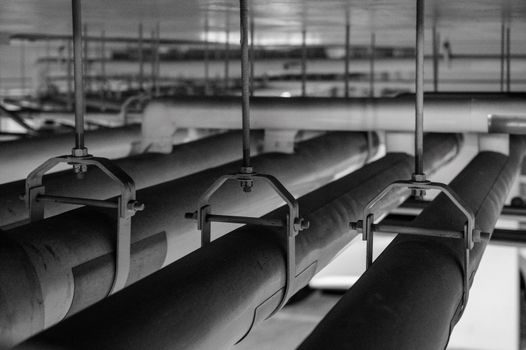
Sprinkler systems trade a probability-weighted fire-loss reduction against four recurring failure modes: (1) water-damage loss when a single head fuses from a non-fire event such as welding sparks or forklift impact — a single ESFR pendent can discharge 100+ gpm and a 165 °F head in a 40 ft clear warehouse will wet roughly 2,000 ft² before isolation; (2) freeze failure in dry-pipe systems when air compressors fail or nitrogen cylinders are not monitored, which is the leading cause of dry-pipe system impairment in cold-climate plants; (3) corrosion of black-steel wet-pipe networks from MIC (microbiologically influenced corrosion), a known issue that has driven specifiers toward CPVC, galvanized, or FM-approved stainless branch lines in newer builds; (4) inspection and impairment cost — NFPA 25 quarterly main-drain tests, annual internal pipe inspections for dry systems, and 5-year obstruction investigations are mandatory and are typically the largest 30-year operating line item per Fire Hydrant TCO analysis [S3].
Comparison: Sprinkler System Types Against Four Spec Criteria
The reliable decision path is: confirm the hazard class, then the occupancy temperature envelope, then the water-damage consequence of a single-head accidental discharge, and only then pick a valve type — not the other way around.
Where Sprinkler Systems Are the Wrong Choice
Sprinkler systems are NOT the right answer where: (a) the protected asset is electrically energized at the time of discharge and water creates an additional hazard, as in certain live electrical rooms where a clean-agent or aerosol system pairs with a preaction dry-pipe barrier; (b) the fire is a deep-seated Class A smolder in a baled commodity that requires foam or water-mist penetration beyond a standard spray pattern; (c) the process is in a cleanroom with optical or semiconductor equipment that cannot tolerate even a dry-pipe valve's accidental trip; (d) the commodity itself is water-reactive, such as magnesium turnings, alkali metals, or certain catalysts — here a dry-chemical or specialized gaseous system must be substituted because water discharge will accelerate the reaction. A frequently-missed boundary is also legacy high-rack storage above 25 ft, which demands ESFR (Early Suppression Fast Response) heads with K-factors of 22.4 or higher and specific ceiling-only storage configurations; standard spray sprinklers will not achieve the required density [S3].
Standards, Inspection Discipline, and the Real Operating Cost
NFPA 13 is the primary installation standard in the United States, with NFPA 25 governing inspection, testing, and maintenance, and FM Global Property Loss Prevention Data Sheets providing the carrier-recognized equivalency path for many industrial occupancies [S3][S4]. For procurement-side cost modeling, the Fire Hydrant Installation depth, bury, valve, and thrust-block spec map is a useful peer reference because the same underground water-supply logic feeds both hydrant and sprinkler lead-in mains. Within the broader B2B encyclopedia, a sprinkler system overview sits alongside related automatic-protection disciplines such as sorting system and ASRS system architecture for fully automated warehouse risk profiles. Bottom line: a properly spec'd wet-pipe system on an ESFR grid remains the lowest-TCO automatic fire-suppression option for typical industrial property, and the engineering discipline is in choosing the valve type and head K-factor to match the hazard class — not in reinventing the suppression medium.