
EN 361-certified full-body fall-arrest harnesses from European brands (Petzl NEWTON, ELYTRA sternal/dorsal models) cluster in a GBP 60–150 ex-VAT retail band as of mid-2026, while Asian-made equivalents on wholesale platforms appear in the US$ 20–50 per-piece range with MOQs as low as 10 units [S3][S1][S7].
The harness itself is rarely the dominant line item in a height-safety budget: compliant shock-pack lanyards, retractable blocks, anchor straps and annual statutory inspection push the per-user annualised cost 3–5× above the harness SKU price [S5][S6]. Buyers who anchor procurement on harness price alone routinely fail the EN 365 mandatory periodic-examination requirement on the surrounding system [S5].
EN 361 and EN 358 — what the standard actually pins down on price
EN 361 governs the fall-arrest attachment geometry: a full-body harness must carry a dorsal D-ring and a sternal attachment point, both marked with the letter "A" on the hardware, and dynamic-load tested to 15 kN with a 100 kg mass [S1]. EN 358 covers work-positioning / restraint belts (waist D-rings rated to a 6 kN static load) and is the reason many "harness" SKUs ship as EN 361 + EN 358 hybrids — the ELYTRA sternal-attachment model being a current case in point [S1][S3].
Compliance with these two standards is non-optional in the EU/UK and is the single biggest filter on price: sub-US$ 20 retail SKUs without an EN 361 / EN 365 traceable certificate and serialised inspection log are typically only legal for short-duration, low-risk tree-stand or recreational use (the Big Dog BDH-2000S US$ 13.96 listing is a consumer hunting SKU, not a construction-spec harness) [S4]. On a B2B site such as RS, the fall-arrest category is segregated precisely on the EN 361 axis [S5].
SKU price bands — what you actually pay in mid-2026
A four-tier stack lines up against typical buyer profiles: [S1]
Tier 1 — Asian OEM / white-label: US$ 20–50 per piece, MOQ 10–100 pieces, polyester webbing, basic dorsal + sternal D-rings, CE paperwork supplied by importer. Common on Made-in-China and Alibaba listings under "safety harness" / "construction harness" [S7]. Lead time 30–45 days ex-Shanghai or Ningbo.
Tier 2 — European mid-range (Petzl NEWTON, ELYTRA equivalent): GBP 60–150 retail, single-piece buy, colour-coded donning straps, semi-rigid back pad, EN 361 + EN 358 dual certification, weight typically 1.0–1.4 kg [S3][S1]. Lead time ex-UK/EU distributor 5–10 days.
Tier 3 — Spec/professional (Petzl AVAO, Honeywell Miller, Capital Safety Protecta): GBP 150–300, integrated load-indicator stitching, fall-indicator lanyard keepers, padded belt for prolonged work-positioning, weight 1.3–1.8 kg.
Tier 4 — Tower/SAS-type / rope-access (Petzl SEQUOIA, AVAO BOD, Skylotec): GBP 300–600, EN 361 + EN 358 + EN 813, sit-board geometry, dedicated ventral attachment for descender rigs.
The retail spread between Tier 2 and Tier 4 is roughly 4×, which mirrors the certification count and the kg-of-padded-ergonomics, not raw webbing cost — useful sanity check against suspiciously cheap "Petzl-equivalent" listings on marketplaces [S3].
Cost levers buyers can actually pull
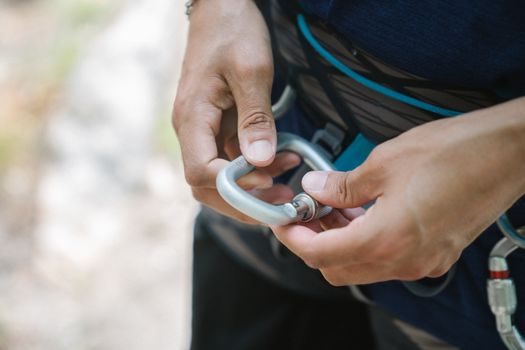
Three levers do most of the work. First, webbing and stitching: 45 mm polyester or HMPE webbing at 22–27 kN break strength is now a commodity; specifying 50 mm or aramid-blend webbing can add 15–25% to the harness price but is rarely justified below 6 m free-fall distances. Second, hardware: aluminium dorsal and sternal D-rings save roughly 80–120 g versus zinc-plated steel and typically cost 10–18% more, but improve wearer comfort on long shifts. Third, certification scope: a single EN 361 SKU is cheaper to tool and test than an EN 361 + EN 358 + EN 813 tri-certified model, so if your workforce only needs fall-arrest, do not over-spec to a rope-access harness [S1][S3][S5].
On the logistics side, B2B platforms (Made-in-China, RS) currently list a 10-piece MOQ as the typical entry point at Tier 1, and ex-UK stock at Tier 2 — buyers who can flex 100+ piece orders into 30-day slots usually negotiate 12–20% off the GBP 60–150 list [S7][S5]. A useful parallel: industrial procurement stacks such as pallet rack buying guide 2026 show similar 15–20% tier breaks at 50–100 unit thresholds, so the same volume discipline applies.
System cost — why the harness is rarely the dominant line
On a single-worker fall-arrest kit, the harness typically accounts for 20–35% of capital cost; the rest sits in a shock-absorbing lanyard (GBP 30–80), a self-retracting lifeline / SRL (GBP 100–350), anchor straps or slings (GBP 15–60 each), and a rigid helmet (EN 397, GBP 20–50). For high-frequency sites, a 6 m retractable block at GBP 200–280 is often specified, which can double the kit total [S5][S6].
Recurring cost is a separate column. EN 365 mandates a competent-person inspection at least every 12 months, with a maximum 6-month interval for harnesses used in arduous conditions; UK providers typically charge GBP 8–15 per harness per inspection, and harnesses carry a typical 5-year service life before mandatory retirement — the harness SKU price amortised over that 5 years is dwarfed by the inspection ledger. Buyers setting up a height-safety budget should benchmark against multi-PPE stacks such as the hearing protector selection guide where recurring fit-test and replacement cycles also dominate TCO.
Who it is for — and where cheap SKUs fail

EN 361 / EN 358 dual-certified harnesses are mandatory for anyone working at height above 2 m in the UK under the Work at Height Regulations 2005, and are the default specification for construction, roof work, tower maintenance, MEWP platforms, and steel erection. Tier 3–4 rope-access harnesses (EN 361 + EN 813) are reserved for rope-access technicians, tower climbers and wind-turbine crews where a sit-harness seat and ventral descender point are operationally required [S1][S3][S5].
Tier 1 Asian SKUs are appropriate for short-cycle, low-risk tasks (one-day hire, scaffold erection in good weather, occasional lanyard work) where the buyer is willing to validate EN 365 paperwork, batch-test the first shipment, and accept a shorter service life. They are not appropriate for permanent fall-arrest in petrochemical, offshore, or high-temperature work where NACE / ATEX / arc-flash considerations also apply — for those environments, harness price is a rounding error against the cost of the rest of the ATEX-rated kit. For buyers comparing adjacent industrial procurement stacks, the solar panel price trend 2026 coverage shows the same pattern: lowest-tier SKUs are excluded from safety-critical spec.
Limitations, failure modes and inspection signals
The three most common failure modes on a fall-arrest harness are: (1) broken or frayed webbing at the dorsal D-ring stitching, usually after a fall event or sustained UV exposure, requiring immediate retirement; (2) buckle slippage, almost always traced to under-tensioned chest-strap donning on the worker side; (3) corrosion of steel D-rings, accelerated in marine or chlorinated atmospheres. EN 365 inspection is the only legally defensible signal that none of these are present [S5][S6].
Harnesses must be withdrawn from service after any fall arrest event, after 5 years of use at most, and whenever the inspection record shows a non-conformance. Buyers who try to extend service life past manufacturer-stated dates typically do so because they benchmarked the harness on SKU price alone, not total system cost [S5].
Sourcing checklist for the next 90 days

Two trackable signals: (1) watch for Q3 2026 distributor promotions on Tier 2 European harnesses, which historically clear GBP 10–20 off list around August–September inventory cycles; (2) watch for fresh EN 365 / BS 8437 cohort inspection-pricing from UK competent-person schemes, which has been creeping up GBP 1–2 per harness per year since 2023 and is the real TCO driver on multi-crew sites [S5][S6].
For component-level specifications, see fall arrest harness, linear guide, and crossed roller guide.