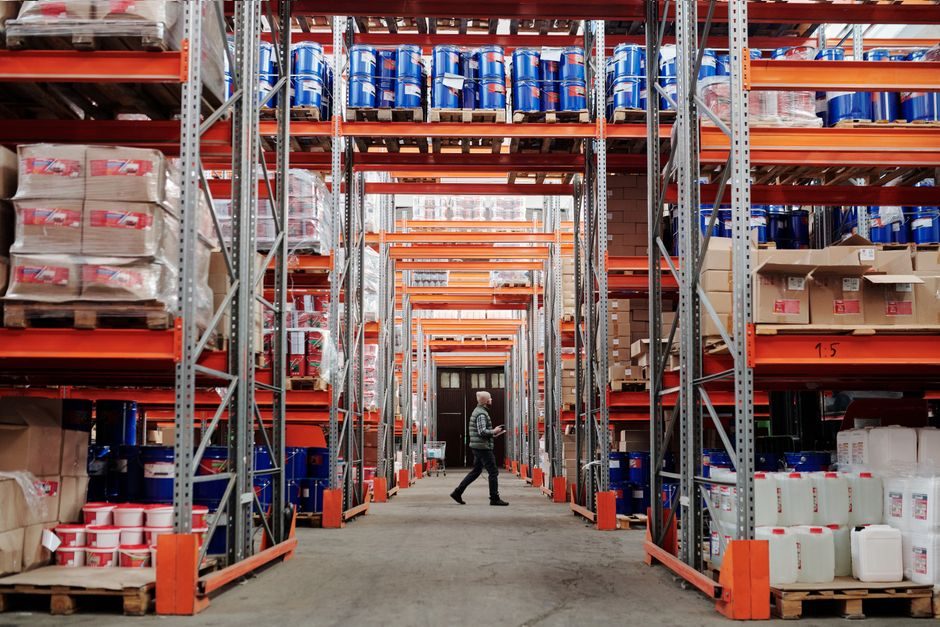
Selective pallet rack frames in the Chinese export channel cluster at US$50.00-80.00 per set at the budget end and US$60.00-380.00 for heavy-duty industrial configurations as of May 2026 listings, with MOQ bands from 1 square foot to 100 sets [S7][S2]. Push-back systems land at US$0.85-1.20 per set with a 3,000-set MOQ, and very-narrow-aisle (VNA) frames trade in the US$0.80-0.90/kg band [S1][S8]. Mezzanine rack kits from Suzhou Highbright and Hongkong Forme sit at US$260.00-304.00 per piece with 30-50 piece MOQ [S9].
Buyers in 2026 are no longer comparing brochures — they are reading the load-class stamp on the beam-end connector, the steel-coating spec, and the supplier's warehouse audit note. Pricing gaps of 8-12× across the same nominal product confirm that headline per-set rates are a starting point, not a comparison tool [S2][S7].
Frame and Beam Load Classes: What the Numbers Actually Mean
Heavy-duty selective frames from Beijing Jiuwei are listed at US$60.00-380.00 per set with a 10-set MOQ, and storage-rack frame listings on the same channel run US$80.00 per square foot for industrial warehouse steel [S2][S7]. The standard unit dimensions quoted by Ukrainian distributor ATB Trade are L 2,700 × W 1,050 × H 5,025 mm, 4 beam levels, 2,500 kg/level — a common 10,000 kg per-bay class that recurs across EU and Turkish supplier listings [S4][S3].
A teardrop-style selective bay in this class typically pairs two upright frames (often 2,700-3,300 mm tall) with 4-5 pairs of step beams, and capacity is governed by the weakest connector — frame thickness, beam gauge, and the locking-pin geometry. For 2,500 kg/level service, 2.0-2.5 mm column steel with RAL powder coat over hot-rolled base is the de-facto minimum; light-duty selective bays under 1,000 kg/level can drop to 1.5 mm [S4]. Buyers who skip the connector-pin spec and accept the price alone are the ones who pay for it in beam-pull-out failures within the first 12 months.
Selective vs Push-Back vs Drive-In vs Mezzanine: A Four-Criteria Cut
First-pass pallet-rack specifiers typically narrow between four structural families: selective (FIFO, 100% selectivity), push-back (LIFO, 2-6 deep), drive-in/drive-through (LIFO/FIFO bulk), and mezzanine (raised floor on rack). The decisive criteria in 2026 are SKU count, pick-rate, pallet rotation discipline, and ceiling-clearance headroom [S1][S8].
On SKU count, selective wins at high-velocity SKUs because every pallet is directly addressable; push-back is quoted for 2-6-deep lanes that cut aisle count by 40-50% but force LIFO; drive-in suits homogeneous-pallet cold storage or bulk FIFO cement-feed applications where selectivity is irrelevant. Mezzanine platforms, priced at US$260.00-304.00 per piece in mid-2026 listings, are the right answer when the building's clear height exceeds 8 m and the operator needs an intermediate pick floor [S9][S1].
On cost per pallet position, push-back pushes per-position steel 1.3-1.5× higher than selective; drive-in pushes it 1.4-1.8× higher; mezzanine combines rack + deck + stair + handrail into a US$200-400/m² build cost that no selective quote can match for vertical-density gains alone. Lead-time separates the families most sharply — selective frames out of Chinese stock ship in 15-25 days, push-back carts add 30-45 days, and engineered mezzanines with stairs and gates run 45-75 days from PO [S2][S9].
Beam Connectors, Column Steel and the Coating Question
The two connector systems that dominate 2026 export listings are teardrop (a teardrop-shaped slot in the column with a pin-locked beam end) and structural-bolt (a bolted flange, typically M10-M12 grade 8.8). Teardrop is the price-leader and lets beams re-locate in 50.8 mm (2″) vertical increments; structural-bolt is the safer choice for 3,000+ kg/level seismic zones and is the system that shows up in EU pallet-rack standard EN 15635 audit reports [S4][S3].
Column steel thickness is the single most under-specified number on Chinese export listings: budget selective frames use 1.5-1.8 mm cold-rolled steel rated for 800-1,500 kg/level; mid-grade runs 2.0-2.5 mm at 2,000-3,200 kg/level; heavy industrial runs 2.5-3.0 mm at 3,500-4,500 kg/level, with yield strength typically 350-450 MPa. The 2,500 kg/level ATB-Trade specification is the median of mid-grade frames and lines up with the bulk of European warehouse practice [S4].
Coating is where cheap quotes get expensive. Standard pre-galvanized (zinc-coat 30-60 g/m²) suits dry warehouses at 5-7 year repaint intervals; hot-dip galvanized (80-120 g/m²) doubles the steel cost and is the right pick for cold-store, food, or outdoor-yard service; epoxy powder over galvanized is the premium tier for pharmaceutical and FMCG. A US$50.00-80.00 per-set frame is pre-galvanized; the US$260.00+ per-piece mezzanine kit at US$304.00 is typically powder-coated over hot-dip [S8][S9].
Reading the Quote: MOQ, FOB Terms and the Hidden 30%
Made-in-China listings in May 2026 show MOQs ranging from 1 square foot on heavy-duty steel frames to 8-10 kg on gravity-flow and shuttle systems, and 100-set MOQs on VNA frames [S2][S7][S1]. MOQ discipline matters because freight on a 6×40'HC container of selective frames in 2026 is running 18-25% of the FOB unit value depending on Tianjin vs Ningbo origin and Mediterranean vs US-East-Coast destination [S1][S2].
Industry buyer inquiries on the same date window — ATB Trade (Ukraine), Dinamik (Turkey) — consistently specify 'customized sizes accepted: yes' and 'regular size/unit' 2,700 × 1,050 × 5,025 mm, confirming that custom dimensions are now the default rather than the exception [S3][S4].
For complete storage-system context, this pricing pattern lines up with the cost bands in the Storage Cage Price & Cost Guide 2026 — the same MOQ-driven and freight-driven dynamic applies to wire-mesh and stackable-cage buyers in 2026.
Inspection, Compliance and the Seismic Question

Three compliance regimes dominate mid-2026 European, North American, and APAC pallet-rack specifications: EN 15635 (operational inspection) for EU operators, RMI/ANSI MH16.1 (design) for the US, and AS 4084-2012 for Australia. The buyer-facing reality is that the supplier's certificate is necessary but not sufficient — the column-stamp and beam-stamp traceability (heat lot, steel grade, coating weight) is what an auditor will check first [S4][S3].
Seismic design in 2026 is a frequent deal-breaker. Frames rated for 2,500 kg/level static service typically derate to 1,800-2,000 kg/level in IBC Seismic Design Category D, and 1,500-1,700 kg/level in Category E/F, with cross-aisle bracing and base-plate anchorage designed to AISC / EN 1998-1 site spectra [S4]. The 2,500 kg/level quote that does not separately call out seismic bracing is almost always a static-only quote. A useful buyer-side check: ask for the column's section modulus (cm³) and yield strength, and verify it against the load table — a 2,500 kg/level beam with a 2,700 mm-wide bay typically requires a column section modulus above 6.5 cm³ at the base level.
Floor-flatness tolerance is the silent killer. Uneven slabs (>3 mm/m deviation) transfer 15-20% of the rated vertical load into horizontal sway, which in turn drives beam-pullout events. The mid-2026 standard fix is shim-stack base plates with at least 50 mm of grout-pack under each column; specifying this up front adds 2-4% to the project but eliminates the most common commissioning failure [S4].
Used Racking, Refurbished Frames and the Total-Cost Play
Used-rack listings in 2026 sit roughly 40-60% below equivalent new frames and are an attractive lever for warehouses with static storage and a 3-5 year horizon. Diversified Rack in NJ/NY/PA explicitly markets 'New and Used' alongside new-rack quotations, signalling that the US East Coast refurb market is active and well-inventoried [S5]. RackZone in Ireland runs pallet-racking as a stock SKU line with next-day delivery, meaning standard 2,700 × 1,050 selective bays are typically available off-the-shelf in 5-10 day windows for buyers in Western Europe [S6].
The catch with used racking is that the original column stamp is often unreadable, and the buyer inherits whatever derate the previous operator accepted. Refurbished frames re-shot-blasted and re-powder-coated at 80-100 µm typically add 25-30% to the used-rack price but bring a 5-7 year repaint-cycle equivalent to new [S5]. For seismic-rated applications, used racking with no paper trail is usually a hard sell to any EU-based insurer; the Pallet Stacker operator looking for short-cycle pallet moves is the more typical used-rack buyer than a long-hold pallet-position buyer.
Sourcing Channels and the Lead-Time Map

Three sourcing routes dominate 2026 pallet-rack procurement: direct-from-factory (Made-in-China platforms, OEM direct), domestic-system-integrator (RackZone, Diversified — stocked, installed, certified), and a B2B RFQ channel (go4worldbusiness, Alibaba RFQ) for buyers who need multi-supplier bids [S1][S2][S3][S4][S5][S6]. Lead-time for direct-from-factory selective bays out of Tianjin/Ningbo is 15-25 days production + 22-30 days sea freight to a typical EU/US port, and 35-50 days for engineered push-back or radio-shuttle systems [S1][S2].
Domestic-system-integrator lead-times are 5-10 days for in-stock selective bays (RackZone, Diversified) and 3-6 weeks for engineered projects, with a 15-30% price premium over the direct-from-factory quote that reflects warehouse, installation crew, and EN 15635 commissioning [S5][S6]. For a 500-bay warehouse, the integrator route typically beats direct-from-factory on total cost when installation labour is included in the comparison.
Buyers evaluating a complete handling line — racks plus the Linear Guide rails for stacker-crane aisles or the Plastic Pallet fleet that rides the racks — should also price the system holistically: a US$60.00-80.00 selective frame paired with EUR-standard 1,200 × 800 mm plastic pallets and a stacker-crane on linear rails is a more useful spec than any single component's headline price [S2][S7].
For full-system budget modelling on a new build, the related Stacker Crane Price & Cost Guide 2026 covers the ASRS-band side; pairing it with the price bands above yields a realistic US$80-220 per pallet position total for a selective + stacker-crane build, US$110-260 for a push-back + stacker-crane build, and US$150-340 for a VNA + stacker-crane build at mid-2026 input costs [S1][S2][S8].