
Fusion bonded epoxy (FBE) coatings on ductile and cast iron gate valve bodies are thermoset polymer films applied as dry powder, electrostatically sprayed onto a preheated substrate, and cured at high temperature to form a seamless barrier against oxygen, moisture, and chloride ions [S3][S8].
The competing system, two-part liquid epoxy, is brush- or spray-applied as a chemically curing wet film and is the default for field repair and touch-up, where powder curing ovens are unavailable [S6]. Both systems are qualified for potable water under ANSI/NSF 61, and both are tested against AWWA C550 for 90-day pH 4-9 immersion at 158°F [S5].
Why FBE is the default for new gate valve bodies
FBE forms a chemically crosslinked barrier that isolates the metal from oxygen, moisture, and chloride ions, the three agents that drive ferrous-body corrosion in buried or submerged gate valve service [S4]. For gate valve bodies in diameters DN50 to DN1200 and pressure classes 150 to 2500, FBE is the standard OEM offering because the powder process reaches into seat pockets and stem bores more uniformly than a brushed liquid film [S1].
The film itself is a smooth, low-friction layer that is preferable for wedge and seat sealing surfaces, where a rougher liquid-epoxy film can interfere with metal-to-metal seating tolerances [S6]. FBE is also the only coating system that most ductile iron valve makers apply to both internal and external surfaces as a single specification, simplifying procurement and audit trail on water and wastewater projects [S2].
Hard numbers: thickness, impact, adhesion
AWWA standards for gate valve interior coatings set a 6 mil minimum thickness, with quarter-turn valves held to 8 mil, while project specifications and most manufacturers target 8 to 16 mil for production FBE films [S5]. The substrate is held to a minimum 1.5 mil surface roughness profile, sharp edges are radiused, and surfaces are required to be dry, clean, and free of oil, oxidation, and foundry dust before powder deposition [S5].
On mechanical performance, fusion-bonded epoxy coatings typically show roughly twice the impact strength of liquid epoxy systems and can reach up to 160 in-lbs on the ASTM D2794 drop-weight test used by the waterworks industry, with adhesion strength rarely being the failure mode when surface prep is correct [S5]. Holiday testing, a low-voltage pinhole detect, is treated as an "optional" production requirement under AWWA, with the cost of full 100% inspection on intricate gate body geometry often pushing buyers to accept sample-based testing [S5].
Standards landscape and certifications
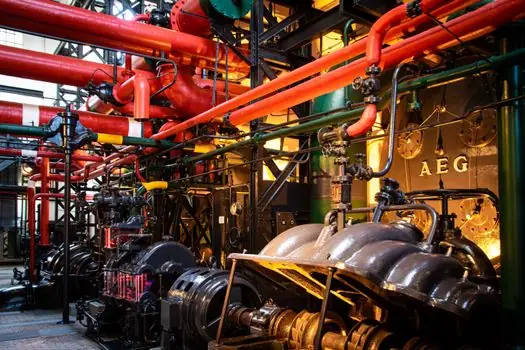
European ductile iron gate valve bodies are typically coated to DIN 3476 part 1 and EN 14901, with GSK (Gütegemeinschaft Schwerer Korrosionsschutz) certification as the quality mark for heavy-duty corrosion protection on potable-water and sewage assemblies [S7]. North American projects layer AWWA C550 (coating), ANSI/NSF 61 (drinking water health effects), and ASTM D2794 (impact) on top of the body standard, which is usually API 600 or ASME B16.34 for steel gate valves and AWWA C500/C509 for iron gate valves [S1][S5].
Note that NSF 61 evaluates only contaminant extraction during a 14-day immersion, not impact, adhesion, or corrosion resistance, so specifying a coating for mechanical ruggedness still requires the buyer to reference AWWA or DIN/EN separately [S5]. For coatings outside the qualified list, the NSF 61 certification of the finished valve is invalidated, which is why most project engineers refuse alternate coating substitutions on potable jobs [S5].
Decision matrix: FBE vs liquid epoxy for gate valve bodies
On a side-by-side basis for gate valve body specification, the comparison runs as follows. Cost per square meter: liquid epoxy is lower, FBE is higher because of oven energy and powder recovery systems. Production uniformity on intricate bodies: FBE is the better choice, liquid epoxy is workable on simple exterior surfaces only. Field repair and touch-up: liquid epoxy is the only practical option, FBE requires a heated substrate and is not field-deployable. Impact resistance per ASTM D2794: FBE rated up to about 160 in-lbs and roughly 2x liquid epoxy [S5]. Surface roughness of cured film: FBE is smoother, liquid epoxy is rougher and can affect seat tolerance [S6]. Specified thickness on AWWA projects: both are applied in the 8-16 mil range in practice, with AWWA minima at 6 mil gate / 8 mil quarter-turn [S5]. Drinking water qualification: both can be qualified to ANSI/NSF 61 if the manufacturer holds the certification [S2][S5].
That matrix points to a clean rule of thumb: specify FBE on new factory gate valve bodies where ovens and powder lines are available, and reserve liquid epoxy for field joints, touch-up, and the exterior of large valves where oven size is impractical. For knife-gate or slurry service, an FBE build is also the right starting point before considering a thicker industrial coating overlay, since FBE is the certified base film under GSK and EN 14901 [S7].
Where each system fails in service
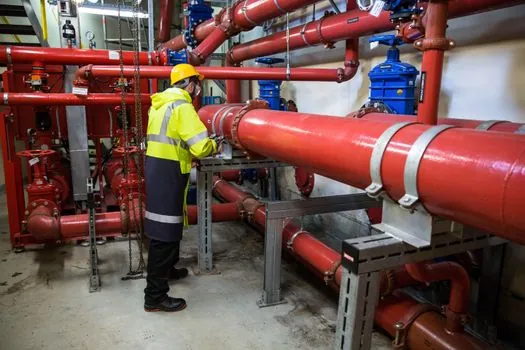
FBE failure modes are almost always upstream of the coating itself: inadequate abrasive blast (below 1.5 mil profile), residual foundry dust, or sharp internal corners that the powder film cannot cover to specified thickness [S5]. Once those conditions are right, FBE holds; when they are not, the failure shows up as localized underfilm corrosion at the sharp-edge site, not as a generalized coating breakdown.
Two-part systems also show a rougher cured finish that can lift the break-away torque on a gate valve stem by a measurable margin compared with an FBE-coated stem [S6]. In both systems, coating thickness gauge verification on the finished body is the practical field check, and is the single test most often skipped on cost-driven projects.
Adjacent systems worth knowing
For buried steel piping alongside the gate valve, FBE on the pipe is the dominant choice for the same three-agent barrier rationale (oxygen, moisture, chloride), and the same powder-application process is used on the pipe as on the valve body, which simplifies qualification [S8]. For above-grade or UV-exposed service, neither FBE nor liquid epoxy is the right answer; a UV-stable waterproof coating topcoat or a polyurethane system is layered over the epoxy base, since standard epoxies chalk and lose thickness under sustained sunlight.
Buyers comparing full valve assemblies rather than just the coating should also look at the seat and trim materials in parallel with the body coating, since a well-coated body with the wrong trim will still fail first. For higher-shock or abrasive service, knife gate valve designs replace the parallel-faced gate entirely and pair FBE bodies with urethane or rubber seats, which is a different selection problem from the coating question but often gets confused in specification.
Trackable signals to watch: AWWA C550 revision activity on holiday-test wording for gate bodies, any GSK guidance update on minimum FBE thickness for DI gate valves, and the next round of EN 14901 amendments for powder coating on water-industry ductile iron components. None of these are scheduled in the public research as of 2026-09-25, but each one will move the FBE-vs-liquid line.
Background reading: Cylindrical vs Prismatic Cell Can and Casing Supply: 2026 Spec Map.