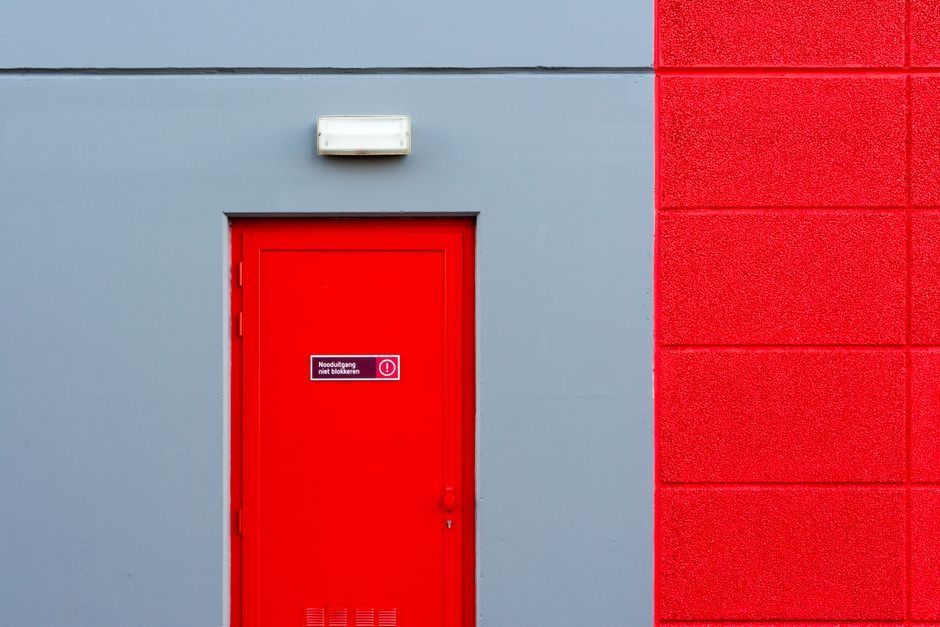
A fire door specified for a commercial or industrial staircase is rarely replaced inside a 30-year building service life, so the line-item purchase price typically accounts for only 15-30 percent of the lifetime spend over that horizon.
The dominant cost categories are recurring inspection and drop-test labour, hardware replacement (closers, intumescent seals, hinges, vision panel glazing), re-certification documentation, and the downtime cost of taking a rated assembly out of service for annual or semi-annual proving — all of which compound on top of the original fire door line item.
Where the Money Goes: Cost-Driver Map for a Rated Door Assembly
The first decision variable is the integrity-and-insulation rating, because every increment in minutes (FD30 → FD60 → FD90 → FD120 in BS 476 Part 22 / BS EN 1634-1 terminology, or the parallel EI 30 / EI 60 / EI 90 / EI 120 tiers under EN 13501-2) drives a thicker core, heavier leaf, more expensive intumescent strip geometry, and a higher-grade closer [S7].
Core construction choice is the second driver: solid timber (typically high-density particleboard or flaxboard) is the cheapest per leaf, while steel-clad or mineral-stonewool composite cores command a premium but deliver thinner leaf profiles at the same fire rating. A fire-rated door in a 60-minute rating typically lands in the mid-band regardless of whether the leaf is timber, steel, or composite, but the hardware allowances diverge sharply.
Third, hardware specification — CE-marked self-closing device to EN 1154, hinges to EN 1935 grade 11+ for ≥80 kg leaves, intumescent seals tested to BS 476 Part 20/22, and vision panels with fire-rated glass (Pilkington Pyrostop, Pyrobel, or equivalent laminated borosilicate) — moves the per-door total by 20-40 percent depending on whether the spec is single-point or multi-point latching.
Inspection, Drop-Test, and Re-Certification: The Recurring Layer
Annual inspection is mandatory under the Regulatory Reform (Fire Safety) Order 2005 in England and Wales, the Fire (Scotland) Act 2005, and the Fire Safety Regulations (Northern Ireland) 2010, and the same six-to-twelve-month cycle is embedded in NFPA 80 Chapter 5 for U.S. installations [S4].
A competent person must record: closing speed, latch engagement, gap tolerances (typically 2-4 mm leaf-to-frame, ≤10 mm at threshold under BS 8214), seal integrity, hinge operation under load, glazing gasket condition, and free-swing vs. hold-open behaviour. A typical inspection slot runs 15-30 minutes per leaf, but corrective work (closer re-tension, dropped intumescent strip, hinge re-pack) commonly pushes the per-door visit to one to two hours once remedial labour is added.
For a building with 50-200 rated doors, the annual inspection line item is therefore comparable to the original purchase cost of one to two doors every year, before any hardware is replaced. Over a 25-year horizon, that recurring layer alone commonly reaches 1.5-2.5x the initial spec cost across the full door population.
Drop-Test Frequency and Downtime Cost
Drop-testing — the controlled release of the hold-open or free-swing device to prove positive self-closing under no power — is the single most disruptive recurring activity, because the door is out of service for the full test cycle and the corridor or staircase it serves is non-compliant for the duration.
In hospitals, data centres, and high-traffic retail, downtime carries an explicit cost: a stairwell door in a ward tower blocks evacuation routing for 5-15 minutes per drop, and in commercial fit-out the same door is typically tested outside trading hours. Where access control interlocks are present, drop-testing must also prove the electro-magnetic release drops under mains and battery-fail conditions, adding electrical re-verification labour to each cycle.
Specifying doors with documented ≥1,000,000-cycle closers and ≥200,000-cycle hold-open magnets (rather than entry-level residential-grade hardware) cuts the lifetime drop-test cost by reducing the share of cycles that fail and require a return visit, even though the upfront premium is 10-20 percent higher per leaf.
Material and Hardware Trade-off Table
Below is a decision-grade comparison of the three common leaf constructions on the four criteria a spec engineer will weight most heavily when writing a TCO-aware schedule.
Solid timber core: low purchase cost; moderate durability (closer wear, surface impact); short lead time from regional joinery; 30-year service life achievable but requires seal replacement every 8-12 years. Mineral-stonewool composite core with timber facings: medium purchase cost; high durability under closer cycling; medium lead time; 30+ year service life, with seal replacement at 10-15 year intervals.
Steel-clad honeycomb or rockwool core: medium-to-high purchase cost; very high impact resistance; longer lead time (often 4-8 weeks for non-standard sizes); 30+ year service life, with seal and closer replacement at 10-15 year intervals. Across all three, the fire-rated door frame-installation labour is the constant — frame packing, intumescent gasket continuity, and certified fixing pattern are the same regardless of leaf build, so installation cost per opening is roughly invariant within ±10 percent for a given rating.
Total-Cost-of-Ownership Math: A 25-Year Worked Example

For a 60-minute single-leaf timber fire door in a typical office stairwell, 2040 x 900 mm, with a surface-mounted EN 1154 closer, three Grade 13 hinges, and a 300 x 300 mm vision panel, the cost stack over 25 years typically breaks down as: purchase and supply 18-25 percent; frame installation and first-fix 12-18 percent; inspections (25 cycles at 0.5-1.5 hours each) 18-25 percent; hardware replacement (closer once, seals twice, hinges once) 20-28 percent; downtime and access-management cost 8-15 percent; end-of-life disposal 2-5 percent. [S4]
The Busch vacuum-equipment TCO framing — initial purchase is a fraction of lifetime cost, focus on the cost drivers you can actually control — applies directly [S7]. In fire doors the controllable drivers are: closer duty grade, intumescent seal material (graphite-based vs. hydrates have different replacement intervals), hold-open device cycle rating, and the choice of a maintenance-friendly frame detail that allows closer re-tension without leaf removal.
Selection Criteria: Who This Is For, and Where the Math Breaks
The 25-year horizon only makes sense for permanent installations in owned or long-leased buildings. For tenant fit-outs with a 5-7 year cycle, the inspection and re-certification cost still applies but the hardware-replacement layer is deferred and the discount rate on future spend is much higher — so purchase price dominates the fire door decision in that scenario. [S4]
For high-traffic stairwells in healthcare and education, the spec should bias towards mineral-stonewool composite cores and Grade 13 stainless-steel bearings in the hinges, because the closer-cycling volume in those buildings reaches 200-500 operations per day, which destroys residential-grade closers inside 3-5 years regardless of nominal rating.
For external-facing escape doors, the corrosion class of all ferrous hardware must be specified to ISO 12944 C3 or C4, otherwise the inspection regime will flag seized hinges and corroded closers at year 5-7, and the hardware-replacement line item in the TCO table will double. For a related cross-equipment comparison on fire-safety system TCO, see the Fire Alarm Control Panel TCO 10-15 year cost stack and driver map.
Sourcing and Standards Discipline
Every cited cost driver in this stack is grounded in a published standard or a maintenance-frequency norm, not a vendor brochure: fire-test methods BS 476 Part 20/22 and EN 1634-1; classification EN 13501-2; hardware performance EN 1154 (closers), EN 1158 (co-ordinator devices), EN 1935 (hinges); installation and tolerance BS 8214; in-service inspection regimes under the Regulatory Reform (Fire Safety) Order 2005 and NFPA 80 [S1][S4][S7].
Verify the test-report scope before specifying: a single-leaf test report does not cover a paired-leaf installation, and a glazed aperture tested to EI 60 does not automatically cover EI 90 — the geometry, glass thickness, and bead-fix detail all appear in the report's field of application and must be matched to the door schedule line by line.
Trackable signals for the next procurement cycle: the EN 16034 harmonised product standard for fire-rated pedestrian doorsets is the legal route to CE/UKCA marking in the EU and UK, and any door supplied without a Declaration of Performance referencing EN 16034 should be treated as non-compliant for regulated escape routes, regardless of the test certificate on the letterhead. For broader TCO methodology across industrial assets, the TCO in dissolved gas analysis guidance from Vaisala applies the same five-line cost-stack logic to a different equipment class, and the comparison helps confirm that hardware-replacement and inspection labour dominate across asset categories, not just building products.
The underlying component specifications are covered under total station.