
Fired clay bricks are not a substitute for the insulated envelope of a modern cold storage warehouse, but they remain a defensible structural and boundary-wall choice, with IS 1077 Class A (above 20 N/mm²) the usual minimum where load-bearing masonry is required [S1].
The decision is not "brick versus panel" but "where fired clay still earns its place and where a PUF or PIR sandwich panel must take over the thermal function", a split clearly visible in Indian industrial practice and material data published through July 2026 [S1][S4][S5].
Why clay brick alone cannot form the cold-room envelope
Clay brick's dry density of 1,800-2,000 kg/m³ is paired with thermal conductivity in the 0.7-1.0 W/m·K band, roughly five to seven times worse than an AAC unit (0.10-0.24 W/m·K) and far worse than the 0.020-0.025 W/m·K typical of a PUF core [S5]. A 230 mm single-leaf clay wall cannot hold a sub-zero box temperature against compressor duty, so any fired-clay wall that touches the cold envelope must be backed by continuous insulation; clay on its own belongs in plinth, partition, and outer-shell roles only [S4][S5].
Where fired clay still earns a place in a cold storage project
Three roles are defensible: the plinth and dock-approach wall (where abrasion and forklift impact rule out foam-faced panels), the firewall separating cold rooms from plant rooms (where IS 1077 Class A masonry gives predictable fire separation), and the site boundary / compound wall (no insulation duty, low cost per running metre) [S1][S4]. For each of these the relevant spec window is compressive strength, water absorption, and efflorescence under IS 3495, with Class AA at above 35 N/mm² reserved for heavy-plinth or load-bearing firewall piers and Class A (above 20 N/mm²) the usual minimum for non-load-bearing plinth and boundary walls [S1].
Spec criteria for fired clay brick in cold-storage service
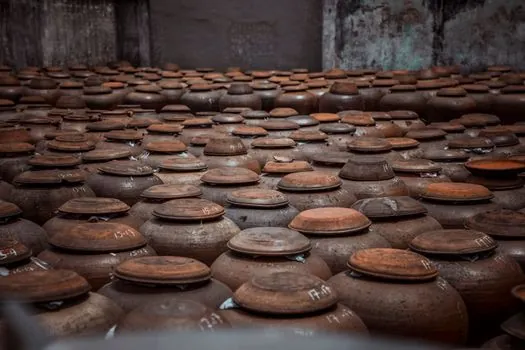
Selection should be driven by four concrete numbers, not brand. Compressive strength, classified under IS 1077:1992 as Class AA (above 35 N/mm²), Class A (above 20 N/mm²), Class B (above 10 N/mm²), or Class C (above 7.5 N/mm²), is the primary structural filter [S1]. Water absorption must read below 20% for Class AA/A and below 20% for Class B/C under IS 3495 Part 2, which is the key moisture control in a humid cold-room plinth where freeze-thaw cycling and condensate can attack the masonry face [S1]. Efflorescence is rated Nil / Slight / Moderate / Heavy / Serious per IS 3495 Part 3, and only Nil or Slight is acceptable for plinth work that will sit under a vapour barrier [S1]. Dimensional tolerance is held to ± 3% of the specified size on length, width, and height per IS 1077 Cl. 5, and warpage is measured per IS 3495 Part 4, since out-of-tolerance units blow out the mortar joint and break the continuity of the outside weather skin [S1].
Comparison: fired clay, AAC, fly-ash, and PUF sandwich for cold-storage walls
On the three variables that matter for a cold-room project, the materials split cleanly. Dry density runs 1,800-2,000 kg/m³ for clay, 1,950-2,050 kg/m³ for fly-ash, 550-650 kg/m³ for AAC, and roughly 35-45 kg/m² for a 50-100 mm PUF sandwich panel [S4][S5]. Compressive strength comes in at 3.5-10.5 N/mm² for clay (class-dependent), 3.5-30 N/mm² for fly-ash (across 10 BIS grade classes), 3.5-5.0 N/mm² for AAC (Grade I minimum 3.5), and is essentially non-structural for a PUF panel which relies on the steel frame for load [S1][S5]. Thermal conductivity is the deciding variable: 0.7-1.0 W/m·K for clay, 0.5-0.8 W/m·K for fly-ash (limited published data), 0.10-0.24 W/m·K for AAC, and 0.020-0.025 W/m·K for a PUF core, which is why PUF panels are the preferred wall for the cold envelope itself and clay is delegated to plinth, firewall, and boundary [S4][S5].
IS 3495 test protocol and what to demand from the lab
Compressive strength testing under IS 3495 Part 1 uses five bricks per lot, with frogs and voids filled with 1:1 cement mortar and cured for 24 hours before crushing, a detail worth pinning in any third-party lab request so the report is comparable across suppliers [S1]. Water absorption under IS 3495 Part 2, efflorescence under IS 3495 Part 3, and warpage under IS 3495 Part 4 should all be on the same test sheet, and the lab should hold NABL TC-14144 / ISO/IEC 17025:2017 accreditation with NHAI / PWD / BRO approval if the project is government-tendered [S1]. Demand the class callout (AA, A, B, or C) on the report itself, not just a single crushing number, since the class determines where the brick can be used structurally [S1].
Where PUF and PIR panels take over, and what to specify there
For the cold envelope, cold-room partition, and clean-room liner, PUF sandwich panels give 0.020-0.025 W/m·K core conductivity, factory-controlled thickness (commonly 50, 80, 100, 120, 150 mm), and the clean finish that pharma, dairy, and frozen-food facilities need [S4]. PIR upgrades fire performance where local codes ask for it. The fired-clay plinth should be designed as a separate element, sized to carry panel base reaction and forklift impact, and detailed with a continuous DPC and a break in the insulation line so the panel does not sit in standing condensate [S4]. For a deeper look at the panel side of that decision, the PUF wall panel comparison for industrial buildings walks through the same density, insulation, and install-time trade-offs.
Common failure modes when fired clay is misused in cold storage
Three patterns show up repeatedly on retrofits. First, clay used as the cold-room wall itself, with no insulation, which forces the compressor to run near-continuously and still loses the temperature band; second, clay used in plinth detail without a vapour barrier break, so condensate wicks into the masonry and lifts efflorescence on the cold face; third, underspecified Class B or C brick used in load-bearing firewall piers, where the IS 3495 Part 1 number on the report never matched the structural drawing [S1][S4]. All three are traceable to a missing test report or a missing class callout, not to the material itself [S1].
Decision framework: fired clay brick in a cold storage project
Use the four-step filter on every wall in the drawing. Step 1: does the wall touch the cold envelope? If yes, specify PUF or PIR sandwich, not clay. Step 2: is the wall structural (plinth, firewall pier, load-bearing partition)? If yes, specify IS 1077 Class A minimum (above 20 N/mm²), or Class AA (above 35 N/mm²) for heavy plinth and high pier loads, with IS 3495 Parts 1-4 test certificates from a NABL-accredited lab [S1]. Step 3: is the wall in a wet or condensate zone? If yes, demand Nil or Slight efflorescence and below 20% water absorption [S1]. Step 4: is the wall a non-insulated boundary, parapet, or screen wall? Clay is usually the cheapest correct answer here, and Class B (above 10 N/mm²) is generally sufficient [S1]. For a parallel decision map on adjacent masonry choices in industrial service, the fired clay brick selection for industrial facilities reference covers non-cold-room plant and warehouse roles. The masonry material itself is described in the fired brick reference page.
Limits of this spec map and what to verify before ordering
The numbers above are drawn from public Indian testing and supplier data published between May and July 2026, and they assume a project in the IS 1077 / IS 3495 jurisdiction; for projects under EN 771-1, ASTM C62, or GB/T 5101 the class bands and water-absorption limits differ, so re-map the acceptance criteria before reusing the values [S1][S5]. No public dataset was found in the research window that ties IS 1077 class directly to cold-room freeze-thaw cycles, so for sub-zero plinth work add a site-specific freeze-thaw check rather than rely on the IS 3495 sheet alone [S1]. Next signals to watch: any BIS revision to IS 1077 water-absorption limits, and any update to IS 3495 Part 4 warpage tolerance, both of which would shift the Class A vs Class AA call for cold-storage plinth work.
The underlying component specifications are covered under storage cage, and storage handling.