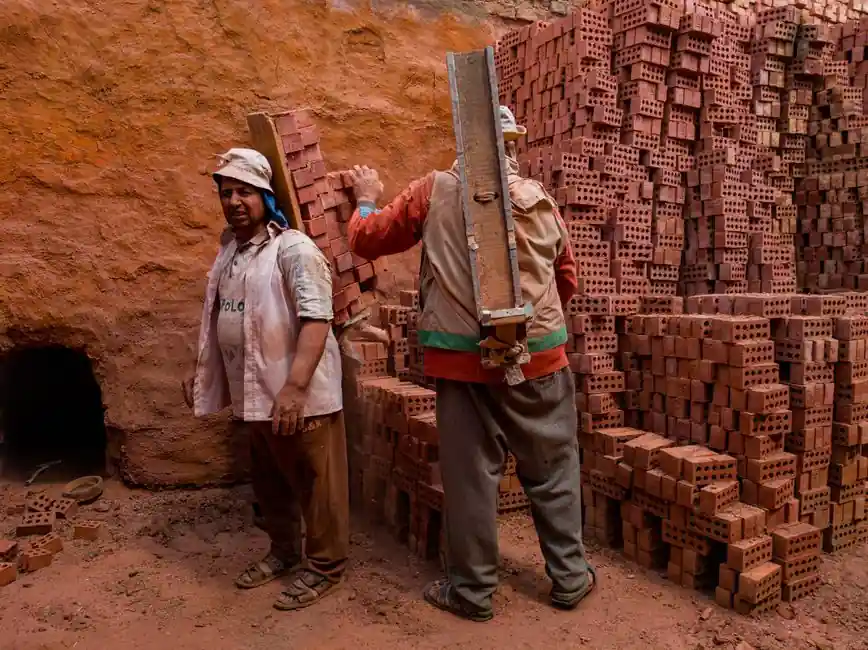
Data center envelopes are pulling fired clay brick into non-residential demand at a 3.18% CAGR through 2031, with clay bricks holding 64.35% of the 2025 global brick market by product type [S3].
Selecting fired clay brick for data center shells is a fire-rating, embodied-carbon, and structural-mass problem, not a decorative one. The 2026 baseline numbers that drive every spec line, kiln firing range 800 to 1100°C, GWP reporting under EN 15804+A2 modules A1–A3, and a global brick market projected to reach USD 2.03 trillion by 2031 at 2.74% CAGR, are anchored below.
Fire Rating and Structural Mass: Why Brick Beats Lightweight Panels for Critical Halls
Data center envelopes are required to resist external fire exposure for 2 to 4 hours on outer walls, and fired clay brick commonly clears that band without intumescent coatings or applied spray [S3]. Fire clay bricks carry 25–45% Al₂O₃ and 50–70% SiO₂, and are designed to operate reliably at temperatures up to 1300–1450°C depending on grade and composition [S5].
Mass matters for blast and forced-entry resilience, not just fire. Dense fired clay masonry contributes passive thermal mass that damps shell temperature swings during generator exhaust events, and the block brick format carries compressive ratings that hollow lightweight panels cannot match on a per-kg basis. For data center perimeter walls, designers typically pair an outer fired-clay wythe with internal mineral-wool or calcium-silicate insulation to hit U-values around 0.35 W/m²·K while keeping the fire-rated mass on the outside. Comparable lightweight partition panels for warehouses, discussed in this spec map, prioritise speed of install over fire endurance, which is the opposite trade-off for a critical facility.
Embodied Carbon and EPD Discipline: The Compliance Lever
EN 15804+A2 requires manufacturers to declare product impacts at module level, and cradle-to-gate modules A1–A3 covering raw material supply, transport to plant, and manufacturing are the minimum declared scope for construction product EPDs [S1]. For data center owners filing under CSRD or SEC climate rules, this module-level data is now a tender prerequisite, not a nice-to-have.
Firing energy is the dominant emissions driver in fired clay brick, and the kiln range 800 to 1100°C sits squarely where fuel choice shifts GWP outcomes [S1]. One practical benchmark shows the value of reuse: reusing a single brick avoids 0.5 kg CO2 versus making a new one, and for a 16,000-brick residential scale this avoids roughly 8 tonnes CO2 [S1]. For hyperscale data centers specifying 200,000 to 1,000,000 facade units, the same unit logic scales linearly and pushes procurement teams to ask for reused or reclaimed units where local supply exists. European producers are simultaneously investing in decarbonised kilns and alternative fuels in response to the Carbon Border Adjustment Mechanism [S3], which means tomorrow's A1–A3 numbers will fall against today's declared values.
Thermal Conductivity: What the Spec Sheet Actually Shows
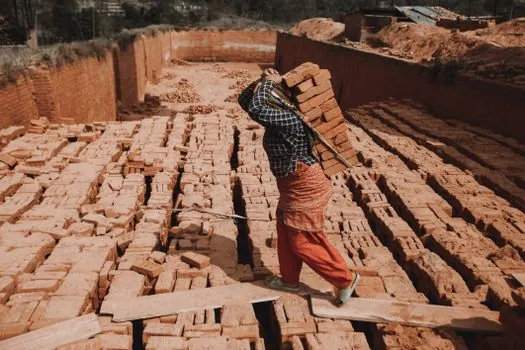
At 20 to 25°C, fire clay bricks typically exhibit thermal conductivity in the range 0.9 to 1.3 W/m·K, with dense grades toward the higher end and porous grades toward the lower end [S5]. This range is why fire clay brick is rarely chosen as a primary insulator; specifiers pair it with a dedicated insulation layer to hit data center wall U-values.
The conductivity-versus-strength trade-off is the operative decision. Fire clay bricks are often selected not because they have the lowest thermal conductivity, but because they offer a balanced combination of structural strength, thermal resistance, durability, and cost [S5]. For a data center wall, that balance resolves as: brick on the outside for fire and mass, calcium-silicate or mineral-wool board on the inside for U-value, with a clear cavity or continuous insulation layer between them. Engineers comparing brick to refractory linings for boiler rooms or generator housings should remember that thermal conductivity should never be evaluated in isolation; thickness, temperature gradient, contact with other refractory layers, and mechanical performance all shift the optimum [S5].
Selection Criteria: Solid Versus Hollow Versus Reclaimed
For data center envelopes, three fired clay formats compete, and the choice pivots on wall function. The criteria-based comparison below lines them up against the four decisions that matter on a tender. [S1]
Solid fired clay brick, in the form covered by the Barcelona tensile test method adapted for solid units, gives the highest compressive and tensile capacity per unit, and is the default for outer wythe and generator-room walls. Hollow clay units, sometimes specified as block brick formats, cut wall weight by 25–40% and improve thermal resistance but reduce fire endurance to a 1 to 2 hour band, which fails some Tier-III and Tier-IV spec lines. Reclaimed brick is the lowest-A1–A3 option when local salvage stock exists, with the 0.5 kg CO2 per reused unit offset and a lower transport footprint if the source site is within 100 km.
The four decision criteria for a data center shell spec are: (1) fire endurance rating in hours, (2) declared A1–A3 GWP per tonne or per square metre of wall, (3) thermal mass in kJ/m²·K against the daily temperature swing, and (4) lead time tied to regional kiln capacity. Solid fired clay wins on criteria 1 and 3, hollow clay wins on criteria 2 (lower transport emissions per square metre) and 4, and reclaimed wins on criterion 2 only when salvage supply is local.
Market Backdrop: Non-Residential Pull and Capacity Constraints
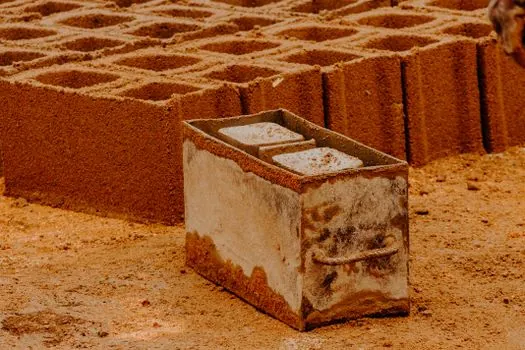
Non-residential construction, including warehouses, data centers, and transport hubs, is outpacing residential activity, with the non-residential segment growing at 3.18% CAGR through 2031 [S3]. The parallel clay-brick forecast projects the segment growing from USD 22.37 billion in 2025 to USD 29.32 billion by 2031 at a 4.61% CAGR [S4].
That growth has a procurement consequence. Direct project-based procurement is accelerating as contractors seek fewer intermediaries, and direct channels are growing at 3.55% CAGR for 2026–2031, the fastest of any distribution channel [S3]. For a data center owner, this means engaging a kiln or regional distributor directly to lock A1–A3 EPD data and to reserve capacity for a 12 to 24 month build window. Asia-Pacific holds 47.30% of 2025 brick revenue and is advancing at 3.30% CAGR through 2031 [S3], so for US and European projects, the local supply base is smaller and tender lead times run longer, which tilts the spec toward lighter hollow formats where solid supply is constrained.
Limits, Failure Modes, and What to Watch
Fired clay brick is not the right wall for every part of a data center. Interior partition walls between hot and cold aisles are served better by lightweight composite panels, covered in this warehouse spec guide, because the operative metric there is speed of install, not fire endurance. Exterior walls in seismic zones also need engineered ties and movement joints every 6 to 9 metres, and fired clay's mass raises the seismic base shear that the structural frame must resist. [S5]
Three failure modes recur in the field: (a) mortar joint carbonation driving efflorescence on north-facing walls, (b) thermal bridging at steel wind columns that bypasses the insulation layer, and (c) A1–A3 GWP values being misread because the declared unit is per brick rather than per square metre of finished wall. Procurement teams should always request the EN 15804+A2 EPD with a square-metre functional unit that matches the wall build-up. Two trackable signals for the next quarter are the publication of revised European kilns' A1–A3 datasets as Carbon Border Adjustment Mechanism reporting matures, and the first wave of reclaimed-brick supply contracts attached to hyperscale build pipelines.
Component reference pages worth checking: data logger.