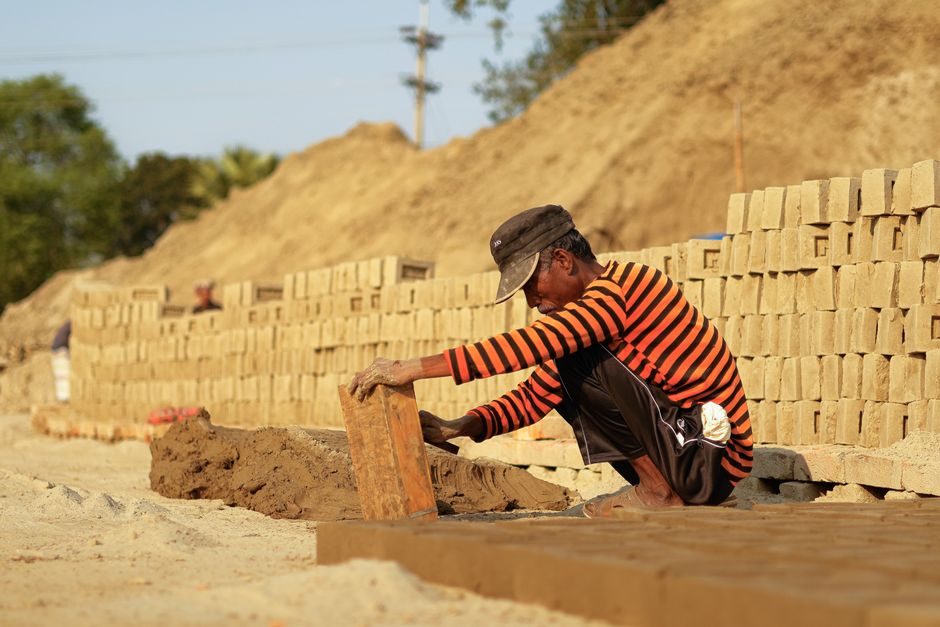
Fired clay bricks are a single product family that splits into sharply different performance classes depending on alumina content, firing regime, and structural form — from 1730 °C refractory fireclay grades with Al2O3 ≥ 40% to load-bearing structural bricks whose compressive strength rises 84% with a 3 wt% steel-filing addition [S2][S3].
The taxonomy covers refractory fireclay (RN-series, 30–55% Al2O3), high-alumina bricks, common burnt-clay structural bricks, and lightweight eco-variants made with agricultural or industrial waste; classification criteria are alumina content, refractoriness, apparent porosity, cold crushing strength, and density [S1][S3][S4].
Classification by Alumina Content and Refractoriness
Refractory fireclay bricks are graded by alumina percentage: low-duty fireclay typically runs 25–30% Al2O3, medium-duty 30–45%, high-duty 45–55%, and super-duty above 55%, with the RN40 grade shown at Al2O3 ≥ 40%, Fe2O3 ≤ 2.0%, refractoriness 1730 °C, and refractoriness-under-load (T0.6) of 1430 °C [S3]. Apparent porosity ≤ 24% and density ≥ 2.15 g/cm³ are typical RN40 acceptance values, while cold crushing strength must be ≥ 28 MPa [S3]. Permanent linear change after 1350 °C × 2 h is held to 0 to −0.3%, which is the value that limits shrinkage cracking in service [S3].
High-alumina bricks extend alumina content beyond the fireclay range, and the same source confirms that high-alumina bricks outperform clay bricks on thermal-shock stability under cycling conditions [S3]. For service above 1300 °C, the RN-series and high-alumina grades dominate; for lower-temperature refractory linings in domestic foundries and heat-treatment shops, conventional fireclay brick is the workhorse.
Classification by Structural Form: Solid, Perforated, Hollow, and Lightweight
Within the broader fired-clay family, common building bricks are subdivided by geometry: solid bricks, perforated bricks, hollow bricks, and porous lightweight bricks — each with a different thermal-conductivity, load-bearing, and mortar-bond profile [S1]. Hollow and perforated brick geometries are documented to reduce thermal conductivity by introducing air voids, with the empty geometry itself being an effective insulator before any additive is added [S1].
Lightweight fired clay bricks are produced by incorporating organic or combustible waste that burns out during firing, generating internal porosity; spent coffee grounds, cigarette butts, recycled paper residues, and olive-mill pomace have all been studied as pore-formers, with thermal conductivity falling as a function of the resulting void fraction [S1]. Such lightweight bricks trade compressive strength for insulation value, and are typically reserved for non-load-bearing partitions where their lower density is an asset rather than a penalty. Structural categories within the broader masonry family — including the related concrete block brick format — sit adjacent to fired-clay products and are specified to different ASTM/EN compression classes.
Mechanical Performance and the Effect of Waste Additives
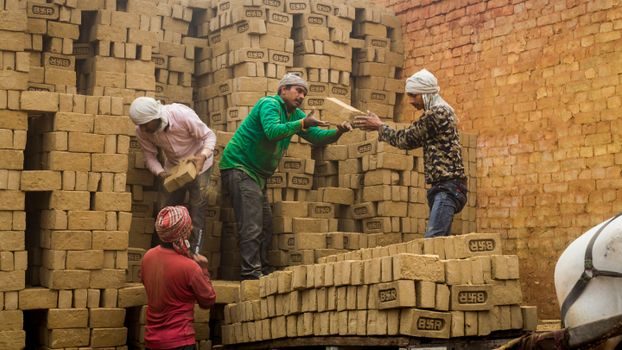
Adding 1, 2, 3, and 4 wt% blacksmiths'-workshop steel filings to a red clay mix and firing prototype bricks produced a monotonic increase in compressive strength with addition rate, peaking at an 84% strength gain over the control mix at the 3 wt% steel-filing level [S2]. The same study reports that dimensions, weight, density, and water absorption were measured before and after addition, with the result that strength gains did not come at the cost of geometric stability [S2]. This places 3 wt% metal-filing addition in the range that practising engineers cite as the practical optimum for load-bearing-wall applications in low-cost housing [S2].
Eco-formulated bricks using agricultural solid waste (oat hulls and similar grain-processing residues) have been investigated as a parallel route, where the waste acts partly as a pore-former and partly as a combustion aid during firing [S4]. The general review by Muñoz et al. notes that mechanical, physical, and thermal properties are highly sensitive to both additive type and firing procedure, and that many published lab results do not yet meet industrial standards — a caveat that applies to nearly every waste-additive brick currently in the literature [S6].
Thermal and Durability Properties by Class
Fireclay bricks are characterised as dense shaped refractory material with high refractoriness, high mechanical strength, low thermal conductivity, and excellent thermal-shock resistance, making them the default lining for industrial furnaces, kilns, and thermal equipment [S5]. Thermal expansion at 1000 °C for the RN40 grade is 0.6%, a value that must be matched by expansion-joint design in masonry assemblies exposed to cycling service [S3].
For insulation-class lightweight bricks, the same low thermal-conductivity property is the design driver, while refractoriness is by definition lower than for the dense fireclay grades; the two product families do not substitute for each other and are specified against different design codes [S1][S5]. Comparison summary across the main classes:
• Fireclay RN40 (Al2O3 ≥ 40%): refractoriness 1730 °C, RUL 1430 °C, density ≥ 2.15 g/cm³, CCS ≥ 28 MPa — used in blast-furnace stacks, cement preheat zones, coke ovens, glass-tank insulation [S3].
• High-alumina (Al2O3 > 55%): higher refractoriness and better thermal-shock cycling than fireclay — used where fireclay service life is marginal [S3].
• Common burnt-clay structural brick: standard masonry units, Egyptian production size 25 × 12 × 6.5 cm, load-bearing capability sensitive to firing temperature and additive [S2].
• Waste-additive structural brick: +84% compressive strength at 3 wt% steel filings; agricultural-waste variants trade strength for lighter weight and lower conductivity [S2][S4].
• Lightweight eco-brick: lowest density and lowest thermal conductivity in the family, designed for non-load-bearing partition walls [S1].
Application Mapping and Service Limits
RN40 fireclay brick is specified for throat, stack, hearth, and bottom zones of blast furnaces; for carbon-baked furnaces in the alumina industry; for preheat zones and cyclones of rotary cement kilns; for glass-tank insulation, coke ovens, reheating furnaces, suspended roofs, lime kilns, and chimney linings [S3]. The combination of low Fe2O3 (≤ 2.0%) and apparent porosity ≤ 24% is what lets RN40 resist carbon deposition in blast-furnace blowholes, where iron-rich grades would spall [S3].
Service limits are tied to refractoriness-under-load: an RUL of 1430 °C means RN40 should not be specified for continuous service above roughly 1400 °C under load, which is the practical ceiling that pushes designers toward high-alumina or chrome-bearing grades for hotter zones [S3]. For structural applications, the failure mode is not thermal but mechanical — the 84% strength gain at 3 wt% steel filings is significant for low-cost housing, but scaling from lab prototypes to production kilns typically degrades that gain by a measurable margin, an issue that the review literature flags as unresolved [S2][S6].
Standards, Sourcing Signals, and Selection Guardrails
Refractory fireclay bricks are typically supplied against ISO 2245 (shaped refractory bricks), ASTM C27 (fireclay refractories), and equivalent GB/T 4414 grades; structural clay bricks are specified under ASTM C62 (building brick), ASTM C216 (facing brick), and EN 771-1, with the Euroclass fire reaction sitting at A1 without further treatment [S3]. Selection guardrails from the research: verify Al2O3, Fe2O3, apparent porosity, and CCS together rather than relying on a single property, and require test data at the project's actual service temperature rather than at room temperature [S3].
Trackable signals for 2026 sourcing: fireclay-brick pricing on the public CNBM / OKorder catalogue for RN40 sits in a $194.77–$238.05 per metric-ton range on a 5-ton minimum order with 1000 t/month supply capability, FOB China main port, and TT or L/C terms — a benchmark that engineers can refresh against the live listing before issuing a PO [S3]. Watch also for ISO 2245 and ASTM C27 revision drafts in 2026–2027, and for any move by the Egyptian and South Asian structural-brick industries to publish standardised recipes for steel-filing and agricultural-waste additive mixes at industrial (not lab) scale [S2][S4].
Spec-level background on the components involved: pressure transmitter.
See also our earlier report, Laser Screed Installation Guide: Sub-Base, Calibration, and Pour Sequence.