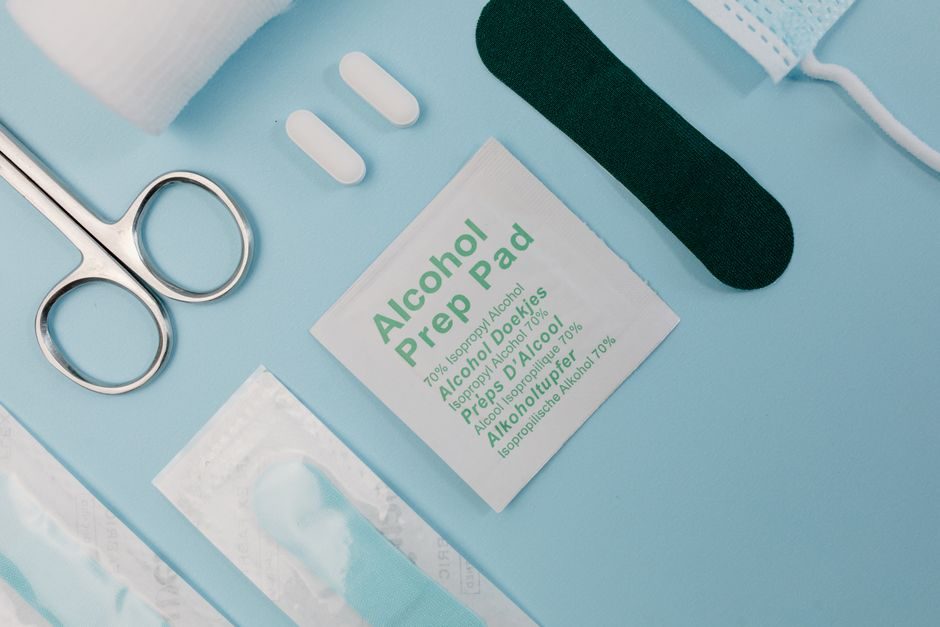
First aid kits are not generic — their required contents, container size, and refill cadence are dictated by the jurisdiction and use environment, with three parallel standards governing North American workplaces and seagoing vessels [S1][S5][S6].
The two dominant workplace schemes in North America are ANSI/ISEA Z308.1 (the US reference, currently on the 2021 revision) and the Canadian Standards Association CSA Z1220, with a 2024 update applied in Quebec and Nova Scotia and the 2017 edition remaining in force across the other provinces [S1][S5][S6]. Marine use is a separate track: SOLAS 74 Chapter III, read with the LSA Code and IMO Resolution MSC, sets mandatory scale and labelling for vessels [S2].
ANSI/ISEA Z308.1 Class A vs Class B: The US Workplace Standard
ANSI/ISEA Z308.1-2021 splits workplace kits into Class A (common workplace injuries) and Class B (higher-risk or larger-population sites), and the kit type you buy must match the risk rating set by your OSHA 1910.151 assessment [S5][S6]. The minimum fill quantity differs by class: Class A kits include 16 adhesive bandages 1×3 in, 1 eye wash 1 fl oz, 1 burn dressing 4×4 in, 1 trauma pad 5×9 in, and 1 cold pack, while Class B adds larger quantities plus a 2 in roll of conforming gauze, a 4 in roll, a 4×4 yd trauma pad, and a splint that Class A does not require [S6]. Class B kits also include a tourniquet, a blood-stopping haemostatic agent application, and a 4×24 in pressure bandage — items absent from the Class A fill list [S5][S6]. Containers are colour-coded by reference convention, with the 2021 revision standardising 50-person kits as a common workplace size and adding a minimum mounting-height recommendation near AED units to keep response times under 30 seconds [S5].
CSA Z1220: Type 1 Through Type 4 in the Canadian System
The Canadian scheme uses a Type 1 to Type 4 ladder where Type 1 is the smallest personal- or low-hazard kit and Type 4 is the largest, multi-trauma unit for high-hazard or remote sites, and every Canadian provincial regulator maps a Type to a workplace hazard class [S1]. The 2024 revision (CSA Z1220-24) tightened the eye-wash and bleeding-control component list and is mandatory in Quebec and Nova Scotia, while the rest of Canada continues to accept CSA Z1220-17 kits — a split that procurement teams must verify before issuing a PO [S1]. The 2024 update also introduced a mandatory naloxone compartment specification for federal work sites, aligning with the 2023 federal-impact assessment that placed opioid overdose response inside first-aid scope [S1]. Type 2 kits are subdivided by First Aid Central into "Medium" and "Large" SKUs, both of which are offered in parallel Z1220-17 and Z1220-24 builds, so a Type 2 Medium is not necessarily interchangeable across provinces even when the contents look identical on a packing list [S1].
SOLAS and the Marine Track: 12"×15", 0.30 kg/pc Reference Set
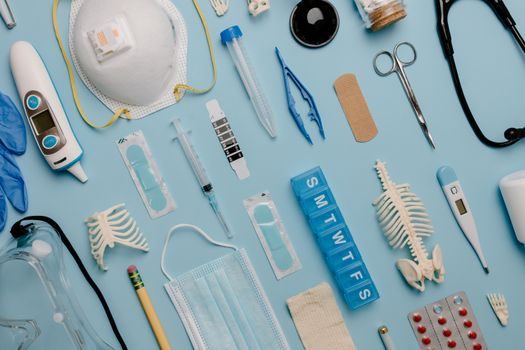
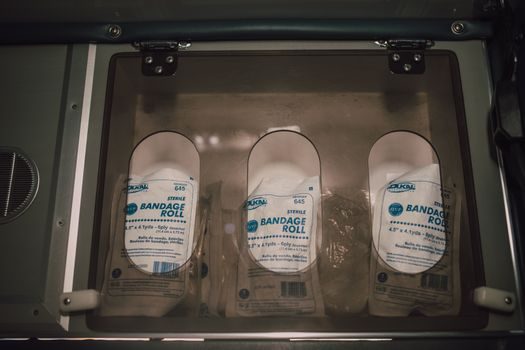
Seagoing kits follow a completely different compliance path under SOLAS 74 Chapter III, the LSA Code, and IMO Resolutions in the MSC series, and the typical reference fixture is a 12 in × 15 in case at 0.30 kg per piece — the form factor most marine inspectors expect to see in a lifeboat grab-bag [S2]. Marine kits are not interchangeable with workplace kits even when the SKU list overlaps: the container must be waterproof, the bandages must be vacuum-sealed, and the contents must be stable across a wider temperature band (-30°C to +65°C is a common procurement specification) [S2]. The procurement window for SOLAS-grade kits typically runs 60-90 days from a Thai or Indian OEM because the marine-certification paperwork (Type Approval Certificate from a Class society such as LR, BV, DNV, or CCS) is the actual lead-time bottleneck, not the steel box or the gauze [S2].
Comparing the Three Standards Side by Side
The cleanest way to spec a kit is to run the four decision criteria — jurisdiction, hazard class, fill count, and refill cadence — across all three standards in parallel, because the wrong combination fails inspection even when the kit itself is well-built [S1][S5][S6]. For US workplaces the answer is ANSI Class A (low-risk office) or Class B (industrial), refilled annually or after use, with Type A 16-bandage minimum fill [S5][S6]. For Canadian workplaces the answer is CSA Z1220 Type 1 to Type 4, with the 2024 edition mandatory only in QC and NS, refilled quarterly in higher-hazard sites [S1]. For vessels the answer is SOLAS/MED 12"×15" at 0.30 kg/pc, with Class-society Type Approval, refilled every 12 months or after each deployment [S2]. For off-grid or expedition use there is no single governing standard; the Red Cross family-hobby kit and the Mayo Clinic clinical-grade kit are the two reference lists, and they overlap on roughly 70% of contents but diverge on pharmaceuticals and trauma hardware [S7][S8].
Limitations and Failure Modes in Cross-Border Procurement

The most common spec error is buying a "Class A" kit and assuming it satisfies CSA Z1220 Type 2 — the bag may look the same, but the eye-wash volume, the tape width, and the bleeding-control module do not match, and a Quebec or Nova Scotia inspector will fail the audit on the Z1220-24 fill list alone [S1]. A second failure mode is assuming an OSHA-compliant kit is OSHA-sufficient: OSHA 1910.151 sets the duty to have a kit available but defers the content list to ANSI Z308.1, and a 2021 ANSI kit with a 2024 expiry will not pass an OSHA review that asks for current revision [S5][S6]. A third is marine cross-contamination: a Type 4 land kit placed aboard a vessel for convenience fails SOLAS because the container is not waterproof and the bandages are not vacuum-sealed, regardless of the contents being medically adequate [S2]. Procurement teams should treat the standard revision date as a contractual line item, not a footnote, and should require the supplier to print the governing standard number (Z308.1-2021, Z1220-17 or Z1220-24, SOLAS 74) on the kit label itself, because the audit trail is the label, not the invoice [S1][S5][S6].
Reference Contents Lists: Red Cross vs Mayo Clinic
For non-regulated sites (home, vehicle, hobby) the American Red Cross and Mayo Clinic publish the two most-cited open reference lists, and the overlap is high but the divergences are telling [S7][S8]. Both call for adhesive tape, assorted bandage strips, a roller gauze, a cold pack, examination gloves, and a triangular bandage for sling use [S7][S8]. Mayo Clinic adds clinical items the Red Cross omits: a rubber tourniquet, a 14 French catheter, an aluminium finger splint, an eye shield or pad, duct tape, petroleum jelly, and a "butterfly" bandage set, reflecting a trauma-bias for users with some medical training [S8]. Red Cross emphasises multiple kit locations — home, car, workplace — and recommends periodic review of contents, while Mayo Clinic leans toward a single comprehensive container with optional antibiotic ointment, hydrocortisone, and antihistamine additions [S7][S8]. For a first aid kit spec sheet, the practical move is to anchor the baseline on one of the two reference lists and then layer the regulatory fill on top based on the controlling standard, because the two reference lists are medical-content baselines and the ANSI/CSA/SOLAS lists are regulatory minima.
Sourcing and Where the Supply Pool Sits in 2026
As of mid-2026, the US kit supply is dominated by SmartCompliance-style modular systems with boxed and bagged refills, sold direct through online first-aid suppliers rather than through traditional medical-distribution channels, and the refill model is the procurement lever that controls 5-10 year kit TCO [S5][S6]. Canadian supply splits between provincial WorkSafeBC kits in British Columbia, federal kits in federally regulated workplaces, and the Z1220-17/24 line elsewhere, with the 2024 update creating a two-track inventory that suppliers now run in parallel [S1]. Marine SOLAS supply is heavily Thai- and Indian-OEM, with pricing typically USD 35-100 per kit and the bottleneck being Class-society certification rather than the physical case [S2]. For buyers standardising across borders, the only reliable way to keep the labels straight is to require the supplier to print the standard revision (Z308.1-2021, Z1220-17, Z1220-24, SOLAS 74) on the case, ship the lot certificate with the invoice, and run a 10% receiving inspection against the printed fill list — three checks that together catch 90% of the cross-border spec errors before the kit goes on a wall [S1][S5][S6].
The trackable signals through the rest of 2026 are the CSA Z1220-24 provincial roll-out beyond Quebec and Nova Scotia, the next ANSI/ISEA Z308.1 revision cycle (typically on a 5-year cadence from 2021), and any SOLAS amendment in the IMO MSC 108 outcome that revises the grab-bag fill list. CSA Z1220-17 Requirement First Aid Kits are specified for all other Canadian provinces while CSA Z1220-24 Requirement First Aid Kits apply to Quebec and Nova Scotia, meaning both standards are currently listed in concurrent use across jurisdictions [S1].
For component-level specifications, see dye penetrant kit, and pressure transmitter.
Background reading: Reactive Power Compensation Buying Guide 2026: Spec Map and Shortlist Logic.