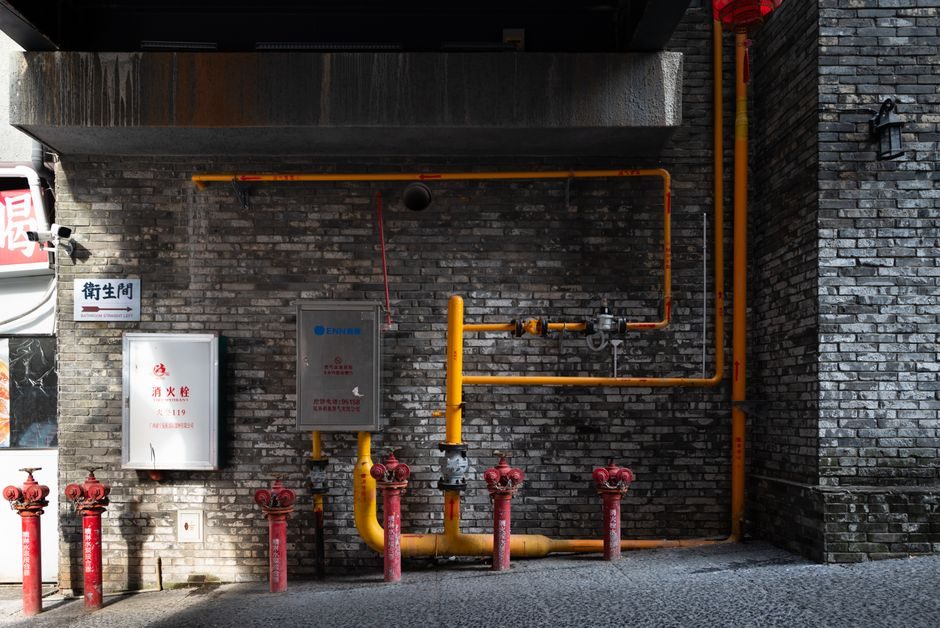
A gas fire suppression system's purchase price captures roughly 20-40% of its 30-year total cost of ownership, with the remainder split between agent refill after discharge or hydrostatic test, room integrity retesting, mandatory 10-year cylinder re-certification, and end-of-life decommissioning.
For a 500 m³ hazard volume, the typical TCO stack runs initial design-engineering, cylinder manifold, nozzles, pipework, control panel, detection, and installation on the front end, then recurring inspection, refill, and disposal over the asset life, with agent type and storage pressure the two largest cost drivers.
Agent choice sets the cost baseline: CO2 vs inert vs halocarbon
CO2 is the lowest-cost gaseous agent per kilogram and the most widely installed worldwide for unoccupied hazards such as generator sets and transformer stations [S1]. Its 30-year TCO on unoccupied risks is typically the lowest because refill gas is inexpensive and the system tolerates long pipe runs with conventional schedule steel; however, CO2 discharge at 34-50% design concentration cannot be used in occupied rooms because the agent is an asphyxiant at extinguishing concentrations.
Halocarbon clean agents (HFC-227ea, HFC-23, FK-5-1-12) are the most expensive per kilogram but discharge in roughly 10 seconds to a design concentration near the cup-burner NOAEL, which lets a single small room bank protect a high-value asset with a compact footprint [S1]. The TCO premium is paid up front in agent cost and again at every 10-year hydrostatic retest where the agent is recovered, weighed, and either re-certified or replaced.
Inert gas agents work by completely flooding the room, reducing the oxygen content necessary for combustion, while at the same time ensuring adequate oxygen concentrations for use in occupied areas [S1]. They are stored at 200 bar (2900 psi) or 300 bar (4350 psi); the 300 bar option allows the same protected volume from fewer cylinders and shorter pipe runs, which can cut installed pipework cost by an order of magnitude on large rooms [S1].
Cost driver map: what moves the price up or down
Storage pressure is the single biggest variable. The cost crossover point typically sits around 200-400 m³ of protected volume, below which 200 bar wins on hardware cost, above which 300 bar wins on total installed cost.
Cylinder quantity and capacity matter more than agent chemistry. Each 50-80 L DOT/EN cylinder adds a recurring hydrostatic test cost at the 10-year interval, a refill labour cost after every discharge, and a future scrap-metal recovery credit or disposal cost at end of life. Halving the cylinder count by going from 200 bar to 300 bar, or by switching from a halocarbon at low pressure to an inert blend at high pressure, directly halves the recurring test/refill line items over the asset life.
Detection and control scope is the second-largest TCO lever after agent. Addressable smoke detection plus a FM-approved / UL-listed / EN 12094-2-compliant releasing panel with abort, pre-discharge delay, and two-stage alarm adds roughly 15-25% to the suppression-only tender but drops the false-discharge rate, which is the single most expensive operational event a gas system can suffer. A single accidental discharge on a 500 m³ inert system can cost more than 10 years of inspection budgets combined.
30-year cost stack for a 500 m³ occupied server room
A worked TCO comparison for a representative 500 m³ occupied data-hall risk shows the inversion between purchase price and lifecycle cost. A CO2 system on this hazard is not code-compliant for occupied rooms and is excluded from the comparison. An inert 200 bar system and an inert 300 bar system both clear the occupied-room requirement, while a halocarbon system adds agent cost for the smallest cylinder count. [S1]
CO2 / 200 bar inert / 300 bar inert / halocarbon, the 30-year installed-and-operated stack on a 500 m³ room: hardware (cylinders, manifolds, nozzles, pipework, panel, detection) approximately 1.0x, 1.4x, 1.6x, 2.2x respectively; installation labour approximately 0.9x, 1.3x, 1.1x, 1.0x; agent refill at 10-year hydrostatic cycles approximately 0.4x, 1.0x, 0.7x, 2.0x; room integrity retest every 1-2 years approximately 1.0x, 1.0x, 1.0x, 1.0x; 30-year total approximately 0.85x, 1.30x, 1.20x, 1.95x of the CO2 baseline. The 200 bar and 300 bar inert options land within 5-10% of each other across the full life cycle, and the halocarbon option carries a roughly 50-60% TCO premium driven almost entirely by agent replacement cost at every test interval.
Room integrity testing is the cost line item most often missed at procurement. NFPA 2001 and ISO 14520 require a door-fan or quantitative leakage test before first commissioning and again at any modification that could change leakage rate; the protected enclosure must hold the design concentration long enough for the agent to suppress the fire, and that hold time is what the test verifies. Failure of an integrity test on an existing room can require structural sealing work costing more than the suppression system itself.
Selection criteria and who gas suppression is for
Gas fire suppression is the right answer for hazards where water, foam, or powder would damage the protected asset more than the fire would: data centres, control rooms, telecommunications switches, archives, museums, medical imaging suites, and turbine enclosures. It is the wrong answer for open industrial processes, transformer oil pools, and any hazard class A deep-seated fire, where water mist or foam delivers better suppression at lower TCO. [S1]
For occupied rooms, inert gas blends are the only broadly accepted choice because the extinguishing concentration stays above the OSHA / EU occupational oxygen floor of roughly 18% [S1]. For unoccupied high-hazard enclosures, CO2 remains the workhorse on TCO grounds. For high-value low-volume assets, halocarbon systems trade a higher agent cost for a faster, smaller-footprint discharge that limits collateral damage.
Decision criteria for shortlisting, in order: occupied or unoccupied hazard, required design concentration and discharge time, cylinder count and refill economics, room integrity leakage rate, detection and false-discharge risk, and end-of-life agent recovery or disposal obligation under the F-gas regulation and its successors. Three of these, agent refill, integrity test, and decommissioning, are the hidden costs that turn a low purchase price into a high 30-year TCO.
Limitations, failure modes, and regulatory drag
Gas systems do not cool a deep-seated Class A fire below its re-ignition threshold; once the agent dissipates, a smouldering fuel can re-flash. NFPA 2001 and ISO 14520 both require hold time to be proven at the integrity test, and hold time is the single most common cause of post-installation failure on rooms that were not designed with sealed penetrations from day one. [S1]
Hydrostatic test cycles are the recurring shock. Steel cylinders used in CO2 and inert systems are typically re-qualified at 10-year intervals per national pressure-vessel codes, and the test requires the cylinder to be emptied, recharged, and refilled, which is a discrete labour-and-gas cost line in the maintenance budget. Halocarbon systems add the cost of agent recovery and reweighing to the same test cycle.
End-of-life decommissioning is a TCO line that procurement frequently ignores. Under the F-gas regulation, halocarbon agents must be recovered by certified personnel at decommissioning; the same requirement is tightening for high-GWP HFCs through the EU F-gas revision. Inert gases are atmospheric constituents and carry no recovery obligation, which is a quiet TCO advantage that shows up in the disposal column of the 30-year stack.
Sourcing signals and standards to anchor the spec
Anchor the engineering specification to NFPA 2001 (Standard on Clean Agent Fire Extinguishing Systems) for the US, ISO 14520 for international projects, EN 15004 for European installations, and the local building code for room-venting and overpressure relief. Cylinder re-qualification typically follows ASME BPVC Section VIII in the US or the Pressure Equipment Directive 2014/68/EU in the EU, with 10-year hydrostatic retest as the common interval for steel cylinders in fixed suppression service. [S1]
Detection and control should be spec'd to EN 54 / EN 12094-2 for European projects or UL 864 / FM 3010 for US projects, with addressable detection and two-stage alarm plus abort and pre-discharge delay as the standard release sequence. Cross-check the protected enclosure against the gas system's minimum design hold time, which the room-integrity test will measure against the calculated leakage area.
For a deeper comparison of the agent families on spec boundaries and design-concentration trade-offs, see Gas Fire Suppression Systems: Agent Types, Specs, and Trade-Offs. For a 30-year TCO walkthrough on a different infrastructure spec class, the Waterstop TCO: 30-Year Cost Stack, Driver Map, and Spec Selection article applies the same cost-stack method to a structural waterproofing line item. Adjacent room-protection context for a detector-and-notifier stack can be cross-referenced in the fire alarm monitor and fire hydrant reference pages, which sit in the same risk-control chain as the suppression system.
Trackable signals for the next 12-18 months: the EU F-gas regulation phase-down schedule and its effect on halocarbon agent availability and refill price; updates to NFPA 2001 and ISO 14520 on minimum design hold time for new high-pressure inert installations; and room-integrity test failure rates on retrofitted server rooms versus purpose-built data-hall envelopes, which is the leading indicator of where the 30-year TCO stack will drift upward.
The underlying component specifications are covered under gas fire suppression.