
Fixed gas detectors are point-mounted, loop-powered safety instruments that continuously measure a target gas concentration and translate it into a 4-20 mA, Modbus RS-485, or relay output for the plant's control or alarm system [S1][S3]. The ATO GD300-NH3, for example, ships as a fixed ammonia (NH3) detector with selectable 0-50 / 0-100 / 0-200 ppm ranges at a $754.13 SKU price point (2026-07-08) [S1]. The KELISAIKE K800, a UL-ATEX approved explosion-proof unit, is offered in 2-, 3- and 4-wire formats with 4-20 mA and RS-485 Modbus output, and ships with built-in alarm and fault relays (2026-06-08) [S3].
Whether the site is an offshore FPSO, a refrigerant plant, a municipal water works or a battery room, the engineering steps to a clean commissioning are the same five gates: gas/range, sensor chemistry, output protocol, hazardous-area certification, and physical mounting + bump-test cadence [S2][S4][S5]. Get any of those wrong and the detector either never trips, trips late, or trips constantly and gets bagged over with a plastic bag by an annoyed operator.
Gate 1 — Target Gas, Range, and Cross-Sensitivity: Pick the Sensor for the Molecule
The first citable rule is that the sensor family must be matched to the target gas's electrochemical or combustion behaviour; a combustible-gas pellistor will not resolve a 10 ppm chlorine leak, and an electrochemical CO cell will not respond to a methane cloud [S2]. Crowcon's fixed-portfolio is structured around hazard families — methane, hydrogen, chlorine, hydrogen sulphide, ammonia, carbon monoxide, oxygen, carbon dioxide — each with its own dedicated sensor and instrument line (2025-06-18) [S2]. The ATO GD300-NH3 is offered specifically for NH3 with three range options (0-50, 0-100, 0-200 ppm) because ammonia has both a 25 ppm TLV and a 300 ppm IDLH bracket that demand different span choices [S1].
For combustible gases, the LEL fraction of the LFL is the spec that drives the detector's range — a typical catalytic-bead or NDIR unit is set to 0-100 % LEL, with the 4-20 mA loop mapping 4 mA = 0 % LEL and 20 mA = 100 % LEL [S3]. For toxic gases, IDLH and TLV/TWA values are the bracket that sets the range, and cross-sensitivity tables (e.g., an H2S cell's response to NO2, or an electrochemical H2 cell's response to CO) are the hidden trap on retrofits. Crowcon's gas-hazard library and Dräger's hospital and industrial fixed-detection solution pages both organise sensor selection by hazard, not by detector model (2026-05-26) [S5].
Gate 2 — Output Protocol and Wiring Topology: 2-, 3-, 4-Wire and Bus Choices
Fixed detectors wire to a controller as either 2-wire loop-powered, 3-wire, or 4-wire devices, and the topology changes both the cable spec and the panel-side input card [S3]. The KELISAIKE K800 explicitly supports all three (2, 3, 4 wires) and exposes 4-20 mA plus RS-485 Modbus in parallel, with onboard alarm and fault relays for direct horn/fan switching (2026-06-08) [S3]. A 2-wire device shares power and signal on the same pair, runs at 16-30 VDC loop supply, and is the lowest-cable option for toxic-gas and oxygen detectors [S3]. A 4-wire device separates power and signal, and is the topology most commonly used for catalytic-bead combustible detectors that need heated-element current.
On the bus side, RS-485 Modbus RTU remains the workhorse for multi-dropping up to 32 or 64 detectors per trunk over shielded twisted pair [S3]. HART overlays a 1.2/2.2 kHz FSK signal on top of a 4-20 mA loop, so a HART detector still needs the analog 4-20 mA wiring — it does not replace it. Foundation Fieldbus and PROFIBUS PA are fully digital protocols that replace 4-20 mA; the engineering decision is whether the host DCS has FF/PA cards or whether the project will accept 4-20 mA + Modbus as the integration point. For offshore FPSO applications, Gastech's engineering content emphasises detector-to-controller signal integrity and segregation, not the brand of the bus protocol (2026-07-11) [S4].
Gate 3 — Hazardous-Area Certification: ATEX/IECEx vs UL/NEC Classes
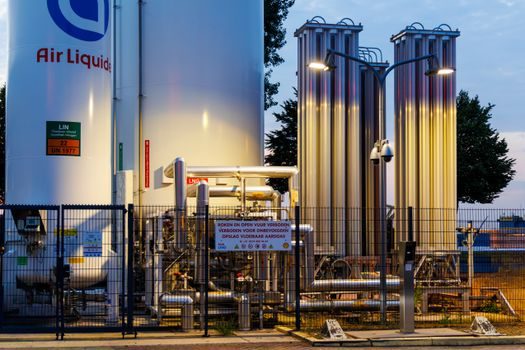
Fixed detectors installed in a hazardous area must carry a zone- or class-rated certification, and the certification must match both the gas group and the temperature class of the worst-case gas that could be present [S3][S5]. The K800 ships with both UL and ATEX explosion-proof approvals, which lets a single SKU cover a European Zone 1 install and a US Class I Division 1 install without a parallel model (2026-06-08) [S3]. Dräger's fixed gas detection solution set is similarly zoned, with detector families that target Zone 0/1/2 and Class I Div 1/2 deployments (2026-05-26) [S5].
The two certification systems do not map 1:1 — ATEX categorises equipment as Category 1, 2, or 3 for Zones 0, 1, 2, while UL/NEC classifies as Class I Div 1, Class I Div 2, and the older Zone system under NEC 505/506. A detector certified to ATEX Ex db IIC T6 is rated for hydrogen-group gases up to 85 °C surface temperature; the same detector in a UL Class I Div 1 Group B/C/D listing is rated for the equivalent US gas groupings. For an offshore FPSO, the engineering specification usually requires both IECEx and ATEX so the same bill of materials is valid on the UK Continental Shelf, the Norwegian sector, and the Mediterranean (2026-07-11) [S4]. For a US refinery, UL Class I Div 1 is the non-negotiable baseline.
Gate 4 — Mounting Height, Density and Diffusion vs Pumped Sampling
Mounting height is set by the molecular weight of the target gas relative to air, and it is the single most-committed-to-but-least-respected error on site [S2][S4]. Hydrogen (MW 2) and methane (MW 16) both rise, so detectors sit at ceiling level or in the high-vortex zone; chlorine (MW 71), sulphur dioxide (MW 64), and most heavier-than-air refrigerants sit at floor level or in low-point sumps. Ammonia (MW 17) is effectively a neutral-buoyancy gas and is normally specified at the breathing zone, around 1.5-1.8 m, but plant practice often adds a second detector at ceiling for the immediate leak-source cloud [S2].
Diffusion-style sensors need a defined air path — Crowcon's fixed-system guidance and Gastech's offshore-FPSO article both call out that the detector head must be in the gas cloud, not shielded behind a beam, cable tray, or process pipe [S2][S4]. For confined-space or sample-line applications, a pumped-aspirated detector or a remote-mounted sensor with a sample draw tube is the alternative. The pump or sample line adds a transport delay (typically 5-30 s) and a filter that needs scheduled replacement, which feeds into Gate 5's calibration/bump-test cadence [S2].
Gate 5 — Calibration, Bump-Test and Functional-Test Cadence

Most fixed gas detectors require a span calibration every 3-6 months and a bump test (functional gas exposure) before each shift, batch, or confined-space entry — and this is the gate that decides whether the detector is still a safety instrument in year 5 or just a green LED on a wall [S2][S4]. Electrochemical toxic-gas cells (NH3, H2S, CO, Cl2) typically have a 2-3 year expected service life and drift on a monthly basis, so periodic span calibration against a certified gas cylinder is non-optional. Catalytic-bead LEL sensors lose sensitivity to poisons like silicones, lead, and sulphur and need bump testing with methane or pentane at 50 % LEL [S2].
Dräger and Crowcon both publish recommended bump-test and calibration intervals in their fixed-system documentation, and the 10-year TCO model for the upstream gas alarm controller is driven largely by sensor-replacement and calibration-gas consumption, not by the initial capex of the controller itself [S2][S5]. For an offshore FPSO, the documentation chain is unusually heavy: every detector's calibration certificate, bump-test record, and sensor-replacement log must be auditable to the asset-management system (2026-07-11) [S4].
Selection Comparison: Which Detector Profile Fits Which Plant
Three discrete profiles cover the majority of fixed-detector installations in 2026. (1) The toxic-gas-only plant — a refrigeration hall, water-treatment chlorination room, or battery room — uses an electrochemical fixed unit with 4-20 mA + relay, e.g., a 0-50/100/200 ppm NH3 detector, $754.13 SKU price, 2-wire loop-powered to a multi-channel alarm panel [S1]. (2) The combustible-gas plant — an FPSO turret, LPG bullet farm, or paint spray booth — uses a catalytic-bead or NDIR LEL detector, 4-wire power, 0-100 % LEL span, with HART or RS-485 Modbus for diagnostics, mounted at the gas-density height [S3][S4]. (3) The multi-hazard process plant — petrochemical, pharmaceutical, or hydrogen skid — uses a mixed topology of toxic (electrochemical) and combustible (catalytic/NDIR) heads feeding a common controller, often via RS-485 multidrop, with the controller's alarm-and-relay logic driving shutdown solenoids and deluge [S2][S5].
The decision criteria across these profiles, ranked by hard-spec weight, are: (a) sensor-to-gas match including cross-sensitivity — wrong chemistry, no detection; (b) hazardous-area certification matching the zone/class and gas group — wrong certification, no commissioning permit; (c) output protocol matching the existing DCS/PLC card inventory — wrong protocol, expensive gateway retrofit; (d) mounting height matching the gas density — wrong height, slow or no response; (e) calibration/bump-test consumables and labour — a hidden 10-year cost line that the explosion-proof motor selection and fixed gas detector decision trees both share with rotating-equipment spec'ing [S2][S5].
Limits, Failure Modes and What to Verify Before Energising
The five most common commissioning-day failures are predictable: (i) wrong gas group on the certificate (e.g., IIC vs IIA), (ii) sensor shipped without its calibration card and the field engineer has to default-calibrate in the wrong atmosphere, (iii) 4-20 mA loop tied backwards so a real 20 mA alarm reads as 4 mA normal, (iv) Modbus address collision on a multidrop trunk, and (v) detector head installed behind a structural beam that shields it from the release plume [S2][S3]. Each of those is caught by a FAT-style bench test of the loop with simulated gas, a documented pre-energisation walk-down, and a bump test at 50 % LEL or 1× TLV for toxic before the area is declared commissioned [S4].
For a project engineer specifying on 2026-07-13, the verifiable signals to track over the next reporting cycle are: (a) the move toward IECEx + ATEX dual-certification on a single SKU to collapse the bill of materials between European and Asian-yard-built plants [S3]; (b) the rising share of RS-485 Modbus plus 4-20 mA "combo" detectors that let the same head talk to both a legacy analog controller and a modern Modbus BMS [S3]; (c) the continued expansion of dedicated fixed-detection product lines for refrigerant leaks, hydrogen, and battery-room off-gassing as the energy-transition build-out progresses [S2][S5].
For related coverage, see Gas Alarm Controller TCO: How to Stop Underestimating the 10-Year Bill.