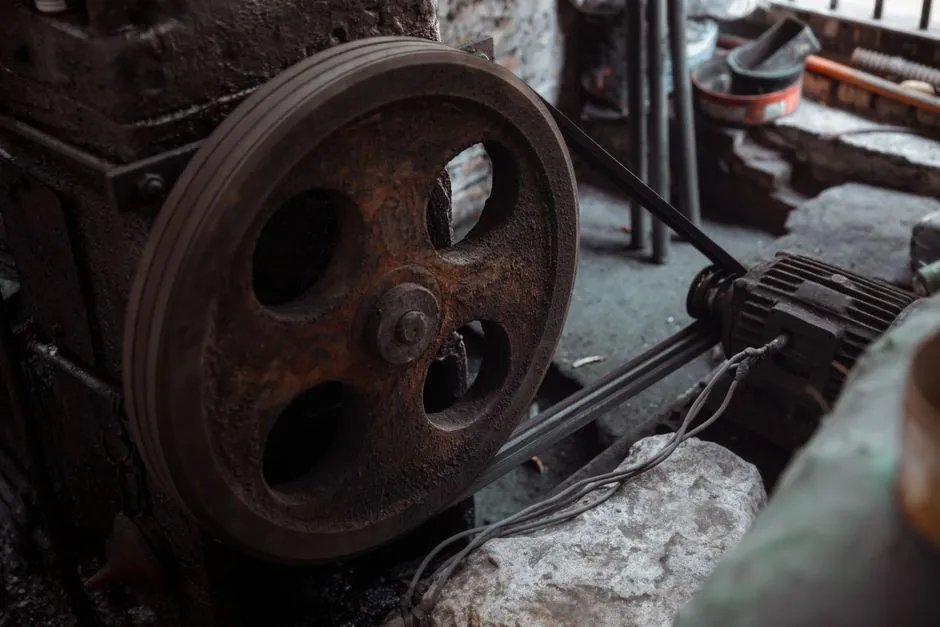
A fixed tensioner holds a constant physical position, so once a belt elongates under operating load the tension it actually sees drops toward zero; a spring-loaded automatic belt tensioner uses an internal coil spring to apply a controlled force against the belt, keeping tension roughly constant as the belt stretches and wears [S1].
The engineering question is not "which is newer" but which is correct for the load class on the drive, because the wrong choice manifests as accelerated rib shear, thrown belts, or premature bearing failure on the tensioner pulley itself. Three concrete data points frame the decision: serpentine belt stretch in service, the over-tensioning hazard of a fixed unit, and the dynamic damping required for supercharger or alternator-heavy drives [S2][S4][S6].
How Each Tensioner Type Actually Works
A fixed tensioner is a rigid idler, either a fixed pivot arm, a sliding bracket locked with a bolt, or a spacer block, that pushes the belt sideways by a fixed amount set at installation [S4]. Because its geometry is constant, any increase in belt length from elastic stretch, wear, or thermal growth subtracts directly from the tension on the belt, and the only way to "compensate" is to install the belt heavily over-tightened, which loads the bearings and shortens belt life [S4].
A spring-loaded automatic belt tensioner uses a preloaded coil spring that pushes an arm or plunger against the back of the belt, generating a near-constant force across the working stroke of the arm, so the belt sees the same tension whether it is new and short or worn and longer [S1]. The spring also damps vibration, which is critical on serpentine accessory drives where belt whip and resonance from crankshaft torsionals can shred ribs in a few thousand miles if the belt is allowed to bounce [S2].
Machine Design's 2005 tensioner survey notes that automatic spring units "eliminate the need to manually retension drives" and reduce the risk of inadvertent over-tensioning, both of which map directly to lower maintenance labour and longer belt life on industrial and automotive accessory drives [S6].
Decision Criteria Side by Side
Comparing the two on four spec-driven criteria gives a clean selection map. Belt tension under load: fixed units lose tension as the belt stretches and are described in enthusiast and engineering discussion as effectively producing "no tension at all on the belt under load" once wear sets in, while spring units maintain force within a small band across the arm stroke [S1][S4].
Belt wear and noise: a spring tensioner that bounces or is too lightly loaded lets the belt whip and is a known cause of premature rib cracking, whereas a properly loaded spring with controlled damping, or a properly pre-tensioned fixed unit, both run quieter and longer; the yellowbullet community thread explicitly lists a too-weak spring tensioner as a failure mode and recommends a manual unit only when the spring rating cannot be matched to the drive load [S7].
Maintenance burden: fixed units require periodic re-tensioning because they cannot follow belt stretch, and SDP-SI's product reference describes spring units as "automatically keep tension constant" across both V-belt and chain drives, which is the core value proposition for both passenger-car and industrial applications [S3][S6].
Load class suitability: fixed units are acceptable for low-power accessories (cooling fan only, small alternator) and for racing engines where a quick re-tension between rounds is acceptable, while spring-loaded units are specified wherever the drive must handle supercharger load, high alternator output, or continuous industrial service where re-tensioning is impractical [S4][S7].
Where Fixed Tensioners Are the Right Call
Fixed or "manual" tensioners make sense in three specific situations, and outside those three, the spring-loaded automatic is the safer default. First, dedicated race engines where the drive is checked and re-tensioned between every pass, so the lack of dynamic compensation is irrelevant; second, very low-load accessory belts where the spring force of a small automatic tensioner would be insufficient to maintain wrap angle, for example some older V-belt drives on lightly loaded industrial fans [S2][S7].
Third, engines with known chronic belt-throw problems where a high-rate spring tensioner is bouncing and accelerating wear, the established fix is to swap in a solid bracket and accept the trade of monitoring belt length manually, an option widely used on Corvette, GTO, and LS-platform blower builds for the same reason [S2][S5]. In each of these cases the trade is explicit: you trade the convenience of automatic tension for either a more compact package, a stiffer drive, or a controlled-cost maintenance routine.
The LS1GTO thread captures the load class cleanly: "you can get away with this if the belt is only driving low power loads, ie not a supercharger," which is the same boundary that shows up in industrial spec sheets for small V-belt drives [S4].
Where Spring-Loaded Automatic Tensioners Are Required
Any drive that combines high peak torque, long belt span, or long service intervals belongs on a spring-loaded unit. Supercharger serpentine drives are the canonical automotive example, because at 12 psi-plus of boost the crank sees massive instantaneous torque reversals through the belt, and a fixed tensioner cannot hold wrap angle through those events [S4].
Industrial V-belt and synchronous-belt drives fall into the same category. SDP-SI lists spring-loaded chain tensioners featuring a steel sprocket with a ball bearing for synchronous belt drives, and the same construction transfers to V-belts where both stretch and wear "wear at an" approximately linear rate over the belt's life, so a constant-force spring tracks the wear curve more closely than a fixed spacer [S3]. Machine Design's piece on belt and chain tensioners frames this as a maintenance and safety issue: eliminating manual re-tensioning removes both the labour cost and the human error of over-tensioning, which is a documented failure mode on industrial drives [S6].
On the inspection side, Brake & Front End's tech tip describes the spring-loaded automatic belt tensioner as applying "just the right amount of force against the belt to keep it tight," and the diagnostic point is that the spring force is part of the design, not a setting the mechanic chooses, which is why spring ratings are matched to the specific drive and not adjusted in the field [S1].
Selection Rules and Common Failure Modes
The simplest rule that fits all the source material: match the tensioner mechanism to the belt's worst-case load, not its average load. For a drive that sees high transient torque, specify a spring-loaded automatic tensioner with a published spring rate and a damper, then verify arm travel stays within the design band under peak load, because an arm that bottoms out behaves like a fixed tensioner and loses all the benefit of the spring [S1][S4].
Common failure modes line up with the wrong mechanism: a fixed tensioner on a high-torque drive will throw the belt or glaze the pulleys, while an under-rated spring tensioner will bounce, whip the belt, and shred the ribs within a service interval [S2][S7]. Over-tensioning from a manually set fixed bracket is a separate documented hazard, because it loads the alternator and idler bearings and can burn out an alternator bearing before the belt itself wears out [S4][S6].
Two trackable signals for spec audits: first, a tensioner arm position that has moved to the limit of its stroke is a sign the belt has stretched past the spring's working range and the belt (and possibly the tensioner) needs replacement, not just re-tensioning [S1]. Second, on any drive that has been retrofitted from a fixed to a spring unit, the pulleys must be aligned to within the belt manufacturer's lateral spec, because a spring will follow misalignment dynamically and accelerate edge wear compared to a rigid bracket that simply holds the belt in one place [S3][S6].
For comparison-driven spec work, the jaw-coupling spider selection guide uses a similar Shore-A versus torque-band matrix, which is a useful cross-reference when the same drive train also includes a coupling stage. For wiring context on the sensors and controls that may sit downstream of a tensioner-driven alternator, the fixed gas detection wiring comparison applies the same constant-force versus digital-decision framework in a different domain.
For component-level specifications, see spring washer, and fixed gas detector.