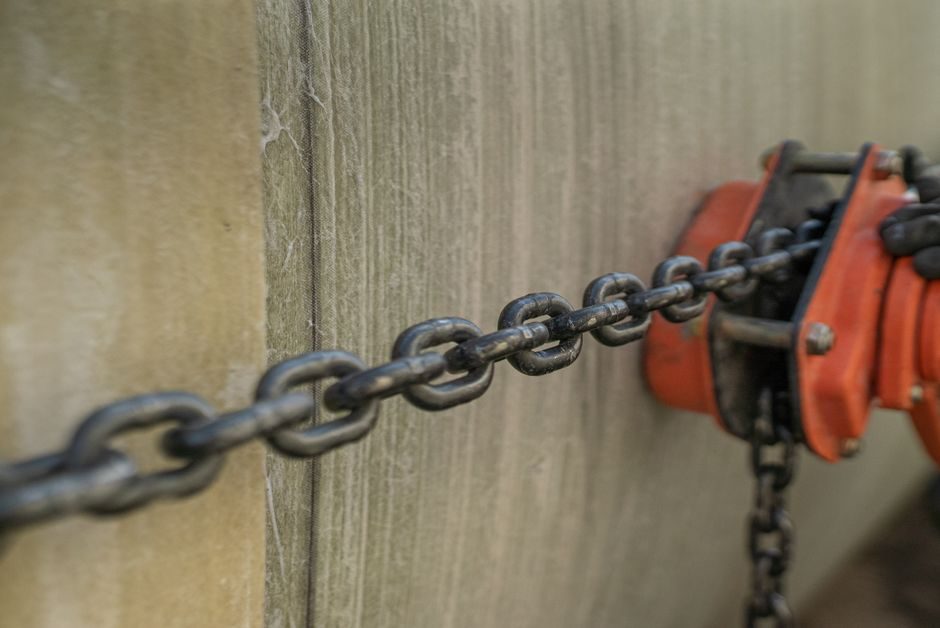
The selection of a conveyor chain is governed by the same physics as drive chain — horsepower, speed, shock load and lubrication — but the conveyor's own geometry and the product being carried add a second layer of constraints that often decide the chain before the drive train is even calculated [S1][S2].
Specifying a conveyor chain by catalog "size number" alone, without first resolving pitch, ultimate tensile strength (UTS), working-load limit and allowable speed, is the single most common root cause of premature elongation, pin shear and roller spalling seen in service [S3][S6].
Pitch, Roller Diameter and the Geometry Stack
Pitch — centre-to-centre distance between consecutive pins — is the master dimension: it sets sprocket tooth count, allowable product size, and the maximum speed at which the chain can run without the roller over-running the sprocket root [S3]. Standard ISO 606 short-pitch transmission chain (08B–24B, 40–160) covers the bulk of light-to-medium pallet handling, while long-pitch conveyor chain (M-series, typically pitch 63–250 mm) is the default for bulk-material trough conveyors and pallet accumulators [S3][S6].
Roller diameter is not a free choice — it is locked to the pitch by the manufacturer (e.g. 08B = 8 mm pitch / 5 mm roller; 12B = 19.05 mm pitch / 12 mm roller; M80 = 80 mm pitch / typically 25–35 mm roller), and the larger the roller the lower the rolling resistance but the higher the inertial load on starting [S1][S3]. Codimar's R12 stainless pallet-handling line for example uses shaft diameters of 15, 17, 20 and 25 mm matched to roller pitch, not free-picked [S1].
Working width and roller pitch together set the product footprint rule: a small-base load needs reduced pitch between rollers, while a wide-base pallet can be carried on a coarser pitch — and the chain's UTS must cover the worst-case accumulated load plus the chain's own weight per metre, not just the live load per pitch [S1].
Tensile Strength, Working Load and Service Factor
Ultimate tensile strength is the catalogue headline number (e.g. 08B ≈ 18 kN, 12B ≈ 29 kN, 16B ≈ 60 kN, 20B ≈ 95 kN, M80 long-pitch ≈ 60–80 kN), but it is never the working number — the operating limit is UTS divided by a service factor that ranges from roughly 1:1 (uniform load, smooth drive, 8 h/day) to 1:8 (shock-loaded, dirty, multi-start, 24 h/day) [S3][S6].
For pallet accumulators and head-driven roller lines the chain typically runs in the 8–20 m/min band — a deliberate slow-speed window that keeps the drive package small and the noise envelope tolerable in operator zones [S1]. For trough conveyors carrying grain or concrete aggregate the same chain type is often moved at 0.45–0.8 m/s (1.48–2.62 ft/s), so bulk throughput is built by cross-section rather than speed, with capacities from 20 t/h to 1,000 t/h on a single Y-series line [S2].
Stainless-steel welded roller chain is the default for food, beverage, pharmaceutical and wash-down environments; the same R12 geometry in painted or zinc-plated mild steel covers dry palletising and assembly lines, and through-hardened or forged variants extend the same envelope into abrasive or high-shock service [S1][S3][S5]. Pinion material and surface finish (metallic, zinc-plated, sandblasted) are part of the same corrosion-wear decision tree and should be specified together, not separately [S1].
Conveyor Form: Sliding, Rolling, Trough, En-Masse
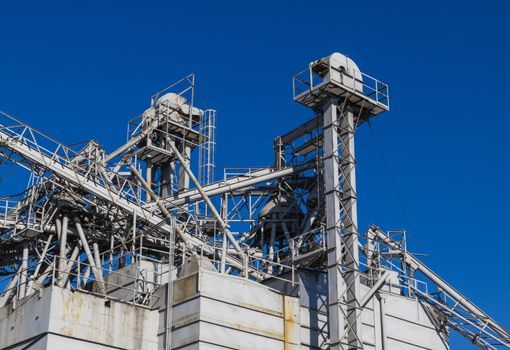
Conveyor geometry usually picks the chain family before the catalogue page is opened. A roller chain driving live-roller conveyors is the workhorse for carton and pallet handling because the roller decouples product mass from chain wear, and the chain itself only carries the drive force plus its own weight [S1][S3].
Trough and en-masse conveyors use paddles welded or bolted to a single or double strand of long-pitch chain, running inside a U-section or fully enclosed casing — Mysilo's Y series is a textbook example, with polyethylene or abrasion-resistant steel liners on the bottom and side sheets to extend service life in grain and concrete-aggregate duty [S2].
For applications where rollers cannot run on a return path, drag or silent chain configurations are sometimes substituted, but the silent-chain trade is reduced noise and smoother speed against higher cost per kN of capacity and stricter alignment tolerance between sprockets [S3].
Specialised derivatives — slat chain for bottling, leaf chain for lifting, forged and cranked-link chain for ash and slag — all share the same sizing backbone (pitch, UTS, service factor) but change the link geometry to suit the load shape and the wear environment [S3].
Service Environment: Corrosion, Temperature, Lubrication, Wash-Down
Corrosion class usually picks the material: stainless 304 covers indoor wash-down and food zones, stainless 316 covers chloride exposure, and hot-dip galvanised mild steel covers outdoor bulk handling where the chain is replaced at predictable intervals rather than washed [S1][S5].
Temperature sets the lubricant and the seal: standard mineral grease covers roughly −10 °C to +80 °C, synthetic polyalkylene-glycol or PFPE extends to 200 °C and above, and high-temperature ash-conveyor chains run unlubricated with hard-pin/hard-bush wear pairs in the 250–400 °C band [S3].
Lubrication regime is the cheapest life-extension lever: re-lubrication every 8 h of operation in dusty grain service, weekly in clean pallet duty, and never in high-temperature ash or in food zones where incidental contact with product rules out conventional greases [S2][S3].
For shock-loaded and reversing service, back-stop or over-running clutches on the head shaft are usually cheaper than the chain-strength upgrade they replace, and they are almost always specified together with the chain [S3][S6].
Supplier Landscape and Sourcing Map (mid-2026)

UK and European supply remains concentrated around established engineered-chain makers — FB Chain, Tsubaki, Sedis, Regina — that publish full pitch/UTS/weight-per-metre tables and hold stock on the long-pitch M-series and standard BS/DIN roller series [S3].
Indian and Chinese manufacturers — Changzhou Dongchuan, Wuxi Changshuo, Mysilo (Turkey-built for export), ESBEE Machinery, Shinelink, Expert Engineering — have moved decisively up the quality stack in 2024–2026, with ISO 9001 certification and engineering support now common even at the SME tier [S4][S5][S6].
For one-off pallet-line retrofits a small in-line stainless chain (R12 geometry, 15–25 mm shaft) is now a stocked catalogue item from multiple European suppliers, with 8–20 m/min speed and ±50 mm levelling feet built into the frame, so the specifier's job reduces to confirming length, useful width and load envelope on the data sheet [S1].
Comparison: Chain Family vs Selection Criteria
The main chain families line up against four spec gates as follows. Short-pitch precision roller chain (08B–24B, 40–160) wins on cost, availability and speed, with UTS roughly 18–95 kN, and is the right call for light-to-medium pallet and carton lines. Long-pitch conveyor chain (M40–M250) wins on bulk-material capacity, with UTS typically 20–250 kN and roller diameters scaled to pitch, and is the right call for trough, en-masse and drag conveyors in grain, aggregate and ash service [S2][S3].
Stainless welded pallet chain (Codimar R12 and equivalents) wins on corrosion and wash-down survivability and loses on cost — about 2–4× the per-metre price of plated carbon steel — and is the right call only when the line will see sanitation chemicals or wet product contact [S1]. Forged and cranked-link chain wins on shock and abrasion tolerance and loses on weight and noise, and is reserved for ash, slag and ore service where the alternative is unscheduled downtime [S3].
A linear guide is not a substitute for a conveyor chain — they solve different kinematics — but on the product-registration and indexing sections of a pallet line both are often specified side by side, and the engineering office should run the two sizing calculations in parallel, not sequentially.
Limits, Failure Modes and Sourcing Standards
Chain elongation beyond roughly 3% pitch on a 12B or 3% on a long-pitch M-series is the canonical wear-out trigger, and a chain wear gauge is the cheapest field instrument a maintenance team can own [S3].
Pin shear, roller spalling and plate-cracking are the three next-most-common failure modes, all of which trace back to either under-rated UTS for the applied service factor or to inadequate lubrication, and rarely to a defective batch from the OEM [S3][S6].
Standards governing the relevant chain dimensions, materials and test methods include ISO 606 (short-pitch transmission chain dimensions), ISO 10823 (selection guidelines for chain drives), and the manufacturer's own extended tables for long-pitch conveyor chain — the specifier should request the load–speed–lubrication data sheet, not just the catalogue page, before issuing a purchase order [S3].
For related coverage, see Globe Valve Selection: Body Pattern, Trim and Shutoff Class Decoded.