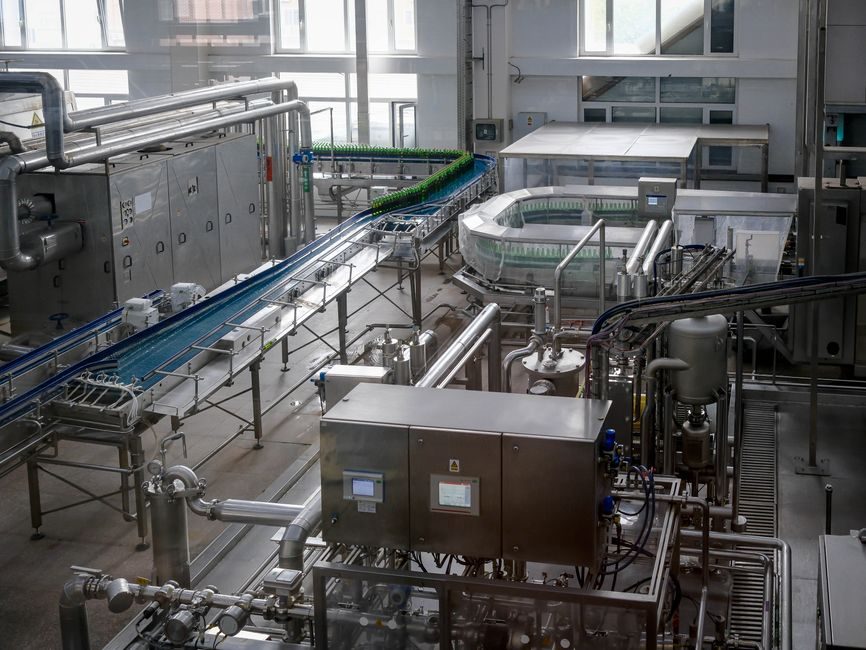
Food and beverage belt conveyor selection is governed by four hard variables — belt material, surface sanitation rating, peak line throughput, and the container mix — and a 2026 Sidel catalogue shows transport conveyors rated up to 160,000 containers per hour with format coverage from 15 to 300 cl [S1].
The duty split is sharp: plastic modular belts with acetal or stainless-steel slat chains carry 95% of bottling, canning, and PET lines; stainless metal wire or flat-veyor belts dominate baking, freezing, and hot-oil discharge; fabric PU/PVC belts handle lightweight dry-goods packaging. Specifying the wrong family is the single most expensive mistake in a greenfield line, because retrofits after sanitary commissioning cost roughly three to five times the in-line price of the correct conveyor.
Belt Material Families and the Duty Bands They Own
Three belt families split the food and beverage conveyor market by temperature, chemical exposure, and cleanability, and Sidel documents the modular plastic class as the high-throughput default with flat-top modular belt or flush-grid surfaces for empty PET, HDPE, glass, and cans [S1].
Modular plastic belts (PP, PE, POM/acetal) are rated for continuous service from roughly -40 °C to +90 °C depending on grade, and the open-hinge design makes wash-down CIP exposure acceptable. Stainless metal belts (AISI 304, 316) extend the high end past 200 °C and tolerate direct flame or hot-oil contact — Fasttrack Engineering's two-track inverted metal belt conveyor targets these high-temperature food lines where plastic would creep or stain [S3]. Fabric PU/PVC belts sit in the lightweight dry zone, with PU taking oily/wet product contact and PVC used for dry-case conveying up to roughly 80 °C. The duty map matters because the same production line will often need two belt families — a stainless infeed from a hot process and a modular outfeed into a cold filler — and undersizing either band forces a costly change-out.
Throughput, Container Geometry, and Format Range
Peak throughput is set by container size and lane count, not motor horsepower, and Sidel's transport conveyor line explicitly handles formats from 15 cl to 300 cl across round, oval, square, and rectangular sections in single-file or mass-flow modes [S1].
Three throughput tiers define the spec conversation: lines below 6,000 packages/hour typically run single-track fabric or modular conveyors; mid-tier 6,000–30,000 packages/hour uses multi-track modular with parallel and perpendicular transfers; high-tier 30,000–160,000 packages/hour demands stainless-steel slat chains, decentralized mechatronic drives, and curve angles restricted to 30°, 45°, 60°, and 90° as Sidel publishes [S1]. At the package-alignment end of the line, DIBAL's automatic belt aligner runs 1 infeed with split belt and 1 exit conveyor with guides, hitting 40 packages/minute on a 3×2-to-1 configuration for products up to 10 kg at H800–H950 mm conveyor height [S2]. Specifying a conveyor below the lane count needed is a guaranteed bottleneck, and adding lanes later is a frame-and-drive rebuild, not a bolt-on.
Sanitation, Lubrication, and Hygienic Design Choices
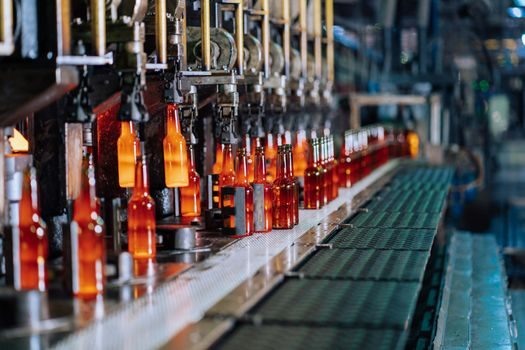
Sanitary design in 2026 is converging on dry lubrication and decentralized mechatronic drives because wet-lube systems carry the highest bioburden risk on a filler line, and Sidel's dry-lubrication option claims up to 8× lower water consumption against conventional wet-lube conveyors [S1].
Three hygienic features now show up on most shortlists. First, IP65 or higher sealed mechatronic motors with integrated inverter eliminate the chain-case lube path entirely and pair with energy-saving gearing that Sidel quantifies at 30% energy reduction versus a standard motor gear [S1]. Second, conveyor surface choice is dictated by cleanability: flush-grid modular belt outperforms flat-top in wash-down because residue cannot pool in the hinge path, while acetal slat chains outperform steel slat in any zone where the product is open to the air. Third, single-cable power-plus-control wiring reduces the number of penetration points in the line — fewer cable glands, fewer crevices, fewer clean-room failures. For more on belt tensioner selection and the take-up architecture that keeps these long modular runs tracking true, the linked reference walks through the spring, gravity, and pneumatic options.
Selection Criteria: Modular vs Metal vs Fabric PU/PVC
A spec-driven comparison of the three main belt families on four selection criteria — operating temperature, sanitation class, throughput ceiling, and unit cost — is the fastest way to disqualify the wrong option before the RFQ goes out. [S2]
On temperature, fabric PU/PVC tops out around 80 °C continuous, modular plastic (POM/PP/PE) spans -40 °C to +90 °C, and stainless metal extends to 200 °C and beyond. On sanitation, modular flush-grid and stainless metal both accept CIP foam and hot-water spray; fabric PU is acceptable for dry or wrapped product, PVC is acceptable only for case conveying. On throughput ceiling, fabric and modular share the 6,000–30,000 packages/hour band, while stainless metal slat chain is the only family proven at 100,000+ containers/hour per Sidel's 160,000 containers/hour high-end rating [S1]. On unit cost per linear meter, fabric PU/PVC is the lowest, modular plastic sits 2–4× higher depending on belt width and curve count, and stainless metal is typically the highest capex but the lowest lifetime cost in hot or corrosive duty. The flat belt family covers most of the fabric-PU/PVC options, and the mesh belt conveyor reference covers the stainless-metal wire configurations that dominate baking and freezing tunnels.
Layout, Curves, and Line Integration
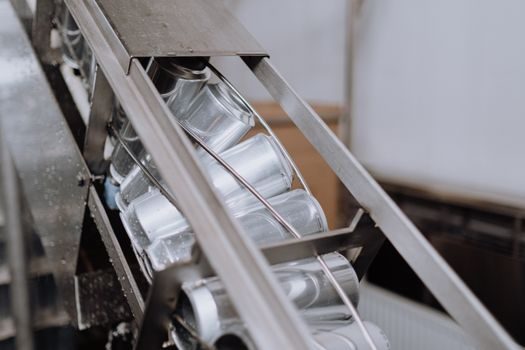
Conveyor layout is constrained by container stability in the curve, and Sidel's catalogue lists only 30°, 45°, 60°, and 90° curve angles as standard offerings, with parallel and perpendicular transfers as the supported intersection types [S1].
Three layout rules govern a food-line conveyor spec. First, bottle- and can-handling lines must keep the centripetal force on the container below the tipping threshold — wider belts and slower belt speeds in the curve, not tighter radii. Second, accumulation zones with auto-diagnosis prevent stoppages downstream, and Sidel explicitly markets auto-diagnosis as a stoppage-prevention feature rather than a post-failure alarm [S1]. Third, infeed and discharge elevation is set by the mating equipment, not by the conveyor itself, which is why DIBAL publishes a fixed H800–H950 mm conveyor-height band on its aligner [S2] and most OEMs publish similar fixed bands in the 800–1,000 mm zone. The broader belt conveyor reference covers the structural frame, drive package, and idler selection that sit behind the belt choice.
Failure Modes, Maintenance Windows, and Spare Strategy
The dominant failure modes on a food-grade belt conveyor are belt mistracking, hinge wear on modular belts, and chain elongation on slat conveyors, and Sidel's design response is fewer part references plus single-cable wiring to compress the spare-parts warehouse footprint [S1].
Spare strategy follows the duty band. Modular plastic belts wear at the hinge and the flight edge; keeping one full belt section in stores per 50 m of installed belt is the standard rule. Stainless metal belts stretch and crack at the weld; the failure mode is end-of-life rather than mid-cycle, and the spare is typically one joint kit rather than a full belt. Fabric PU/PVC belts tear at the splice or at the scraper contact; the spare strategy is vulcanizing stock and one cold-splice kit per shift. For drives, the decentralized mechatronic motor-inverter-reducer unit Sidel specifies is field-replaceable in under 30 minutes, which is why the same catalogue emphasizes fewer wiring runs and 1-cable power-plus-control — the mean time to repair drops dramatically when the drive is a single swap rather than a panel intervention. Maintenance windows of 30 minutes or less per shift are now the 2026 baseline expectation on European and Australian filler lines.
Supplier Map and Sourcing Signals (2026)
Food and beverage belt conveyor sourcing splits across three regional clusters, with European OEMs (Sidel, France) holding the high-throughput bottling and canning end, US and Australian integrators (DIBAL, Fasttrack Engineering) covering aligner and specialty metal-belt duty, and Indian/Chinese fabricators addressing the dry-goods and case-handling mid-market [S1][S2][S3].