Most food and beverage distributors cap pallet weights at 2,500-3,000 lb, well below the ~4,700 lb a GMA pallet can nominally hold, so a walkie stacker in the 2,200-3,500 lb class usually covers the typical case without oversizing the truck or the aisle [S4].
The selection question is not which brand looks best in the catalogue. It is whether the machine will hold up under cold-room condensation, daily washdown, dense beverage loads and HACCP-driven hygiene rules, and whether its pallet stacker drive, mast and battery are specified for the actual route through the plant.
Define the Operating Route Before Choosing a Drive Class
Anxing's 2026 food, beverage and cold-chain guidance breaks the facility into five zones, ambient receiving, production and packaging, chilled storage, frozen storage, and dispatch/cold dock, and warns that one electric forklift model is rarely correct for all five [S3]. A standard catalogue truck should not be assumed cold-store suitable without a model-specific review of lubricants, seals, hydraulics, displays, condensation behaviour and battery duty at the actual zone temperature [S3].
Two further guardrails sit on top of that. Electric power is the natural starting point for enclosed food rooms because there is no exhaust at the point of use, but cold rooms add a second layer: low temperature changes battery performance, and repeated cold-to-warm transitions can condense moisture onto electrical and mechanical components if the truck re-enters before drying [S3]. Equipment selection should follow the full route, not the single zone where the truck spends most of its shift.
Electric Walkie Stackers vs Semi-Electric: Match the Daily Volume
Mobile Pallet Truck's June 2026 comparison frames the decision cleanly: semi-electric stackers win on lower budget and occasional lifting, while full electric stackers win on frequent daily use, operator effort reduction, smaller facilities with high throughput, and long-term productivity [S5]. In that matrix, semi-electric is a cost-effective upgrade from manual lifting, whereas electric stackers suit high-volume operations where speed, consistency and reduced operator effort dominate the total-cost calculation [S5].
For food and beverage plants running two or three shifts with continuous pallet movement, a fully powered walkie stacker is the lower-effort, higher-throughput answer; for back-of-house retail beverage rooms or staging corners where pallets move only a few times a day, a semi-electric unit typically delivers the lift assist without the drive-motor cost [S5]. The functional split is simple: semi-electric stackers still require the operator to push or pull the unit, while electric stackers power both lifting and travel, which directly changes how many pallets per hour a single operator can move.
Capacity, Lift Height and Mast: Numbers That Matter in F&B
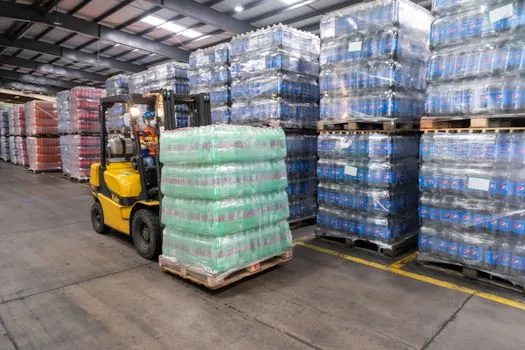
Clark's WSTX30/35 counter-balanced walkie stacker lifts up to 3,500 lb to heights of up to 157 in (about 13 ft) and handles 5% grades fully loaded on a 24V battery, which is the upper end of the heavy-duty walkie class and covers most pallet configurations a beverage warehouse will see [S4]. The lighter WSTX22 sits below that in capacity but is targeted at the same food, beverage, construction-materials and warehousing segments where footprint and manoeuvrability matter more than maximum lift [S4].
Clark's heavy-duty walkie line uses maintenance-free electromagnetic brakes (no master cylinder, no hydraulic fluid, no leaks) that engage automatically in the upright/down handle position and double as a parking brake to prevent rollbacks, an underrated safety feature on wet beverage floors [S4]. The nested I-beam mast, shared with Clark's larger forklifts, is the structural reason these walkie units can hold 3,000+ lb without the chassis flex that plagues lighter designs, and it is also why maintenance intervals on the AC travel controllers, AC drive motors and transmissions are long enough to keep utilisation high across a multi-shift food plant [S4].
Cold-Chain Realities: Condensation, Corrosion and Battery Duty
Anxing's 2026 application note is blunt: do not pressure-wash a forklift unless the manufacturer specifically permits it, because humidity, salt and cleaning chemicals accelerate corrosion on unprotected components and the truck's sealing philosophy has to be matched to the washdown method actually used on the floor [S3]. The same note lists four cold-store failure modes that drive most warranty claims: temperature-dependent battery runtime, condensation at temperature transitions, wet or slippery floors where tire choice cannot replace housekeeping, and dense beverage loads where pallet weight and stack height must be verified rather than estimated [S3].
For frozen storage specifically, the recommendation is an application-specific review of cold conditioning, fluids, seals, electrical protection, battery behaviour, corrosion exposure, tires and operator protection, which is a longer checklist than most catalogue pages acknowledge [S3]. In a chilled room, the review tightens around actual temperature, dwell time, humidity, floor moisture, door cycles and battery duty, because these five parameters together decide whether a 24V or 36V pack will finish the shift or strand a half-charged truck at 2 a.m. For a deeper dive into spec bands and coatings for these zones, the Pallet Stacker Selection for Cold Chain: Specs, Coatings, and Capacity Bands map covers the model-level detail.
Hygiene, Regulation and Indoor Air Quality: Why Electric Wins Indoors

The FDA Food Safety Modernization Act (FSMA) guidelines updated in 2025 require warehouses storing food products to maintain equipment that prevents contamination through proper sanitation and design features, which is the regulatory hook behind the move away from internal-combustion trucks inside enclosed F&B facilities [S2]. For a beverage warehouse running over 3,000 SKUs (a common challenge per Yale's beverage industry analysis), electric reach and stacker equipment also supports HACCP compliance by eliminating exhaust fumes that could contaminate products, on top of the air-quality benefit for operators [S2].
OSHA classifies forklifts into seven classes by design and use, and matching the right class to the duty cycle is the first filter; the second filter is whether the equipment supports the sanitation design features FSMA expects [S2]. In practical terms, that means smoother, sealed surfaces that survive daily cleaning, electrical enclosures rated for the washdown method on site, and mast geometries that do not trap product debris in pockets that are hard to reach with a sanitation crew. The Hyster and Yale line-up covered in the May 2026 Food Chain Magazine review targets this combination, with electric powertrains and component layouts designed for technician access that minimises downtime [S2].
Food-and-Beverage Pallet Stacker Comparison: Decision Criteria
The four criteria that drive most F&B purchases are duty cycle, environment, capacity, and total cost. On duty cycle, fully electric walkie stackers are specified for multi-shift plants and high pallet-per-hour targets, while semi-electric units are the right answer for low-volume back rooms and staging corners [S5]. On environment, cold-rated electrics with sealed electrical enclosures and cold-spec batteries cover chilled and frozen zones, whereas standard electrics suit ambient dry storage and packaging lines [S3]. On capacity, the 2,200-3,500 lb band aligns with the 2,500-3,000 lb cap most F&B distributors enforce, and avoids the wasted footprint of a sit-down counterbalance when a walkie will do [S4].
On total cost, electric stackers carry a higher purchase price but cut operator effort, reduce wear-related maintenance versus ICE units, and regenerate braking energy to extend battery life, factors that compound across multi-shift operation [S4][S5]. Walkie stackers also let a facility use narrower aisles than a traditional forklift, which directly increases pallet positions per square foot, often the single biggest lever in a beverage warehouse where SKU counts run into the thousands [S2][S4]. For fleets that need to move pallet loads alongside the stacker, the electric pallet truck category pairs naturally as the horizontal-transport complement.
What a Pallet Stacker Is Not the Right Tool For

Walkie stackers are not a substitute for a stacker crane in true high-bay AS/RS installations, where aisle widths and lift heights exceed what a rider-walkie chassis can clear, and they are not the right answer for long horizontal hauls where a pallet rack picking pattern is better served by an electric pallet truck or low-level order picker. They are also the wrong tool when pallet weights consistently exceed the model's rated capacity with load centre and lift height factored in, a common mis-spec in dense beverage stacks where shrink-wrap and pallet condition can quietly push the real load 10-15% above the planned figure [S3].
If the operation is genuinely low-volume and budget-constrained, a semi-electric stacker is a smarter buy than an under-utilised electric unit, and if the only zone in the building is a single ambient dry warehouse, a standard electric walkie without cold-store sealing is the correct, lower-cost answer [S3][S5]. The selection fails when buyers default to "electric" as a single attribute and skip the model-specific verification of seals, lubricants, battery duty and washdown rating that the cold-chain checklist exists to enforce.
Sourcing and Specification Discipline
Two technical signals to track over the next procurement cycle: cold-store-rated electric stacker model releases with sealed electrical enclosures and documented low-temperature battery duty cycles, and OEM-published guidance on pressure-wash compatibility, because the absence of that statement in a spec sheet is itself a disqualifier for washdown-heavy beverage and dairy rooms [S3]. Pair those signals with the lighting equipment and electric lamps and plastic pallet choices that round out a hygienic F&B pallet-handling station, and the spec pack becomes auditable rather than aspirational.