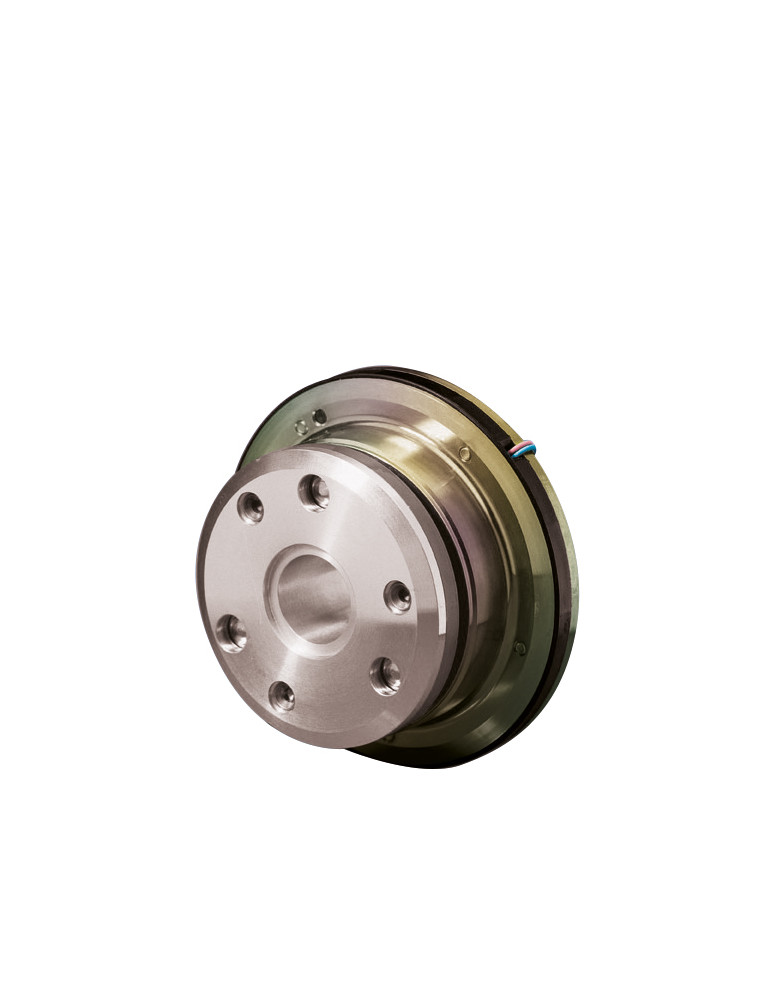
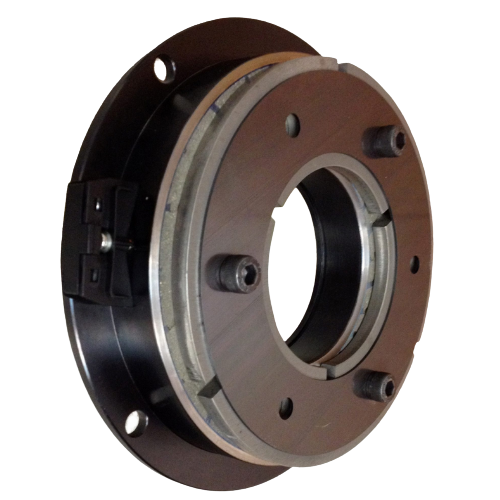
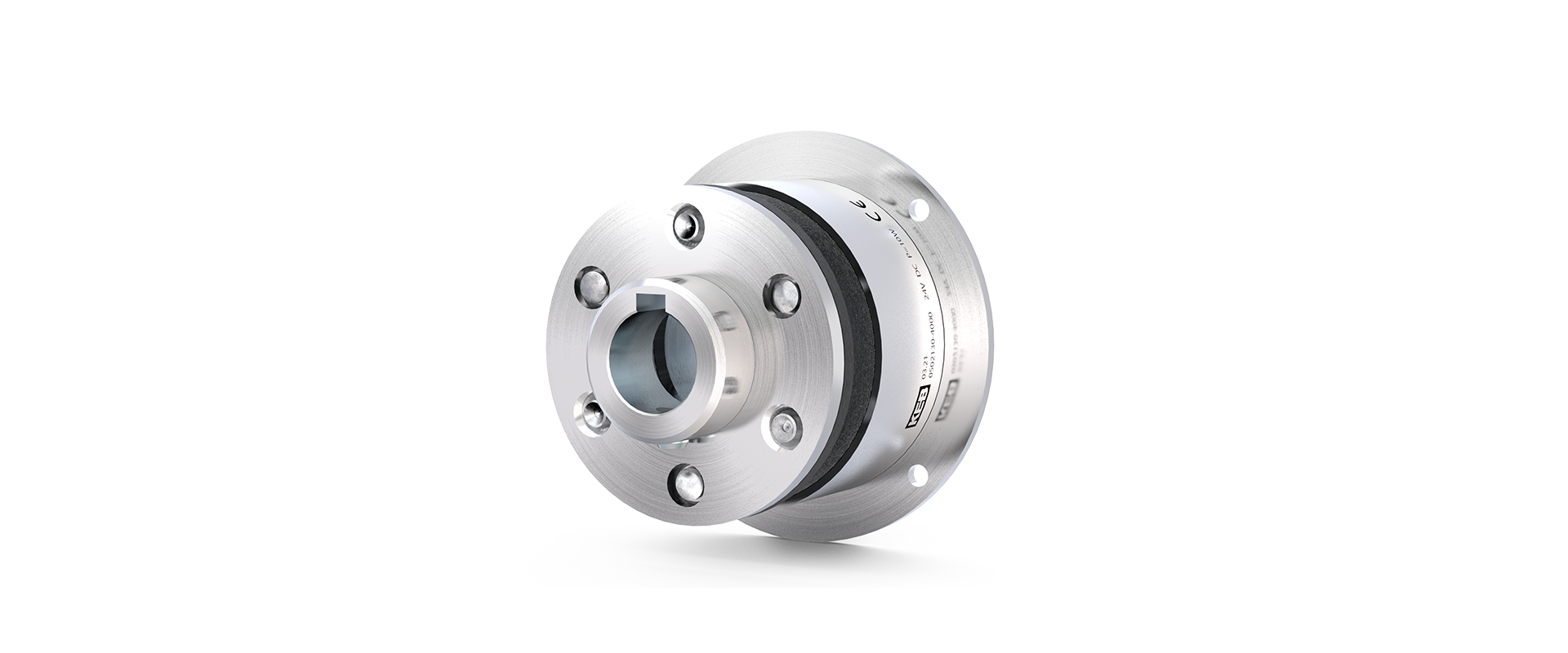
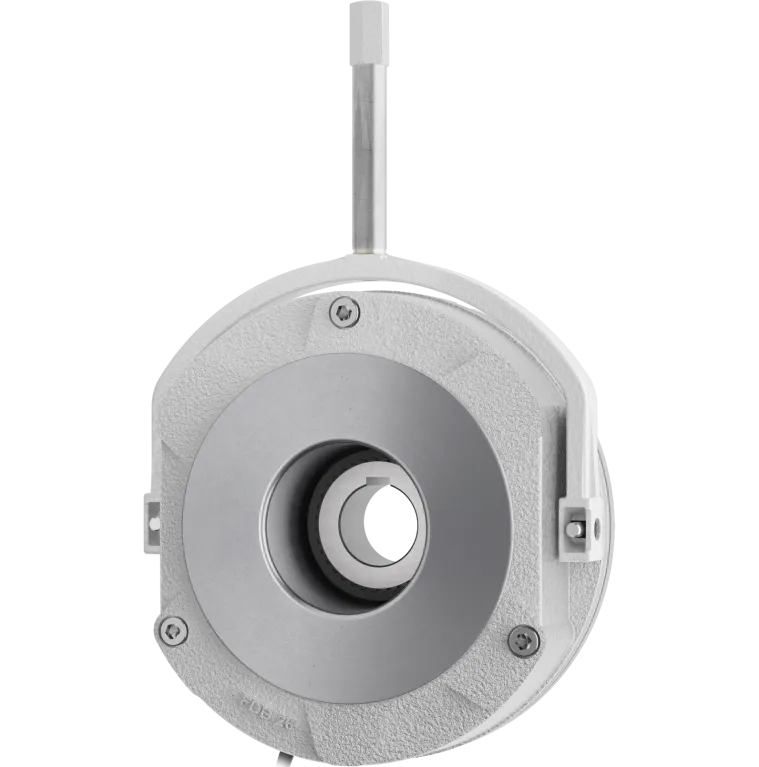
An electromagnetic brake stops or holds a rotating shaft using a magnetic field generated by an electromagnetic coil. In the dominant industrial form, the spring-applied power-off brake, compression springs clamp a friction disc whenever power is removed, and energizing the coil pulls the armature back to release the shaft. This makes the brake inherently fail-safe: a power cut, broken wire, or emergency stop leaves the load locked.
The same coil-and-armature principle also drives power-on single-face brakes, magnetic particle and hysteresis brakes for tension control, and multiple-disc brakes for high torque in small envelopes. Each variant trades torque, response time, slip-speed life, and cost differently, so correct selection starts with whether the brake must hold on power loss or only act on command.
Photo: EMB Systems AG, CC BY-SA 3.0, via Wikimedia Commons
This guide is written for industrial purchasing engineers and design engineers. Across 6 chapters it covers brake families and default state, friction and tension-control technologies, friction materials and coil ratings, the torque and response parameters that actually drive selection, and a step-by-step decision sequence, with 7 selection FAQs and manufacturer comparisons. Safety and rating references include EN ISO 13849-1 for machinery safety control systems and the IEC 60085 insulation-class system; manufacturer data is drawn from published catalogs from Kendrion, Mayr, Miki Pulley, Ogura, Warner Electric, and others.
Chapter 1 / 06
What is an Electromagnetic Brake
An electromagnetic brake is a device that stops, slows, or holds a rotating shaft using a magnetic field produced by an electromagnetic coil. When current flows through the coil, it generates magnetic flux that moves an armature plate either onto or off a friction face, engaging or releasing the brake. Although the physics is shared with the electromagnetic clutch, the brake couples a moving member to a fixed housing, removing kinetic energy as heat, whereas a clutch couples two rotating members together. In process and motion-control plants the electromagnetic brake sits alongside the motor, gearbox, and drive as a core machine-control element.
Structurally, a friction-type electromagnetic brake has three functional parts: (1) the electromagnetic coil and its steel field housing, which carry the DC excitation and the magnetic circuit; (2) the armature plate, a steel disc that is pulled toward the coil when energized; and (3) the friction interface, a non-asbestos lining on a hub or disc that transmits torque between the rotating and stationary members. In a spring-applied design, a set of compression springs sits between the field housing and the armature, holding the friction disc clamped when the coil is off; energizing the coil overpowers the springs and opens the gap, freeing the shaft.
The defining engineering distinction is the default state on power loss. A power-off brake (spring-applied) is engaged when de-energized and released when powered, so it holds the load whenever electricity is absent. A power-on brake (power-applied) is engaged only while powered and freewheels when off. The power-off form is the fail-safe standard for any duty where an uncontrolled load must not move during a fault, including hoists, elevators, robot joints, stage rigging, and vertical servo axes. The power-on form suits cycling, indexing, and tension duties where torque is required only on demand.
A separate but related family is the eddy current brake, which uses electromagnetic force directly rather than friction. Both technologies rely on a magnetic field, but a friction brake ultimately depends on contacting surfaces and can hold full torque at standstill, while an eddy current brake induces drag in a conductive rotor that vanishes at zero speed. Because an eddy current brake has no holding torque when stationary, it serves only as an auxiliary retarder, never as a parking or safety brake. This guide treats the friction-based electromagnetic brake as the primary subject and contrasts the eddy current type where the distinction matters for selection.
Application scale spans roughly five orders of torque magnitude. Sub-newton-metre holding brakes lock the shafts of small stepper and servo motors in semiconductor and laboratory automation, with static torque from about 0.06 Nm upward. Mid-range spring-applied brakes from a few newton-metres to a few hundred newton-metres dominate servo axes, conveyors, packaging machines, and AGVs. Large multiple-disc and caliper-style brakes reach thousands of newton-metres for cranes, wind-turbine yaw and pitch, and mill drives. No single brake covers this whole range; selection is the act of mapping a specific duty cycle, load, and safety requirement onto a specific brake family and torque class.
Chapter 2 / 06
Brake Families and Default State
Industrial electromagnetic brakes divide into a small number of families distinguished by default state, friction geometry, and intended duty. Choosing the wrong family is the most expensive early mistake, because a power-on brake on a gravity load will drop that load on a power cut, and a single-face cycling brake used for continuous holding will overheat. The table below summarizes the main friction-type families and their defining behavior.
Family
Default state (no power)
Primary duty
Typical applications
Spring-applied (power-off)
Engaged (holding)
Holding, emergency stop
Hoists, elevators, robots, servo axes
Power-applied single-face
Released (free)
Cycling, indexing
Conveyors, packaging, sorting machines
Permanent-magnet power-off
Engaged (holding)
Compact holding
Robot joints, AGV drives
Multiple-disc
Either variant
High torque, small envelope
Gearboxes, off-road, mill drives
Toothed / positive
Engaged (holding)
Zero-slip holding
Vertical axes, indexing locks
Spring-applied power-off brakes are the workhorse of fail-safe motion control. Compression springs hold the friction disc clamped between an armature plate and a cover plate when the coil is off; applying rated DC voltage energizes the coil, pulls the armature against the springs, and frees the disc. Because the holding force is mechanical, the load stays locked through any electrical fault. These dry single-disc brakes mount to the A-face or B-face of a servo or AC motor and are the type specified on most motor purchase orders that call for a holding brake.
Power-applied single-face brakes reverse the logic: a single friction plate engages the rotating hub to the stationary field only while the coil is energized, and the shaft runs free when power is removed. This family accounts for roughly 80 percent of power-applied brake use. It suits high-cycle stop-and-hold-briefly duties such as sorting, labeling, and indexing, where torque is needed on command and a power cut should leave the machine coasting rather than locked.
Permanent-magnet power-off brakes use permanent magnets instead of springs to attract the armature and hold the load when de-energized. Releasing the brake requires a controlled current that cancels the permanent field, so these brakes need more sophisticated drive electronics but achieve a very compact, low-residual-torque package favored in robot joints and AGV wheel drives. Multiple-disc brakes stack several friction surfaces to deliver high torque in a small diameter and can run wet or dry, serving gearboxes and off-road equipment. Toothed or positive brakes add mechanical teeth for absolutely zero slip when holding, used where even minor creep on a vertical axis is unacceptable.
A practical selection cue: if the answer to "what must happen on power loss" is "the load must stay put," the family is power-off, and the only remaining questions are torque class, response time, and safety rating. If the answer is "the machine should be free to coast or be moved by hand," a power-on single-face brake is correct. Mixing these intentions is the single most common cause of field incidents with electromagnetic brakes.
Chapter 3 / 06
Tension-Control and Non-Contact Technologies
Beyond on-off holding and stopping, a distinct group of electromagnetic brakes produces a controllable, speed-independent torque set by coil current. These are the tension-control brakes used in web, wire, foil, film, and tape handling, plus the non-contact eddy current retarder used as an auxiliary brake. Their common trait is that torque tracks current rather than simply switching between clamped and free. The table below compares the three controllable or non-contact technologies against the baseline friction brake.
Technology
Torque vs current
Holding torque at 0 rpm
Wear interface
Best for
Friction (on/off)
Binary (clamp / free)
Full
Lining and disc
Holding, stopping, safety
Magnetic particle
Near-linear
Full
Powder and bearings
Cost-sensitive tensioning
Hysteresis
Near-linear
Full (static)
None (air gap)
Precision, high-speed tensioning
Eddy current
Rises with speed
Zero
None (non-contact)
Auxiliary retarding
Magnetic particle brakes fill a narrow gap between the rotor and the housing with a fine, dry stainless-steel powder that flows freely until the coil is energized. Coil current builds magnetic flux that binds the particles into a quasi-solid coupling, so the transmitted torque is nearly linearly proportional to current and is independent of shaft speed. This gives fast response, low inertia, and smooth control, making particle brakes a cost-effective choice for tension control where slip speed runs from roughly tens to a few hundred rpm. The trade-off is that the powder and bearings limit continuous slip speed and heat dissipation, so very high speeds or heavy continuous slipping shorten service life.
Hysteresis brakes reach the same speed-independent, current-proportional torque but produce it magnetically across an air gap with no contacting powder. A hysteresis disc is dragged through the rotating magnetic field, and the magnetic lag (hysteresis) of the disc material creates a smooth retarding torque. With no wearing interface, hysteresis brakes offer the longest maintenance-free life, the smoothest torque at very low speed, and the best repeatability and stability over their life, which is why they are preferred for precision test stands and high-speed unwinding. The cost is higher unit price and somewhat higher rotor inertia than an equivalent particle brake.
Both particle and hysteresis units hold full torque at standstill and produce torque set purely by current, so they can be driven open-loop from a current source or closed-loop from a tension feedback signal. The practical split: choose a particle brake when cost and size dominate and slip speeds are moderate, and a hysteresis brake when precision, high slip speed, or long unattended life are the deciding factors. Ogura and Miki Pulley are leading suppliers of both clutch-brake and particle-brake product, with catalog torque ranges spanning small fractional units to thousands of newton-metres across their families.
Eddy current brakes are fundamentally different: a conductive rotor spins through a magnetic field, inducing circulating eddy currents whose own field opposes the motion by Lenz's law. The result is a non-contact drag with no pads, discs, or powder to wear. Crucially, the braking torque is proportional to relative speed and falls to zero at standstill, so an eddy current brake cannot hold a stationary load and is never a safety or parking brake. Its role is auxiliary retarding, for example slowing a vehicle or absorbing power on a dynamometer, where large retarders reach 3,000 Nm or more with zero friction wear. Any system using an eddy current retarder still needs a separate friction brake for final holding.
Chapter 4 / 06
Friction Materials and Coil Ratings
Two component-level choices govern whether an electromagnetic brake survives its duty cycle: the friction lining and the coil insulation. Both are matched to the application rather than chosen in isolation, and both are common sources of premature failure when undersized. Modern brake linings are non-asbestos and are formulated differently for static holding versus dynamic stopping.
Friction linings for spring-applied brakes come in grades tied to duty. A single-piece organic friction disc assembly suits mainly static holding, where the brake rarely stops a moving load and mostly clamps a stationary shaft. For semi-dynamic duty, where the brake occasionally stops motion, aluminum carriers with double-bonded friction discs handle the higher energy. For demanding dynamic duty, where the brake repeatedly absorbs kinetic energy at speed, steel carriers with double-bonded linings provide the heat capacity and wear resistance required. Specifying a static-grade lining for repeated dynamic stops is a frequent cause of rapid wear, torque fade, and growing air gap.
A fresh lining does not deliver full catalog torque immediately. Rated static torque is typically reached only after run-in, and an unworn lining can sit 20 to 30 percent below nominal until the surfaces bed in. Safety calculations must therefore use the guaranteed minimum torque, not the nominal figure, and a documented run-in or burnishing procedure is part of commissioning a safety-critical brake. As the lining wears, the air gap grows, which slows release and eventually prevents the coil from pulling the armature in at all, so periodic gap checks and shimming are required maintenance.
Coil ratings follow the IEC 60085 thermal-class system, which sets the maximum permissible winding temperature for the insulation. Class B, F, and H are the common grades, with higher classes tolerating higher coil temperatures and thus permitting higher excitation or hotter ambients. The table below summarizes the standard thermal classes and the parameters that interact with them.
Insulation class (IEC 60085)
Max hot-spot temperature
Typical use
Class B
130 °C
General-purpose brakes
Class F
155 °C
Standard servo and motor brakes
Class H
180 °C
High-temperature and high-duty brakes
Coil temperature matters because a hot coil has higher resistance and therefore lower current at fixed voltage, which weakens the magnetic field and can slow or prevent release. This is why many drives use overexcitation with reduced-voltage holding: a brief elevated voltage at switch-on forces a fast current rise to release the brake quickly, then the controller drops to a lower holding voltage, often around one third of pickup power, that keeps the brake open while limiting coil heating. The technique both shortens release time and protects the insulation, extending coil life. On de-energizing, a suppression element across the coil is mandatory to absorb the inductive spike: a plain flyback diode protects the switch best but slows engagement, while a varistor or diode-plus-Zener network lets the field collapse faster for the shortest, most repeatable engagement time.
Chapter 5 / 06
Key Specification Parameters
A brake datasheet may list a dozen lines, but only a handful drive selection: static torque, dynamic torque, rated voltage and power, release and engagement time, maximum speed, air gap, insulation class, and weight or inertia. Each is explained below, with representative values drawn from published catalogs such as a 24 VDC spring-applied unit rated 12 Nm static, 20 W, with roughly 100 ms engagement and 60 ms release at 2,000 rpm maximum speed.
Static torque is the torque the brake holds without slipping at standstill, the headline number for any holding brake. Dynamic torque is the lower torque the brake develops while actually slipping at speed, and it is the number that governs stopping distance during an emergency stop. Confusing the two is a classic error: a brake rated 12 Nm static may slip at a noticeably lower dynamic value while hot, so dynamic stops must be sized on dynamic torque, while gravity holding is sized on static torque. The table below shows how the key specifications interact across a representative torque range.
Static torque
Typical voltage
Rated power
Max speed
Typical envelope
0.06 to 1 Nm
24 VDC
3 to 8 W
to 4,000 rpm
NEMA 11 to 23 stepper / servo
4 to 12 Nm
24 VDC
15 to 25 W
to 3,000 rpm
NEMA 34 / mid servo
30 to 100 Nm
24 / 90 / 180 VDC
25 to 60 W
to 2,000 rpm
Large servo / gearbox input
200 to 1,000+ Nm
24 to 207 VDC
60 W and up
to 1,500 rpm
Crane, mill, multiple-disc
Rated voltage and power set the excitation. 24 VDC is by far the most common control-level rating, while larger industrial brakes also use 90 VDC, 180 VDC, or rectified 207 VDC from line voltage. Rated power, for example 20 W on a 12 Nm unit, determines coil heating and the size of the supply, and it is the basis for the reduced-voltage holding economy described in Chapter 4. Always confirm whether the quoted voltage is at the coil or at the rectifier input, since AC-side switching introduces extra delay.
Release time and engagement time are the two halves of brake response. Release time is the interval from energizing the coil to the brake opening; engagement time is from de-energizing to the friction faces clamping. For a small-to-mid spring-applied brake, engagement is on the order of 100 ms and release on the order of 60 ms, with both growing as torque and coil size increase. Release is dominated by coil inductance and is shortened by overexcitation; engagement is dominated by how fast coil current decays and by the suppression network. For any safety brake, the guaranteed maximum engagement time is a hard specification, because stopping distance and the protected hazard depend directly on it.
Maximum speed, air gap, and inertia round out the selection. Maximum speed limits where a dry friction brake may slip without overheating, with catalog values such as 2,000 rpm for a mid-size unit; tension brakes specify a separate continuous-slip rating. The air gap, the clearance between armature and coil face when engaged, is set at the factory to a few hundredths of a millimetre and is re-shimmed as the lining wears; too large a gap prevents release. Rotor inertia matters for servo axes, where the brake's added inertia affects acceleration and tuning. Backlash is a further servo-specific spec: a toothed hub-to-disc connection minimizes circumferential play, and precision servo brakes hold the air-gap tolerance to a few hundredths of a millimetre to keep positioning accurate.
Chapter 6 / 06
Selection Decision Factors
To turn the preceding chapters into a specific model, follow the ordered decision sequence below. Most selection failures come not from a single wrong number but from deciding torque before deciding default state, or ignoring the dynamic-versus-static distinction. These eight steps double as a fixed RFQ template.
Default state on power loss: Decide first whether the load must stay locked on a power cut (power-off, spring-applied) or be free to coast or be hand-moved (power-on, single-face). This choice constrains every later step and is non-negotiable for gravity and personnel-safety loads.
Static versus dynamic duty: Determine whether the brake mainly holds a stationary load or repeatedly stops a moving one. Size holding on static torque with a 1.5 to 2 times safety factor; size emergency stops on dynamic torque and the permitted stopping distance, accounting for hot-brake torque fade and unworn-lining shortfall.
Torque class and family: Map the required torque to a family: spring-applied single-disc for general holding, multiple-disc for high torque in a small envelope, particle or hysteresis for current-proportional tension control, toothed for zero-slip vertical holding.
Response time: Specify the required release time and, for safety duties, the guaranteed maximum engagement time. Add overexcitation if fast release is needed and a varistor or diode-plus-Zener suppressor if fast engagement is needed.
Voltage, power, and drive: Confirm coil voltage (24, 90, 180, or rectified 207 VDC), rated power for supply sizing, and whether switching is on the AC or DC side. Plan the coil suppression network as part of the control circuit, not an afterthought.
Mounting, speed, and environment: Verify the motor flange interface (A-face or B-face), shaft and bore, maximum operating speed against the brake rating, and ambient temperature against the IEC 60085 insulation class. Confirm enclosure protection for dusty, wet, or washdown areas.
Friction lining and life: Match the lining grade to static, semi-dynamic, or dynamic duty, and account for run-in torque shortfall and lining wear. Plan air-gap inspection and shimming intervals for any brake that stops motion regularly.
Safety rating and compliance: For machinery safety functions, establish the required Performance Level under EN ISO 13849-1 and any sector duty rules; lifting and personnel applications typically demand redundancy, documented maximum engagement time, and certified components rather than commodity holding brakes.
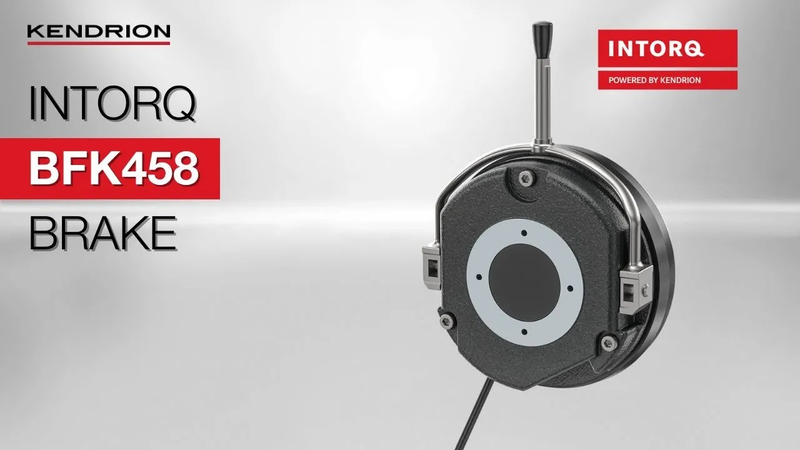
One last dimension is manufacturer serviceability: availability of shim and lining service kits, documented run-in procedures, spare-coil supply, and local technical support over a 10-to-20-year machine life. Kendrion (which now owns the INTORQ brake brand), Mayr (ROBA-stop), Warner Electric, Miki Pulley, and Ogura maintain catalogs, application engineering, and spares for holding, safety, clutch-brake, and tension-control duties, which makes them dependable for long-life and safety-critical projects. For non-safety holding from roughly 1 to 400 Nm, regional suppliers can cut cost substantially, but only after confirming the duty is genuinely non-critical and the dynamic and run-in margins still hold.
FAQ
What is the difference between a power-off and a power-on electromagnetic brake?
A power-off (spring-applied) brake is engaged by compression springs when de-energized and released when DC voltage energizes the coil, so it clamps the shaft automatically on power loss. A power-on (power-applied) brake is the opposite: it produces torque only while the coil is energized and freewheels when power is removed. Power-off brakes are the fail-safe choice for holding and emergency stopping on hoists, elevators, robots, and servo axes, because gravity loads stay locked during a power cut. Power-on single-face brakes are used for cycling and indexing duties where torque is only needed on demand. Same electromagnetic coil, opposite default state.
How do I size the holding torque for a spring-applied brake?
Start from the worst-case static torque the brake must hold, then apply a safety factor. For a vertical or gravity-loaded axis, the holding load is the motor rated torque reflected through any gearing, and a typical practice is to size the brake at 1.5 to 2 times that value to cover lining wear, friction-coefficient scatter, and shock. For a horizontal axis the dominant load is inertia during an emergency stop, so the dynamic braking torque and permitted stopping distance govern the choice, not the static number. Brake catalogs list static torque (holding) and a lower dynamic torque (slipping at speed) separately, and the two should never be confused. Always confirm the rated static torque is reached only after run-in, because a fresh lining can be 20 to 30 percent below nominal.
What is the difference between a magnetic particle brake and a hysteresis brake?
Both produce torque proportional to coil current and independent of shaft speed, which makes them ideal for tension control in web, wire, foil, film, and tape lines. A magnetic particle brake fills a narrow gap with fine dry stainless-steel powder; coil current binds the particles so they couple the rotor to the housing, giving near-linear torque, low inertia, and fast response, but the powder and bearings limit continuous slip speed and life. A hysteresis brake produces torque magnetically across an air gap with no contacting powder, so it has the longest life, smoothest low-speed torque, and best repeatability, at higher cost and inertia. Choose particle brakes for cost-sensitive, high-cycle, lower-speed tensioning, and hysteresis brakes where precision, high slip speed, or long maintenance-free life dominate.
How fast does an electromagnetic brake engage and release?
Response is split into release time (coil energized, brake opens) and engagement time (coil de-energized, springs clamp). For a small to mid-size spring-applied DC brake, engagement is typically on the order of 100 milliseconds and release on the order of 60 milliseconds, with both values rising as torque and coil size grow. Release is dominated by coil inductance and the time to build flux, so overexcitation, applying a higher voltage spike at switch-on, shortens it. Engagement is dominated by how fast coil current decays, so a fast-acting diode alone slows engagement, while a varistor or diode-plus-Zener network speeds the magnetic-field collapse and the mechanical clamp. Safety brakes for hoists and presses must specify guaranteed maximum engagement time, since stopping distance depends on it.
What is the difference between an electromagnetic friction brake and an eddy current brake?
An electromagnetic friction brake, whether power-off or power-on, ultimately converts motion to heat through contacting friction surfaces and can produce full holding torque at zero speed. An eddy current brake or retarder is non-contact: a conductive rotor spinning in a magnetic field induces eddy currents whose own field opposes the motion, generating drag with no pads, discs, or wear. The decisive limitation is that eddy current braking torque is proportional to relative speed and falls to zero at standstill, so it cannot hold a stationary load. Eddy current retarders therefore serve as auxiliary brakes for trucks, trains, and dynamometers, with large units reaching 3,000 Nm or more, while a friction brake is still required for final holding and parking.
How do I protect the coil and switching contacts when de-energizing the brake?
Switching off an inductive coil produces a high reverse voltage that can arc relay contacts and damage transistors, so a suppression element is mandatory across the coil. A single flyback diode clamps the spike most effectively but lets current decay slowly, which lengthens engagement time, an unacceptable trade-off for a safety brake. A varistor (MOV) or a diode-plus-Zener combination clamps at a higher voltage so the field collapses faster, giving the shortest engagement time while still protecting the switch. The control method also affects timing: switching on the DC side of the rectifier engages the brake faster than switching the AC supply, because it avoids the rectifier and smoothing-capacitor discharge delay. Safety circuits should switch both AC and DC sides.
Which manufacturers and standards apply to industrial electromagnetic brakes?
For motor-mounted holding and safety brakes, Kendrion (which owns the INTORQ brand), Mayr (ROBA-stop), Warner Electric, and Miki Pulley are the established European and Japanese names, with Ogura and Miki Pulley dominant in clutch-brake and particle-brake product. Safety-related braking on machinery is assessed under EN ISO 13849-1 for the control system Performance Level, while the lifting sector imposes additional duty and redundancy requirements, and brake coils follow IEC 60085 insulation classes (B, F, H). Friction linings are non-asbestos and must match static versus dynamic duty. Chinese suppliers offer DC power-off brakes from roughly 1 to 400 Nm at a fraction of imported pricing, suitable for non-safety holding duties, but for hoists, presses, and personnel-lifting equipment, certified brakes with documented maximum engagement time and redundancy are required.
Electromagnetic Brake Manufacturers
Source-backed product routes. Open a company dossier for procurement scope and cited evidence.