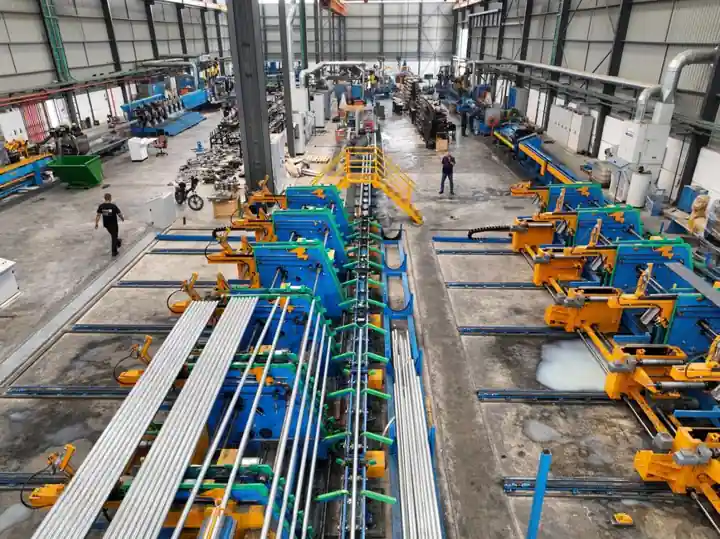
Global food processing equipment revenue is estimated at USD 60.35 billion in 2026, on track to USD 87.82 billion by 2035 at a 4.27% CAGR, with no individual supplier controlling more than 5% of the market and Asia Pacific commanding 36% of 2025 regional share [S5][S8].
The competitive structure is unusually fragmented for a capital-equipment industry: IBISWorld's US distribution channel shows no company with a market share above 5%, while the global OEM tier is anchored by Tetra Pak, GEA Group, Alfa Laval, Krones AG, Middleby, Bühler AG, and Marel (now consolidated into JBT) [S8][S9].
Market Sizing Across the 2026 Reports: USD 59.0B to USD 68.27B
Published estimates for 2026 food processing equipment revenue cluster in a tight band: Grand View Research puts the market at USD 59.0 billion in 2026 rising from USD 56.8 billion in 2025 toward USD 78.7 billion by 2033 at a 4.2% CAGR [S7]. Precedence Research cites USD 60.35 billion for 2026, growing to USD 87.82 billion by 2035 at 4.27% CAGR [S5]. The Business Research Company widens the range, reporting USD 64.81 billion in 2025 advancing to USD 68.27 billion in 2026 at 5.3% year-on-year growth, then to USD 87.14 billion by 2030 at 6.3% CAGR [S2]. MarketsandMarkets tracks the broader food and beverage processing equipment category at USD 64.6 billion in 2023 toward USD 84.9 billion by 2028 at 5.6% CAGR [S4]. GMI's earlier baseline sits lower at USD 48.1 billion in 2024 with a 4.8% CAGR through 2034 reaching USD 75.8 billion [S1]. The wide spread reflects definitional drift between "food processing equipment," "food processing machinery," and "food and beverage processing equipment" categories.
Category splits within those totals are themselves decisive for share calculations. The processing equipment sub-segment held 47.75% of the 2026 food processing and handling equipment market, while bakery products captured 35.23% of the 2026 application mix [S3]. GMI's 2024 cut shows the bakery and confectionery equipment segment at 61.2% of revenue, with automatic equipment alone valued at USD 23.5 billion [S1]. This granularity matters because plant-level procurement decisions in 2026 are increasingly being routed through category-specific RFQs rather than vendor-level master agreements.
Top Manufacturer Roster: Seven OEMs Anchor the Global Tier
The leading food processing equipment manufacturers in 2026, ranked by global revenue and installed base rather than market share percentage, are Tetra Pak (private, dairy and beverage packaging dominance), GEA Group (public, separators, homogenizers, and complete dairy lines), Alfa Laval (public, heat transfer and separation), Krones AG (public, beverage filling and packaging), The Middleby Corporation (public, cooking and baking platforms), Bühler AG (private Swiss, grain milling, chocolate, and feed), and Marel (now operating inside JBT Marel after the 2024 acquisition, protein and seafood processing) [S9]. Supporting tier names drawn from GMI's 2024 player list include Bucher Industries, Dover Corporation, Heat and Control, Hosokawa Micron, Illinois Tool Works, JBT, Satake, and SPX FLOW [S1].
For specification engineers building pressure transmitter or flow meter bills on dairy and beverage skids, the practical question is rarely "which OEM is biggest?" and more often "which OEM's reference platform accepts my instrument bus?". GEA, Tetra Pak, and Alfa Laval all publish standard control architectures that accept HART, PROFIBUS PA, and increasingly Ethernet-APL, but the field-device tagging conventions are vendor-specific and must be confirmed against the project's Functional Specification before the P&ID freeze [S9].
Competitive Structure: Fragmented Distribution, Consolidated OEMs
The 2026 distribution layer is highly fragmented: IBISWorld's US food processing equipment distributor industry shows no company above 5% share, with thousands of regional fabricators, system integrators, and value-added resellers bridging the OEM-to-plant gap [S8]. In contrast, the global OEM tier is consolidating. JBT's acquisition of Marel, completed in 2024 and now branded JBT Marel, folded two of the top ten protein-processing OEMs into a single entity [S9]. Middleby's long-running roll-up of cooking and baking brands (TurboChef, Blodgett, Viking, Celfrost) has produced a USD 4 billion-revenue specialty platform that competes head-to-head with GEA in the bakery and convenience-food sub-segments [S9].
Buyers evaluating construction machinery and equipment platforms for greenfield food plants should map the OEM landscape against four procurement criteria: (1) reference installed base in the target sub-segment (dairy vs bakery vs meat), (2) regional service footprint weighted toward Asia Pacific given its 36% 2025 share [S5], (3) cybersecurity certification for IIoT-connected lines (IEC 62443), and (4) spare-parts lead time under 72 hours for critical wear items. On those four criteria, the 2026 short list for greenfield dairy lines typically reads Tetra Pak, GEA, and Alfa Laval; for protein it reads JBT Marel, Middleby, and Heat and Control; for bakery and snacks, Middleby, Bühler, and GEA; for beverage filling, Krones and Tetra Pak [S1][S9].
Regional and Application Mix: Asia Pacific at 36% Pulls the Center of Gravity East
Asia Pacific held 36% of global 2025 food processing equipment revenue, the largest of any region, and is the fastest-growing geography per the 2026 reporting cycle [S5]. Europe remained the largest single region in 2025 per The Business Research Company, reflecting the deep installed base of European-headquartered OEMs (Bühler, GEA, Tetra Pak, Krones, Alfa Laval, Bucher) that ship globally but produce and finance locally [S2]. On the application side, meat, poultry, and seafood is the leading 2025 application segment, followed by bakery and confectionery, then dairy and beverages [S5]. The Business Research Company's segment gain forecast through 2030 puts refrigeration at USD 5.46 billion incremental, mixers at USD 4.74 billion, and extruding machines at USD 4.21 billion, identifying those three equipment types as the highest-growth sub-categories in the forecast window [S2].
The refrigeration sub-category gain aligns with what specifiers see in 2026: ammonia/CO2 cascade systems, plate freezers, and spiral freezers are the workhorse line items, and the procurement cycle increasingly requires verified refrigerant Global Warming Potential (GWP) and leak-detection instrumentation that ties into the plant's flow meter and pressure transmitter network. Where this turns into a sourcing problem is the parallel market for industrial solvents, lubricants, and cleaning chemicals that ride alongside capital equipment: plant procurement teams are now cross-mapping chemical and equipment vendors using tiered frameworks, a method detailed in the 2026 industrial solvent sourcing guide.
Selection Criteria vs Failure Modes: What Sourcing Teams Get Wrong in 2026
Three recurring specification failures show up in 2026 food plant builds. HART is FSK modulated on a 4-20 mA analog loop and is not native to digital fieldbus segments, while Foundation Fieldbus and PROFIBUS PA are fully digital protocols and require a different physical layer. Specifying the wrong bus protocol forces a redesign of the marshalling cabinet after P&ID freeze. Second, undersized spare-parts inventories for OEM-proprietary wear parts (Bühler roller shells, GEA separator bowl kits, Tetra Pak filling-valve rebuild kits) that carry 12-26 week factory lead times. Third, ignoring water-treatment integration: membrane-based CIP water recovery is now standard on European dairy builds, and the membrane skid must be specified in parallel with the lighting equipment and electric lamps and HVAC packages, not after the process line is ordered. [S1]
The membrane and reverse-osmosis link is a concrete buy-side decision point: RO dominates new 2026 food-plant water trains, and the spec map in the 2026 membrane water treatment digest breaks down vendor selection by rejection rate, recovery ratio, and CIP chemical compatibility. Treating RO as a standalone procurement package, separate from the food processing line vendor, consistently produces lower total cost of ownership than bundling water treatment inside the OEM's scope.
Standards and Sourcing Signals Trackable Through 2026-2027
No public 2026 vendor disclosure of IEC 62443-3-3 SL2 certification coverage across the top seven OEMs has been published, so plants specifying IIoT-connected lines should require a per-line cybersecurity conformance certificate rather than relying on a corporate-level attestation. EHEDG (European Hygienic Engineering and Design Group) Doc. 2 and Doc. 8 remain the working hygienic-design baseline for stainless process equipment surface finish (Ra ≤ 0.8 μm on product-contact surfaces) and connections, and the 2026 update cycle should be verified against each OEM's updated certificate register before PO release. 3-A Sanitary Standards continue to govern dairy and beverage equipment in the US, with TSE (Technical Sanitary Equipment) compliance for the European market. For the China and Southeast Asia build cycle, GB 4806.1 and GB 16798 food machinery safety standards apply and are referenced in the OEM cross-border shipment paperwork. [S5]
Trackable 2026-2027 signals: (1) JBT Marel's first full-year combined revenue disclosure, due Q1 2027, will recalibrate the protein-processing segment share against Middleby and Heat and Control; (2) the EU F-Gas regulation phase-down will force refrigeration skid redesigns starting 2027 and will reshape the USD 5.46 billion refrigeration sub-segment gain forecast; (3) Asia Pacific's 36% share should hold or expand through 2027 as Chinese and Indian dairy capacity additions outpace European replacement demand.
See also our earlier report, Best Function Generator for HVAC Bench Work: Specs, Pairings, and Pitfalls.