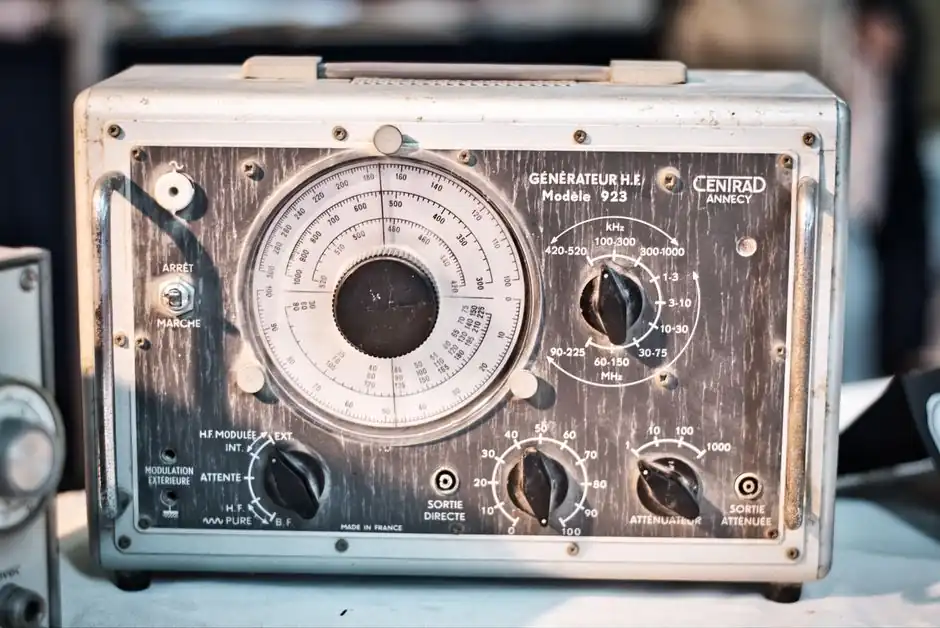
A general-purpose 5–10 MHz DDS function generator, augmented by a dedicated 0–10 V / 0–20 mA process signal conditioner, covers roughly 80% of HVAC control-board bring-up, valve-actuator simulation, and transducer loop checks seen in service shops.
The HVAC service market overlaps surprisingly little with the RF/embedded test crowd that drives most function-generator marketing: 30 MHz arbitrary waveform generators, dual-channel 160 MHz pulse sources, and 14-bit 300 MSa/s AWGs are aimed at semiconductor and clock-margin work [S2][S3], not at a rooftop-unit (RTU) controls bench. For an HVAC technician or building-automation engineer, the decision is dominated by stimulus type, output compliance, and whether the device can drive real-world 0–10 V damper actuators and 4–20 mA pressure-loop receivers without an extra signal conditioner in line.
What a Function Generator Actually Does for HVAC
A function generator is an electronic test instrument that produces standard waveforms (sine, square, triangle, ramp) plus modulated and swept variants, used as a stimulus to characterise a device under test (DUT) [S1][S2]. For an HVAC DUT, the "device" is typically a control board, a variable-frequency drive (VFD) input, an electronic expansion valve (EEV) driver, a room thermostat's thermistor input, or a 0–10 V modulating actuator. The classic arbitrary function generator (AFG) architecture, which produces stable sine, square, pulse, and triangle shapes and allows user-defined arbitrary waveforms with internal or external modulation and frequency sweeps, is the prevailing low-cost platform [S2].
Two design philosophies matter to HVAC buyers: the AFG (repeating standard shapes, low jitter, lowest cost) and the arbitrary waveform generator (AWG), which replays long point-by-point memory of any captured signal at high sample rate (e.g., 300 MSa/s, 14-bit resolution, 150 built-in waveforms as in the OWON DGE2070 class) [S2][S3]. For most HVAC bench work, an AFG is sufficient; AWG horsepower is wasted unless you are replaying a recorded compressor inrush current or a captured power-line disturbance.
Selection Criteria: Bandwidth, Channels, Output, Modulation
Bandwidth is the headline spec, but HVAC rarely needs more than 1 MHz. Entry-level AFGs cluster in three tiers: 3–5 MHz analog (e.g., B&K Precision 4001A 4 MHz at $323.00 list / $340.00 regular, 4003A 4 MHz with 5-digit red LED at $422.75 / $445.00, 4005DDS 5 MHz DDS at $433.20 / $456.00, 4011A 5 MHz) [S1]; 5–10 MHz DDS with sweep and modulation (e.g., B&K Precision 4007B 7 MHz DDS Sweep at $472.15 / $497.00) [S1]; and 25–70 MHz+ dual-channel DDS/true-arb units from OWON, Rigol, Siglent, and FeelTech (e.g., the EUR 80–150 "Chinese two-channel" tier running FeelTech FY6600-60-class silicon, or the OWON DGE2070 at 70 MHz / 300 MSa/s / 14-bit) [S3][S4].
Channel count matters more than most spec sheets admit. Differential clock signals (PECL, LVPECL, LVDS) and differential VFD gate-drive signals are best driven from a dual-channel source with floating outputs and matched amplitude/phase tracking [S2]. Single-channel units in the 3–5 MHz tier are fine for one-shot loop tests; dual-channel is the right tool when you are sweeping a setpoint on one input while watching a feedback channel.
Output compliance is where HVAC buyers get burned. A standard function generator outputs ±10 V into 50 Ω (so ±20 V open-circuit). That is enough for logic-level work, but a 0–10 V damper actuator is fine, while a 4–20 mA loop, a 24 V receiver, or a thermistor-bridge input needs a real process signal conditioner such as the Flex-Core MSG-1-01-H (0 to 1 mA DC, 115 V AC supply, $845.50 sale / $890.00 regular) or the SG-1-02-H (0 to 1 mA DC plus 0 to 10 V DC, $724.85 / $763.00) [S1]. The Precision Digital PD9502, a 0 to 20 mA / 0 to 10 VDC signal generator at $147.00 with 1–2 week availability, is a closer match to a pure HVAC loop simulator and is markedly cheaper than a general-purpose AFG [S1].
Comparison: Three Real Options for the HVAC Bench
Lining the three practical paths up against the criteria a controls tech cares about:
Option 1, low-cost analog AFG (B&K Precision 4001A / 4003A / 4005DDS family): bandwidth 4–5 MHz, single channel, DDS or analog synthesis, list price roughly $323.00 to $456.00, availability 1 to 2 weeks from a US distributor, sweep on DDS models only [S1]. Good for sine/square stimulus into op-amp inputs, thermostat thermistor bridges simulated with a precision resistor decade, and VFD enable-input checks. Bad fit for live 4–20 mA loops without an external conditioner.
Option 2, mid-tier DDS with sweep (B&K Precision 4007B 7 MHz): same UI family, adds true sweep and modulation, $472.15 sale / $497.00 regular, 2 to 3 week lead time [S1]. The right tool when the test is "does this VFD follow a 0.1–10 Hz sine setpoint without faulting," or "does the EEV driver track a triangle command."
Option 3, dual-channel 25–70 MHz DDS/true-arb (OWON DGE2070 class and FeelTech FY6600-60 class): 70 MHz bandwidth, 300 MSa/s, 14-bit, 150 built-in waveforms, 3.6 inch LCD, portable; price point EUR 80 to EUR 150 for the FeelTech-tier generics, roughly $300 to $600 for branded equivalents [S3][S4]. Two channels, modulation, sweep, and a desktop form factor make this the workhorse for parallel actuator tests. Caveats called out by users: low-quality wall-wart supply and R-2R-ladder DACs on FPGA outputs in the cheapest FeelTech-class units, both fixable but not by an HVAC tech on a service call [S4].
Who It Is For, and Who Should Skip It
The right buyer is a controls technician, building-automation programmer, or HVAC service engineer who needs to drive a 0–10 V actuator, simulate a 4–20 mA pressure transmitter, sweep a VFD setpoint, or fault-inject a thermostat board in a shop setting. The right buyer also values a process signal conditioner in the same kit: a Precision Digital PD9502 or a Flex-Core SG-1-02-H, since neither a DDS AFG nor an AWG will source a clean, loop-powered 4–20 mA signal on its own [S1].
The wrong buyer is anyone whose HVAC problem is at the system level (refrigerant charge, airflow balance, duct static pressure trending) and can be solved with a pressure transmitter calibrator, a flow meter and a manometer instead. Likewise, a controls engineer specifying a building-automation system at design stage does not need bench stimulus at all and is better served by marine HVAC reference designs or static var generator sizing for the power-quality side of large chiller plants.
Buyers who should pass entirely on a function generator: anyone needing a stimulus above 70 MHz, anyone who needs long arbitrary playback beyond what an AFG's memory holds (semiconductor characterisation, radar pulse replication), and anyone who needs an arbitrary waveform generator (AWG) with deep memory and 1 GSa/s+ for power-electronics switching loss replay [S2][S3]. For these, the right category is AWG, not AFG, and the HVAC overlap drops to zero.
Real Use Cases on the HVAC Bench
Use case 1, VFD setpoint sweep: drive the VFD's 0–10 V reference input with a 0.1–2 Hz triangle from a 5 MHz DDS unit, log motor current and discharge air temperature on a scope or data logger, look for hunting or integrator wind-up. The 4007B's DDS sweep is well-matched; cheaper analog units cannot do a clean low-frequency triangle at constant amplitude [S1][S2].
Use case 2, 4–20 mA loop simulation: most AFGs cannot source a compliant 24 V loop. The right tool is a dedicated process signal source, the PD9502 (0–20 mA, 0–10 VDC, $147.00), or a Flex-Core SG-1-02-H conditioner ($724.85 sale) [S1]. Use the function generator only as a low-level stimulus into the conditioner's input.
Use case 3, EEV driver characterisation: a 70 MHz dual-channel DDS/true-arb unit (OWON DGE2070 / FeelTech FY6600-60 class) lets you step the stepper command and capture the resulting valve position on channel two, with the AFG's two floating outputs preserving the differential drive [S2][S3][S4].
Limitations, Failure Modes, and Sourcing Standards
Common failure modes on the HVAC bench: a function generator's 50 Ω output loaded with a 0–10 V actuator divider network will halve the output voltage, and the operator blames the actuator; a 4–20 mA receiver back-fed from a 50 Ω source will read wrong by 4 mA before the loop is even closed; cheap wall-wart supplies on entry-level DDS units inject 100/120 Hz hum into low-frequency triangle commands, which then shows up as damper hunting on a real VAV box [S4]. The fix in every case is the same: use the right output stage for the loop (process signal conditioner, isolation amplifier, or a current loop simulator) rather than fighting the function generator's 50 Ω design.
Sourcing and standards: HVAC instrumentation loops are commonly specified against the 4–20 mA HART analog layer (HART is FSK superimposed on the 4-20 mA loop) and against field-device standards. For an HVAC controls buyer, the relevant signal-conditioner specs are input range, output range, supply voltage (115 V AC for Flex-Core MSG/SG units, 24 V DC common for loop-powered), and isolation rating, all of which the Flex-Core and Precision Digital catalog entries make explicit [S1]. Function generators themselves are bench instruments, not safety-rated devices, so they should not be wired into operating HVAC systems without isolation, and they should not be relied on for ATEX/IECEx-classified area work.
For a shop buying one instrument, the data-backed pick in the September 2026 catalog is the B&K Precision 4007B 7 MHz DDS Sweep ($472.15 sale) paired with a Precision Digital PD9502 process signal source ($147.00); total roughly $620, both in stock from a US test-equipment distributor [S1]. For a two-channel upgrade, the OWON DGE2070 70 MHz / 300 MSa/s / 14-bit platform extends reach to EEV and dual-actuator work at a sub-$700 street price [S3]. Verify lead time, calibration certificate, and that the wall-wart PSU is the regulated-switching type on any FeelTech-class unit before relying on it below 1 Hz [S4]. Cross-reference the function generator category for AFG vs AWG architecture differences, and see the signal calibrator suppliers roundup for the process-source side of the bench kit.
