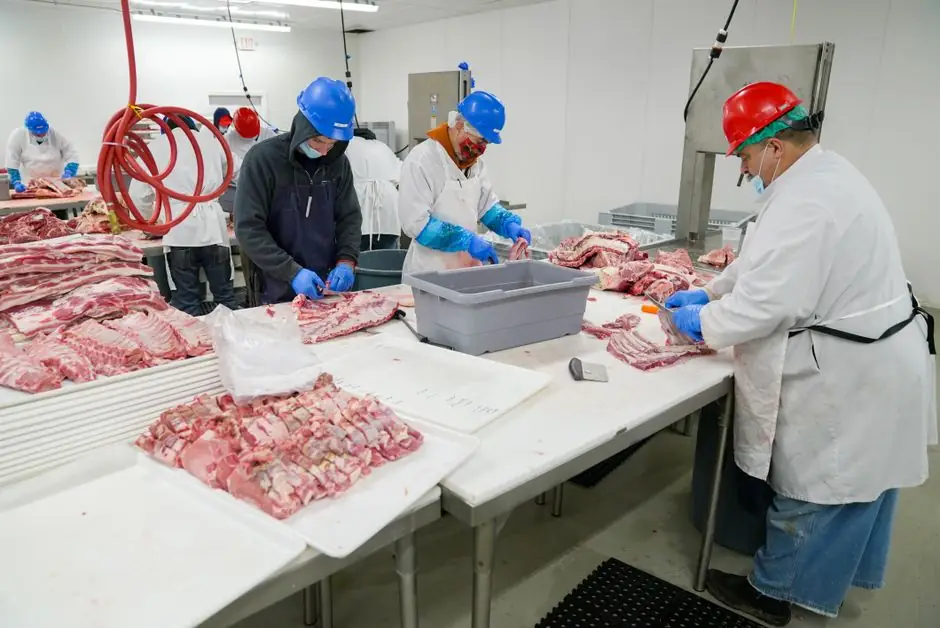
Anti-microbial nitrile drainage mats with raised pedestal bases are the dominant spec for wet processing zones in 2026, paired with grease-resistant compounds for fryer and bakery lines and low-temperature flexibility for cold-store aisles [S2].
Selection splits across at least seven functional types: anti-fatigue, anti-slip, drainage, disinfectant footbath, anti-microbial workstation, freezer, and entrance mats, each governed by a different failure mode in a HACCP-managed plant [S2][S4].
Material Grade Comparison: Nitrile vs Natural Rubber vs PVC
Nitrile rubber (NBR) compounds resist animal fats, vegetable oils, and dairy residues far better than natural rubber, which swells and softens under prolonged lipid exposure, a behaviour documented across food-grade mat catalogs since 2022 and reiterated in 2026 supplier guidance [S2]. PVC mats sit in the middle on cost but fail brittle below roughly -10 deg C, making them unsuitable for chilled and frozen aisles where line workers stand for 8+ hour shifts [S2].
Anti-microbial additives are typically compounded into the NBR or PU base material and rated to suppress Staphylococcus aureus, E. coli, Klebsiella pneumoniae, and Candida albicans growth over the mat's service life; absence of independent test certification is the most common spec-failure seen on generic imports [S2]. For broader material selection context in hygienic plants, see this gearbox selection map for food processing duty which shares the same hygiene-versus-duty logic.
Drainage Geometry and Wet-Zone Traction
Raised-pedestal drainage mats elevate the worker 12-20 mm above standing fluids, channeling water, blood, oil, and rinse water through slotted or holed surfaces to a floor drain below; this geometry is the standard mitigation for slip incidents in boning rooms, fillet lines, and washdown corridors [S3]. Slot width typically runs 6-10 mm to pass bone fragments and product debris without heel entrapment, and the open area ratio is held above 40% to keep the walking surface drained during continuous washdown [S3].
Anti-slip performance in greasy zones is governed less by the mat compound and more by surface texture: grit-coated NBR outperforms smooth NBR by a wide margin on inclined, oil-coated floors, with documented slip-resistance improvements in vendor testing [S3][S4]. For related flooring-prep equipment, see floor grinder selection for plumbing installation where the same substrate-finish logic applies before any mat is laid.
Zone-by-Zone Application Map

For meat, poultry, and fish processing, specify NBR anti-microbial drainage mats with grease resistance and dishwasher-safe ratings up to 80 deg C for chemical sanitization cycles [S2]. Slaughterhouses layer in disinfectant footbath mats at personnel and animal crossing points to control bacterial ingress; these footbaths have been used in disease outbreaks including Foot & Mouth and more recently Covid-19 [S2].
Bakeries and fryer lines demand grease-resistant compounds; standard NBR tolerates continuous animal-fat exposure, but palm-oil-heavy operations may need specialty FKM-blend top surfaces [S2]. Dairies and wet-fill lines run closed-cell NBR to prevent moisture absorption, while chilled and frozen aisles need low-temperature-flexibility ratings down to roughly -30 deg C to prevent cracking under foot traffic [S2]. Sticky tack mats at packaging-line entrances capture particulate down to sub-100-micron size, and forklift-traffic zones require heavier 20-25 mm thick rubber mats rated for pallet jack and electric forklift turning loads [S2][S4].
Cleaning Regime Compatibility
Anti-fatigue mats in food zones must tolerate three cleaning modes: routine detergent wash, periodic chemical sanitization (typically quaternary ammonium or chlorine-based at 100-200 ppm), and high-temperature washdown up to 80 deg C for allergen-changeover sanitation [S2]. NBR passes all three; PVC yellows and embrittles under repeated hot cycles; natural rubber degrades under chlorine sanitizers above 200 ppm [S2].
Disinfectant footbath mats require solution refresh schedules aligned with foot-traffic volume, typically every 200-400 crossings to maintain biocidal concentration, a frequency dictated by the chemistry used [S2]. Cross-referencing with broader safety mat selection principles confirms the same three-mode wash tolerance framework applies across industrial mat categories, not just food-grade lines.
Standards, Slip Data, and Failure Modes

WorkSafe New Zealand data cited in 2026 industry guidance records roughly 10,000 ACC claims per year for same-level falls nationally, with wet floors, contaminated surfaces, and standing fatigue as the three controllable contributing factors [S4]. In food plants the failure modes are concrete: mat edge curl on worn units, drainage slot clogging with product debris, anti-microbial additive leaching when mats are cleaned with incompatible solvents, and thermal cycling cracking on PVC placed in freezer aisles [S2][S4].
Anti-microbial mat certification should reference documented test data against the four organism panel above; supplier claims without a dated test report should be treated as unsubstantiated [S2]. The general machine safety floor-surfaces guidance and safety certification requirements both emphasize that mat performance in food plants is a documented verification, not a marketing claim, a position reinforced by 2026 supplier updates.
Rental vs Purchase: Total-Cost Drivers
Purchase wins on cost-per-shift for plants with on-site industrial washers rated for 80 deg C cycles; rental wins when mats are contaminated frequently, when HACCP documentation is audited tightly, or when shift patterns rotate mats across zones faster than in-house cleaning can handle [S4].
Trackable 2026 signals: vendor catalogs increasingly publish independent anti-microbial test certificates with batch numbers rather than generic claims, and drainage-mat slot geometries are widening from legacy 4-6 mm to 8-10 mm to handle particulate-heavy produce and fish lines without manual clearing [S2][S3].