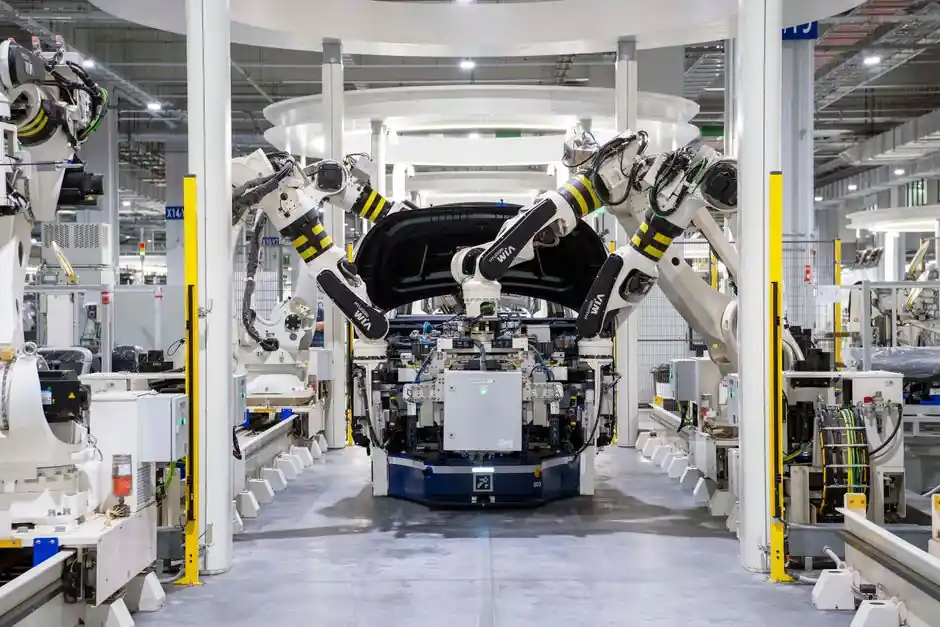
Force-controlled robotic grinding applies programmed contact force to remove casting gates, flash, risers, and parting-line mismatch, reducing over-grinding compared with uncompensated manual fettling [S1][S5].
Robotic grinding uses an industrial robot carrying a belt grinder, cup wheel, or spindle-driven abrasive to remove gates, risers, flash, and parting-line mismatch from castings under programmed position and force control [S5].
What Force-Controlled Fettling Removes
Robotic grinding is designed for abrasive casting cleanup rather than precision removal of hardened steel to micrometre tolerances. Defined jobs include cutting gates flush, removing parting-line flash, reducing core fins and risers, blending die-mismatch steps, and breaking sharp edges [S5].
Force feedback is the decisive control variable because contact conditions change as the robot crosses a casting edge or follows a curved surface. Insufficient force wastes cycle time and abrasive media, while excessive force can damage the casting; a force-controlled robot adjusts its movement to maintain contact pressure as tool compliance and part geometry change [S3].
The historical process literature also identified two materially different robotic deburring problems: small burrs and large burrs removed with a force-controlled grinding cup [S6]. That distinction remains useful for cell design because burr scale changes the contact area, required force, and suitable abrasive tool.
Selection Criteria for Robotic Fettling Cells
A robotic fettling system should be selected against the casting geometry, material, stock condition, required finish, and repeatability rather than against robot reach alone.
Machine vision handles positional variation by supporting automatic positioning, deviation compensation, and path correction. A documented automated casting process images the component, reconstructs a 3D model, identifies parting-line flash, creates a tool path, and generates a motion plan [S9]. This combination is more useful than fixed teaching alone when castings arrive with variable flash geometry or placement.
Tooling selection must match the removal task. Published systems specify individually selected grinding belts and contact discs, while the wider casting-grinding process covers belt grinders, cup wheels, and spindle-driven abrasives for gates, risers, flash, and mismatch [S2][S5]. The tooling choice should also be reviewed alongside abrasive belts versus grinding wheels for large castings.
Force Control, Vision, and Robot Architecture Compared

Force control, machine vision, and added robot axes solve different problems and should be evaluated separately. Force control regulates contact pressure and compensates for tool wear; vision corrects location and geometry; additional axes extend reach and improve angular access, but do not replace either sensing function [S4].
Active and passive force-control methods are both used to manage casting-to-casting variation [S8]. The practical selection test is therefore whether the cell can maintain stable material removal without removing acceptable casting stock.
Material and Feature Compatibility
Tool and force settings must also distinguish fettling wheels for gray iron and steel castings from non-ferrous applications.
Safety, Cycle Time, and Production Integration
Robots are increasingly used for grinding, de-burring, and finishing because these manual material-removal tasks are difficult, dirty, and hazardous [S3]. An enclosed robotic cell can capture dust at the source, remove the operator from direct contact with the vibrating tool, and repeat the programmed path and pressure across shifts [S5].
Robotic fettling also reduces dependence on operator skill, which can otherwise produce over-grinding, under-grinding, and surface inconsistency [S4]. Robotic grinding uses an industrial robot carrying a belt grinder, cup wheel, or spindle-driven abrasive to remove gates, risers, flash, and parting-line mismatch from castings [S5].
Cycle-time evaluation should include robot motion, tool changes, loading, fixture presentation, vision acquisition, and inspection, not only the time the abrasive contacts the casting. The robotic fettling cycle-time comparison provides a useful framework for separating productive grinding time from total cell availability.
Acceptance Tests for Force and Finish Quality
Acceptance testing should verify that the robot maintains the specified contact force, removes the defined flash or gate, preserves acceptable wall and edge stock, and reproduces the result across multiple castings. Force-controlled execution is necessary because a nominal robot position does not guarantee constant pressure when the tool twists around a corner [S3].
Three test groups are appropriate: dimensional checks on gates, risers, and parting lines; surface checks at blended steps and flash zones; and force-log checks covering normal runs, part-to-part variation, and the robot following curved geometry [S3][S4]. Tool wear should be included because advanced force control can compensate for wear and maintain process stability [S4].
Vision performance also needs verification against the 3D reconstruction sequence used for parting-line flash, including detection of the feature, generation of a collision-safe path, and correction of actual part position [S9]. A cell that passes dimensional inspection but repeatedly misses thin flash is not ready for production release.
Sourcing Standards and Supplier Capabilities
Machine and systems suppliers should be evaluated against demonstrable application experience and process integration, not only robot model or cycle-time claims. Alvar Process Technologies reports more than 30 years supplying robotic grinding, casting fettling, CNC grinding, and casting-fettling machinery, processes, and equipment, including automatic and robotic systems [S2].
Robotic grinding and casting fettling differ from precision CNC grinding because the former removes gates, risers, flash, and mismatch from cast metal, while the latter controls final dimensions on hardened steel [S5]. This distinction matters when issuing an RFQ: abrasive fettling equipment, a fettling grinder, and precision grinding machinery serve different acceptance criteria.
For foundries producing castings that still require gate removal or parting-line cleanup, the practical qualification sequence is material characterization, feature mapping, force-control trial, abrasive selection, vision-path validation, and a multi-part acceptance run [S1][S3][S9].