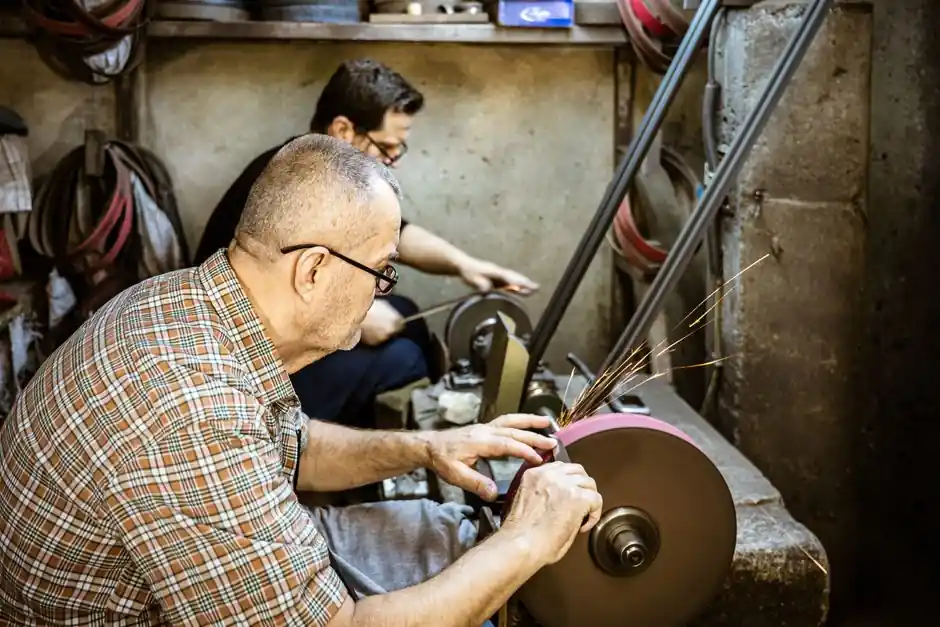
For large castings, an angle grinder can aggressively remove gates, risers, and parting-line metal, while belt grinding is faster but generally leaves a rougher finish than belt sanding [S1][S4].
The practical decision is not belt versus wheel in the abstract: use the wheel where excess metal must be separated, the belt where a moving abrasive contact area improves blending, and a separate fettling grinder where access, power, and operator control determine productivity [S1][S3][S4].
Large-Casting Work Split by Removal Duty
A castings fettling operation normally removes gates, risers, fins, flash, rough edges, parting-line material, weld-repair areas, and surface defects after shakeout and cleaning [S3].
Grinding wheels are suited to heavier stock removal, casting cleanup, edge preparation, and weld cleanup. Cut-off wheels are the more specific choice for separating gates, risers, and excess metal, while mounted points, plugs, and cones reach internal corners and confined profiles [S3]. An abrasive belt is strongest in the complementary phase: blending and smoothing broad or irregular surfaces [S3].
This division matters because a tool intended for finishing can consume several consumables before matching the removal life of one heavy-duty wheel. That cost observation is equipment-specific, not a universal replacement rule, but it shows why abrasive consumption belongs in the calculation.
Access and Workpiece Handling
A stationary belt grinder requires the operator to bring the casting to the machine, which becomes impractical for large, heavy castings; a handheld angle or die grinder lets the tool reach the casting instead [S1].
The work-envelope effect is decisive. A stationary belt grinder can improve productivity only if the casting can be safely loaded, supported, indexed, and presented to the abrasive contact point [S1].
For large castings, compare access in four steps:
1. Can the gate or riser be reached with a 100–230 mm wheel without loading the casting onto a conveyor?
2. Can the operator inspect and change the abrasive while keeping hands clear of pinch points?
3. Can the casting be rotated to expose parting lines and internal corners?
4. Can the machine accept a fixture or support that prevents the workpiece from shifting?
Use portable tools when geometry or mass prevents safe presentation to a fixed belt. Use a fixed belt only when the casting can be handled by lifting equipment or positioned by a fixture, because a stationary machine offers no solution by itself to an oversized workpiece [S1].
Removal Rate, Finish, and Consumable Life
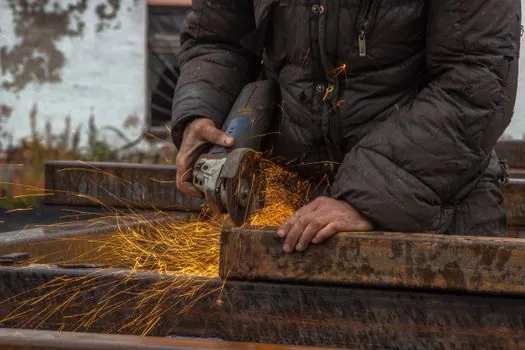
Belt sanding produces a smoother, finer surface, whereas belt grinding removes material faster but generally leaves a rougher finish [S4]. Grinding wheels remain the stronger choice for heavy stock removal, while belts and flap discs are assigned to blending and smoothing [S3].
The comparison against major decision criteria is straightforward:
For a 10-inch wheel used in repeated hollow-grinding work, one production comparison noted that a wheel could hollow-grind many times more knives than a belt grinder, while belts occupied a different production role [S5]. The transferable lesson is that production geometry and removal duty determine life; machine size alone does not.
Tool Format and Process Sequence
Die grinders are smaller and suited to tight spaces and internal cavities rather than the first pass across a large casting [S1].
A practical large-casting sequence is:
1. Use a cut-off wheel to separate gates, risers, and accessible excess metal.
2. Use a grinding wheel to remove remaining pads, flash, and heavy parting-line stock.
3. Use mounted points, plugs, or cones for confined areas and irregular internal corners [S3].
4. Use a belt or flap disc to blend scratches and produce a smoother local finish [S3][S4].
Do not force a belt through gate-removal work merely because belt abrasives are readily available. Foundry guidance specifically warns that using a grinding wheel for cutting can reduce efficiency and accelerate wear of both the tool and abrasive [S7]. Match the abrasive format and bond to the operation: many foundry grinding wheels use silicon carbide with a binder system, while composition must be adjusted for alloy, hardness, equipment, and finish requirements [S3].
Machine Selection for Heavy Castings
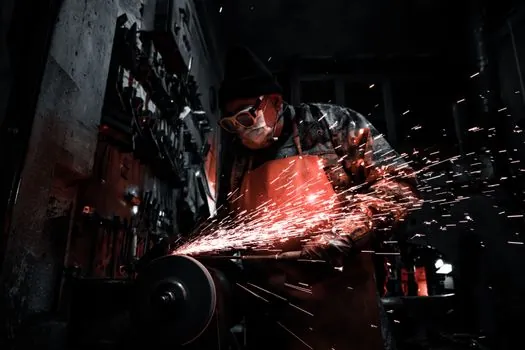
Select a high-frequency angle or straight grinder according to casting access, abrasive support, power requirements, and practical handling considerations [S6].
Compare the main options against the four variables that control large-casting economics:
<strong>Against removal rate:</strong> the wheel wins at gates, risers, and flash because it is intended for heavy stock removal. A large wheel may also remove more metal per pass where the casting geometry permits broad contact.
<strong>Against access:</strong> the handheld wheel wins because the operator and tool travel to the casting. The fixed belt wins only when the casting can be moved safely into its work envelope.
<strong>Against finish:</strong> the belt offers the better smoothing result because belt sanding is associated with a finer surface, while belt grinding remains faster but rougher [S4].
<strong>Against integration effort:</strong> a stationary belt requires a loading, supporting, and indexing system for large parts. A handheld grinder requires a good fixture, lifting aid, housekeeping discipline, and controlled access, but avoids a conveyor or powered roller layout.
The stated comparison values are useful for an initial shortlist, not a final equipment specification: 500–2,500+ W angle grinders, 300–900 W die grinders, 1–5+ HP stationary belt sanders, 4,000–8,000 SFPM belt speed, and 2,800–3,600 RPM bench grinders cover distinctly different duties [S1].
Safety, Quality Control, and Failure Modes
Wheel selection must match the machine and the removal task because the intended wheel, cut-off wheel, and belt formats impose different operating and handling requirements [S1][S3].
The common failure modes are predictable. A wheel used for cutting may wear rapidly and work inefficiently [S7]. A belt used for heavy stock removal on an undersized fractional-horsepower machine will wear faster than on a larger machine [S2]. A fixed belt selected for an oversized casting creates loading and pinch-risk problems before any finishing benefit is gained [S1].
Three controls should therefore be written into the fettling instruction:
• Separate heavy removal from blending duties and state the designated abrasive for each.
• Record abrasive consumption, elapsed fettling time, remaining stock, and achieved surface condition by casting family.
• Define support and repositioning methods for heavy castings so the operator is not using abrasive pressure as a substitute for secure workpiece control.
For procurement, calculate cost per casting rather than cost per belt or wheel. Include labor time, abrasive consumption, wheel or belt changes, surface rework, and any damage caused by over-removal. The correct choice is the system that removes the required stock with the fewest safe handling and rework operations.
The next verifiable step is to trial one representative large casting with a 230 mm grinding wheel for gate and flash removal and a production-rated belt or flap disc for blending, then compare minutes per casting, abrasive units used, and final surface acceptance results.