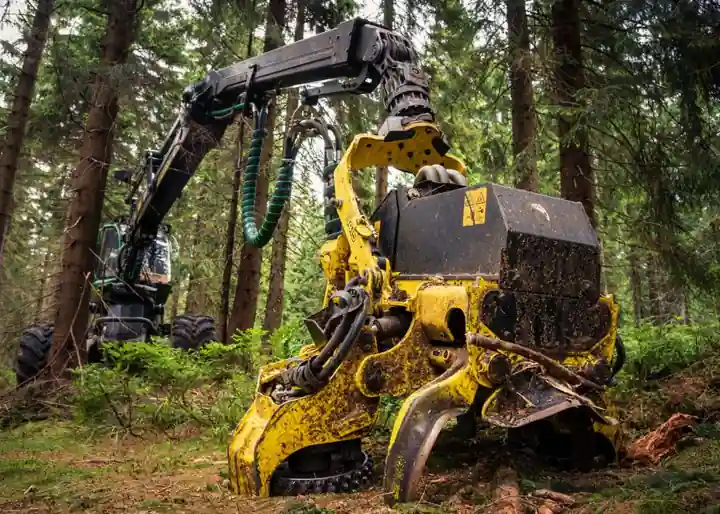
Forestry-spec skid-steer loaders sit in a narrow operating window: 70-100 hp engine output, ≥30 gpm (113 L/min) high-flow auxiliary hydraulics, 1,800-2,200 lb (816-998 kg) rated operating capacity (ROC), and a factory forestry cab rated to FOPS Level II for falling trees and rocks [S1][S3][S6].
Standard-flow machines in the 1,300-1,600 lb ROC band (e.g., the Bobcat S130 at 1,300 lb / 590 kg ROC, 49 hp Kubota V2403 diesel, 7.3 mph travel speed) [S1] are explicitly under-powered for production mulching; the Diamond Mowers engineering note flags sub-70 hp platforms as marginal for any high-flow rotary cutter above 60 in (1,524 mm) cutting width [S3].
ROC, Tipping Load, and Counterweight Math
Rated operating capacity (SAE J732) is the spec that determines whether a forestry skid-steer can actually carry a mulching head at full lift height without tipping [S1][S7]. The Bobcat S130 baseline delivers 1,300 lb (590 kg) ROC, scaling to 1,400 lb (635 kg) with the factory counterweight option, against a 2,634 lb (1,195 kg) SAE tipping load; lift breakout force is 2,800 lb (1,270 kg) and tilt breakout is 3,000 lb (1,361 kg) [S1]. The CASE B-series mid-frame line spans 1,600-2,100 lb ROC at operating weights of 5,645-6,970 lb, with engine power from 60-74 hp and lift heights at pin between 112-123 in (2,845-3,124 mm) [S5].
Forestry attachments add 800-1,400 lb of dead weight, so a 1,300 lb ROC machine is functionally a 0 lb machine the moment a 60 in rotary cutter is hung on the auxiliary plate; operators routinely select the next ROC class up and add rear counterweights rather than chase the spec sheet [S3]. Across the 370-model population indexed by RitchieSpecs, ROC ranges 370-4,130 lb and operational weight 1,750-18,528 lb, with net power 15-191 hp [S2].
High-Flow Hydraulics and Hydraulic Horsepower
Hydraulic horsepower, not engine horsepower, drives a forestry mulcher, and is calculated as flow × pressure / 1,714; a 70-100 hp skid-steer paired with a high-flow circuit typically delivers the 40-60 hydraulic hp needed to keep a 60-72 in rotary head at rated rotor RPM without stalling [S3]. Standard-flow circuits (≈15-20 gpm) cannot sustain a production mulcher; high-flow auxiliary plumbing at 30-40 gpm (114-151 L/min) is the practical floor for any disc- or drum-style forestry head [S3][S6].
Tracked forestry platforms from manufacturers including ASV, Bobcat, Caterpillar, John Deere, Kubota, New Holland, and Takeuchi are typically specified for the role because lower ground pressure improves stability on slopes and soft soils, while wheeled machines remain acceptable on prepared, level sites [S3][S6]. The CASE SR210B at 2,100 lb ROC, 6,970 lb operating weight, 123 in lift height at pin, and 74 hp engine illustrates the upper end of the mid-frame class that forestry buyers cross-shop against the dedicated forestry packages from ASV and Caterpillar [S5][S6].
FOPS Level II Cab and Operator Protection
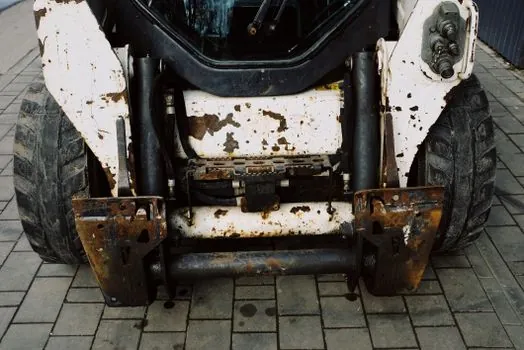
FOPS Level II (Falling Object Protective Structure, Level II) acceptance is the engineering certification that separates a landscaping skid-steer from a forestry skid-steer: it is defined for protection from falling trees, rocks, and debris in site clearing, overhead demolition, and forestry operations, in contrast to FOPS Level I which only covers falling bricks, small concrete blocks, and hand tools in highway maintenance and landscaping duties [S1]. Polycarbonate cab doors, chain curtains, hydraulic intake debris deflectors, and rear-screen guards are the standard add-ons in factory forestry packages, and OEM-published guides flag them as required rather than optional for any production mulching cycle [S3].
Beyond FOPS, the cab environment also needs ROPS (Roll-Over Protective Structure) integration, and most current forestry-spec loaders pair FOPS Level II with a sealed, pressurized cab with HEPA filtration, because fine organic particulate load in a mulching cycle will defeat a standard filtration element in under 50 hours [S3][S6]. Buyers who skip the cab rating to save capital cost typically pay it back in the first operator injury or the first dropped tree through a non-FOPS roof.
Attachment Cutting Width, Coupler, and Lift Match
Forestry mulching heads are commonly offered in 50-84 in (1,270-2,134 mm) cutting widths, with 60 in (1,524 mm) the most common production size; pairing an 84 in head to a 1,600 lb ROC machine is a maintenance event, not a working setup, because the head's own weight can exceed 25% of ROC at full lift height [S3]. Hydraulic couplers must match the carrier's high-flow flat-face connectors; a 60 in head on a standard-flow auxiliary is a guaranteed stall [S3][S4].
Lift geometry also matters: vertical-lift linkage is preferred when the work is at or above eye level (loading trucks, pushing into canopy), while radial-lift machines are acceptable for below-eye-level work (low brush, ground-engagement mulching) [S3]. A radial-lift 2,100 lb ROC machine with a 60 in forestry head will out-produce a vertical-lift 1,600 lb ROC machine on the same head on flat ground, but the vertical-lift platform earns its keep on truck-loading and high-reach selective clearing [S3][S5].
Selection Comparison: Mid-Frame vs Heavy Forestry Platforms
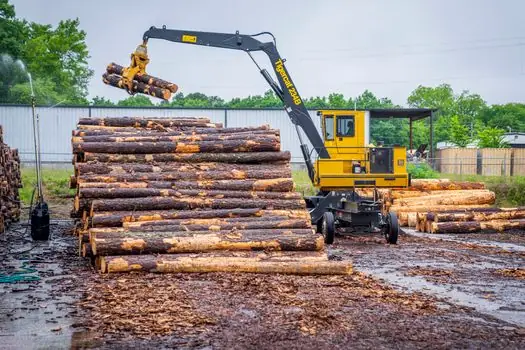
Mid-frame skid-steers in the 1,600-2,100 lb ROC band with 60-74 hp engines (CASE SR160B through SR210B, Bobcat S650-S770 class) [S5] handle 50-60 in forestry heads on light-to-medium brush, with operating weights of 5,645-6,970 lb and lift heights at pin of 112-123 in. Heavy forestry platforms (Bobcat T86, Caterpillar 299D3 XE, John Deere 333G, ASV RT-135 Forestry, Takeuchi TL12V2, Kubota SVL97-2, New Holland C345, JCB 3-series) sit in the 2,500-4,130 lb ROC band with 90-110 hp engines, and are the spec for 72-84 in heads, full-time mulching cycles, and steep or soft terrain [S2][S6].
The decision is governed by four criteria: ROC class (mid-frame 1,600-2,100 lb vs heavy 2,500-4,130 lb), engine power (60-74 hp vs 90-110 hp), high-flow hydraulic capacity (typically 30-35 gpm mid-frame vs 35-45 gpm heavy), and ground-contact system (wheels acceptable on hard, level sites vs tracks mandatory for slopes, soft soils, and standing brush) [S2][S3][S5][S6]. For dedicated forestry mulching contractors running 1,000+ hours per year, the heavy class is the only economic answer; for diversified operators splitting time between landscaping, light construction, and seasonal brush work, the mid-frame class with a forestry cab and high-flow option is the lower-total-cost spec.
Sourcing, Pricing Models, and Buy vs Rent Signals
Direct-to-consumer forestry attachment brands offer transparent pricing and shorter lead times than traditional dealer channels, but the skid-steer carrier itself is still predominantly dealer-sourced for warranty, financing, and FOPS-rated cab certification; the morningagclips buyer's guide notes that direct-to-consumer is most common for the head, not the carrier [S4]. For low-hour or seasonal operators, rental with a forestry cab and high-flow plumbing is the lower-risk path: a typical rental avoids the $40,000-80,000 capital outlay for a dedicated heavy forestry platform and lets the operator test ROC class and head width before committing [S4][S8].
Verifiable next signals to track: OEM release notes for FOPS Level II factory cab options on mid-frame B-series (CASE SR175B, SR210B already documented at 1,750 lb and 2,100 lb ROC) [S5], updated SAE J732 ROC curves for high-flow forestry heads above 72 in cutting width, and any dealer-channel price moves on heavy forestry platforms (Bobcat T86, Caterpillar 299D3 XE, ASV RT-135 Forestry) through Q4 2026. For a broader view of how ROC, cab safety, and fire suppression requirements carry over to mining-spec skid-steers, see the skid-steer spec map for mining.
The underlying component specifications are covered under skid steer loader, backhoe loader, and wheel loader.