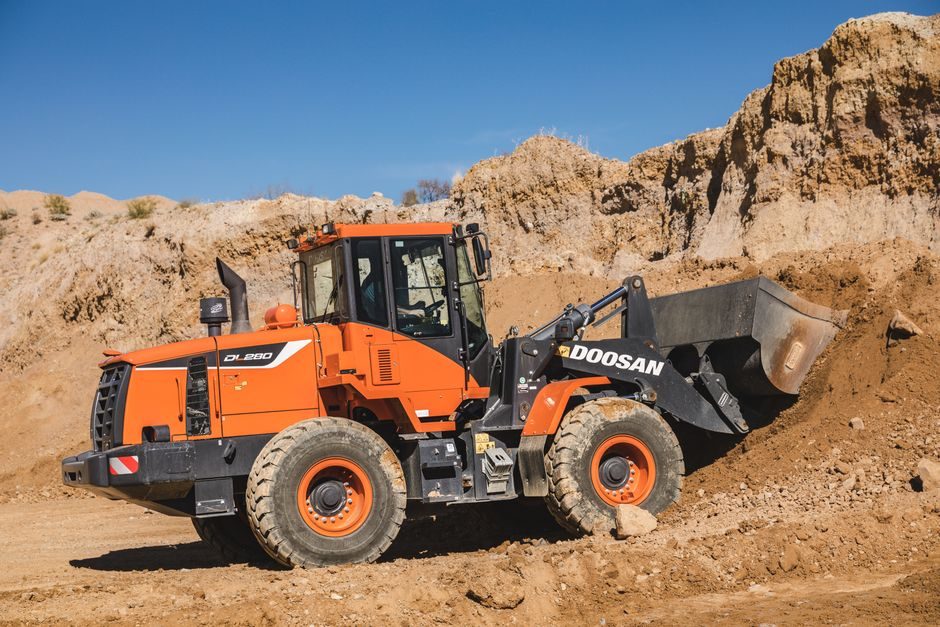
Selecting a quarry excavator is a four-axis decision — operating weight class, diesel engine power, crawler undercarriage duty, and breaker/hydraulic tool pairing — and the production-tier benchmark remains the Cat 60 series with operating weights from 154.3 t (170.1 us ton) up to 660 t (727.5 us ton) and engine power from 824 hp to 3,023 hp [S2].
For mid-size aggregate and dimension-stone quarries, Deere mining & quarrying crawlers and similar diesel-hydraulic carriers from the same tier fill the gap below 150 t, and dedicated two-moving-part hydraulic breakers such as the BTi series cover the primary-break duty across construction, demolition, recycling, mining, and quarrying applications [S1][S3].
Operating weight classes and what they actually carry
The Cat 60-series payload range of 154.3 t minimum to 660 t maximum — roughly a 4.3× span — is the widest among OEM hydraulic-shovel lines and is engineered to pair with the manufacturer’s mining-truck family for matched-payload loading [S2].
Quarries running 30–90 t articulated haulers usually sit in the 50–120 t excavator bracket; below that, compact and mid-size carriers handle shot-rock loading and scalp work, while 150 t+ machines move into primary face-loading duty where a single pass equals a truck payload. A 660 t class shovel is not a mobile unit — it is assembled on site, which is why OEM literature describes the 6020B as “easy to assemble, easy to learn, easy to operate and easy to maintain” [S2].
Engine power and the diesel-only reality
Every entry in the current quarry-crawler catalogue runs diesel: the Cat 60 series is explicitly diesel, the Deere mining & quarrying crawler range is diesel, and no major OEM in this segment lists a viable fully electric quarry-class excavator for primary hard-rock duty [S1][S2].
Power density matters because limestone, granite, and basalt benches demand high hydraulic flow rather than just tractive effort. The 824–3,023 hp envelope on the 60 series lets a single machine drive either a large boom-and-stick configuration or a heavy breaker at sustained duty cycle [S2]. For the broader decision framework used in adjacent mobile-equipment categories, the cut-off machine selection map for road maintenance walks through the same power-to-blade/duty matching logic that applies when sizing a hydraulic breaker.
Primary break, secondary break, and breaker matching
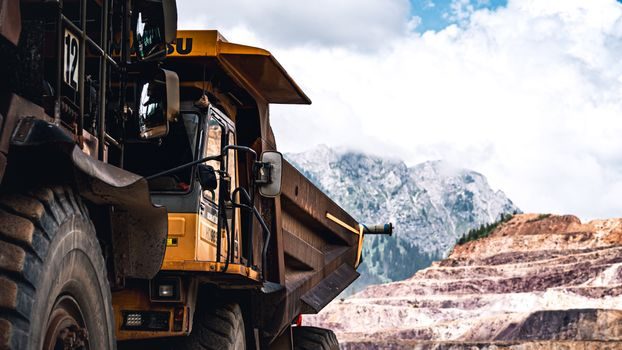
The BTi hydraulic-breaker design uses only two internal moving parts, and is specified for construction, demolition, recycling, mining, and quarrying duty — a single attachment platform that covers secondary breaking at the face, boulder reduction in the pit, and selective demolition on dimension-stone benches [S3].
Two-moving-part architecture is the relevant reliability spec because breaker downtime is the dominant cost driver in a quarry — not the carrier machine itself. The carrier-to-breaker weight ratio is the next decision: a breaker rated for a 30–50 t carrier will be under-utilised on a 200 t shovel, while a breaker sized for 200 t+ machines will not cycle fast enough on a 40 t carrier. For tunnel-style hard-rock drives with similar tool-carrier logic, the angle grinder selection map for tunnel construction sites covers the matching of tool to confined-space duty.
Selection criteria compared: Cat 60 vs Deere quarry crawler vs BTi breaker
The table below lines the three options against the four decision axes a quarry engineer actually weighs. Numbers are sourced verbatim from the OEM catalogues; where a value is not published, the cell is left qualitative rather than guessed.
Cat 60 series: operating weight 154.3–660 t, engine 824–3023 hp diesel, locomotion crawler, application mining & quarrying, breaker fit integrated hydraulic-shovel boom (not a bolt-on breaker) [S2]. Deere mining & quarrying crawler: operating weight in the mid-size excavator class, locomotion crawler, engine diesel, application mining & quarrying, breaker fit accepts mid-size bolt-on hydraulic breakers such as the BTi range [S1]. BTi hydraulic breaker: two internal moving parts, applications construction/demolition/recycling/mining/quarrying, weight class matched to mid-size and large carriers via the OEM sizing chart, duty primary and secondary break [S3].
The 60-series pays off when face height, truck payload, and annual tonnage justify a 150 t+ shovel; the Deere crawler is the workhorse for sub-150 t quarries and is the only realistic carrier if the operation also runs a BTi breaker for boulder reduction; the BTi breaker itself is the right call whenever any carrier in the fleet hits oversize that a mobile breaker can crack without secondary blasting.
What quarrying is — and is not — the right use case
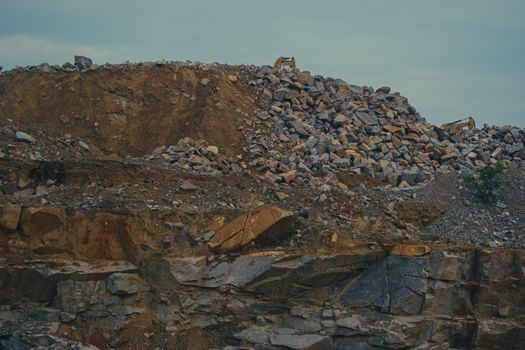
Quarrying here means hard-rock aggregate, dimension stone, and industrial-mineral extraction where the face is drilled-and-blasted or ripped, not soft-ground trenching or bulk earthworks. The 60-series application label is explicitly “mining and quarrying”; Deere’s mining & quarrying crawler line covers the smaller end of the same duty; and the BTi breaker is rated across the same five segments — construction, demolition, recycling, mining, and quarrying [S1][S2][S3].
These machines are not the right pick for finish-grading, landscaping, indoor demolition, or any site where a compact mini-excavator would already do the job — a 660 t shovel is wasted on a 200 t/day yard. Conversely, a compact carrier is the wrong tool for a 10,000 t/day limestone bench because it cannot sustain the hydraulic flow a heavy breaker needs at production cycle rates. For operations that also run compressed-air or pneumatic tooling on the same site, the solenoid coil selection map is a useful cross-reference for matching electrical control hardware to dust-heavy, vibration-heavy quarry duty.
Failure modes and constraints to plan for
The dominant failure mode on a quarry excavator is not the engine — it is undercarriage wear on crawler machines and hydraulic-breaker downtime on the tool side. Crawler undercarriage life scales inversely with face-floor rock hardness, and a 660 t shovel on abrasive granite will see track-pin and sprocket life measured in a few thousand hours rather than the 10,000+ hours typical of softer-ground applications [S2].
Breaker downtime concentrates in the bushings, accumulators, and the two moving parts (piston and valve) that the BTi architecture deliberately minimises [S3]. On the tool side, the strain gauge selection piece covers the same alloy-versus-environment reasoning that applies when specifying wear-resistant steel in breaker bushings and tool retainers exposed to silica dust.
Sourcing, standards, and trackable signals
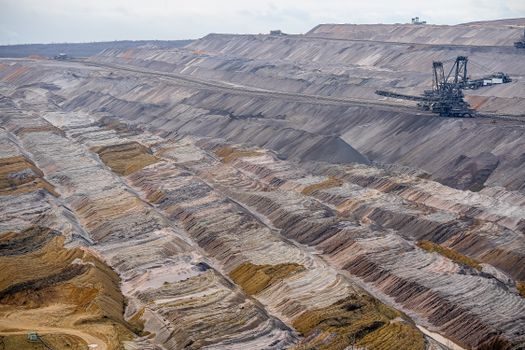
OEM published specs are the only reliable source for the operating-weight and engine-power envelope — Cat publishes 154.3–660 t and 824–3023 hp for the 60 series [S2], Deere publishes mid-size mining & quarrying crawler data via its manufacturer catalogue [S1], and BTi publishes the two-moving-part design point directly [S3]. No industry-wide standard governs excavator selection for quarrying; the relevant codes are site-specific (MSHA in the US, equivalent national bodies elsewhere) and are not retrofitted onto a spec sheet.
Trackable signals for the next planning cycle: OEM updates to the 60-series payload-and-power envelope, the first credible diesel-electric hybrid quarry excavator in the 100–200 t class, and any third-party BTi-breaker sizing chart revision for the 150 t+ carrier tier [S1][S2][S3].
Spec-level background on the components involved: excavator, pressure transmitter, and flow meter.