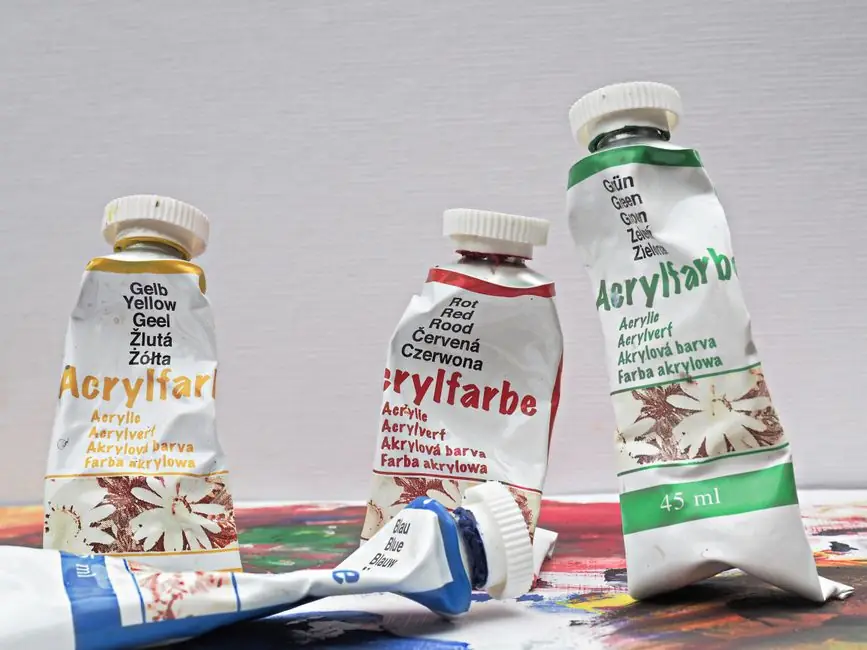
Alkyd and acrylic paint binders produce films with measurably different long-term durability profiles, and the choice is driven primarily by substrate, exposure, and cure-time tolerance rather than price [S1][S3].
Alkyd resins cure by oxidative crosslinking with atmospheric oxygen, a slow chemistry that builds high surface hardness and strong metal adhesion; acrylic resins dry mainly by water or solvent evaporation and particle coalescence, yielding flexible, UV-stable films that resist chalking on exterior walls [S1][S5]. For spec-driven projects, the question is never "which resin is better" but "which failure mode matters more in this service environment".
Resin Chemistry and Curing Mechanism
Alkyd resins are oil-modified polyesters built from vegetable oils (commonly soya or linseed), polyols, and petroleum solvents; the oil length is the key grading variable, with short-oil grades under 45% oil, medium-oil at 45-55%, and long-oil above 55% [S4]. Short-oil alkyds air-dry slower and harder; long-oil grades are more flexible and penetrate timber better [S4].
Pure acrylic resins contain no vinyl or styrene modification, which gives them superior UV resistance, colour retention, and weather durability versus blended acrylic systems [S3]. Styrene-acrylic and vinyl-acrylic copolymers cut cost and improve opacity but trade away some long-term exterior durability, with PVA (polyvinyl acetate) binders further limited to low-moisture interior use [S3]. For deeper resin-background context, see the synthetic resin reference entry.
Drying Speed and Hardness Development
Acrylic resins typically dry faster to touch but may not achieve optimal hardness immediately, whereas alkyd resins develop superior ultimate hardness at the cost of longer cure time [S5]. The underlying reason is the curing dichotomy: alkyd oxidative crosslinking keeps building molecular weight for days, while acrylic films reach most of their final properties once water or solvent has left the film [S5].
Practical consequence for contractors: an alkyd trim coat can feel "tacky" on cabinet doors for days because "dry" (no longer wet to the touch) and "cured" (fully blocked-resistant) are different milestones, with full alkyd cure often measured in weeks [S2]. Acrylic systems shorten recoat windows and reduce dust pickup, which is why waterborne acrylic cabinet paints have displaced classic solvent alkyds in many residential trim applications [S2].
Durability Criteria: Hardness, UV, Adhesion, Flexibility
Alkyd films are described as the best compromise between durability and flexibility for indoor use including kitchens and bathrooms, with strong adhesion to metal and good moisture resistance once cured [S4]. Their main weaknesses are yellowing in low-light conditions and slower solvent-borne dry times, which is why urethane-modified alkyd grades are commonly used to improve blocking resistance on doors [S2][S3].
Pure acrylic films resist cracking as substrates expand and contract, retain flexibility over time, and are commonly specified for exterior masonry and façades exposed to strong sunlight and heavy rainfall [S3]. Alkyd is the higher-hardness, higher-adhesion option; pure acrylic is the higher-UV, higher-flexibility option. For applications requiring both traits, urethane-modified acrylic and waterborne alkyd hybrids are now standard cabinet-coating workhorses, with waterborne alkyds giving classic enamel flow at lower odour [S2].
Side-by-Side Comparison on Decision Criteria
Comparing the three dominant binder families against four spec criteria gives a usable decision matrix: alkyd scores high on hardness and metal adhesion but low on UV and yellowing resistance; pure acrylic scores high on UV, colour retention, and flexibility but lower on ultimate hardness; urethane-modified hybrids balance hardness with faster cure, at higher raw-material cost [S1][S2][S3].
Drying-to-touch: acrylic faster than alkyd; ultimate hardness: alkyd higher than acrylic; UV and colour retention: pure acrylic higher than alkyd; metal adhesion: alkyd higher than water-based acrylic [S1][S3][S5]. This trade-off is exactly why cabinet-coating formulators now offer three parallel SKUs (waterborne alkyd, urethane-modified alkyd, urethane-modified acrylic) rather than a single "best" resin [S2].
Selection by Use Case

For exterior masonry, façades, and any surface with strong sun or rainfall exposure, specify pure acrylic, not styrene-acrylic or vinyl-acrylic blends, because pure grades contain no vinyl or styrene modification and therefore deliver superior UV resistance and weather durability [S3]. The penalty is slightly higher cost versus vinyl-acrylic, and the benefit is decades of service rather than years [S3].
For interior trim, doors, cabinets, and metal equipment, alkyd remains the default because of its enamel feel, smooth levelling, and abrasion resistance; a waterborne alkyd cuts odour while preserving the classic cure profile [S2][S4]. For factory floors, structural steel, or impact-prone industrial surfaces, alkyd or alkyd-urethane hybrids are preferred for hardness and solvent resistance, with the caveat that ventilation must be designed around higher solvent content [S1][S4].
Limitations, Failure Modes, and Health Considerations
Alkyd paint typically has stronger odour and higher volatile solvent content than acrylic, so application areas need good ventilation and solvent cleanup is required, while acrylic systems clean up with water and have lower VOC, which makes them more suitable for enclosed or occupied spaces [S1][S2]. Alkyd films can yellow under low-light interior conditions and chalks faster than pure acrylic under UV, the two most common in-service failures cited across the formulation guides [S3].
Acrylic systems fail differently: they are softer at peak hardness, more sensitive to solvent exposure post-cure, and can show early blocking (sticking) on cabinet doors if recoated before the previous film has coalesced [S2]. Both resin families are sensitive to substrate preparation; the Berkem technical brief stresses that alkyd's compatibility with most materials holds "as long as they are prepared properly", meaning primer selection and surface profiling are not optional on either chemistry [S4].
Standards, Sourcing, and Trackable Signals

No single ISO or ASTM standard uniquely governs "alkyd versus acrylic" binder selection; instead, performance is qualified by resin-specific test methods for hardness (pendulum or pencil), adhesion (cross-cut), and accelerated weathering (QUV or xenon arc) referenced in coating manufacturer datasheets [S1][S3]. Specifiers should request the actual test data sheet rather than rely on resin-family labels alone, because the same "acrylic" label can cover pure, styrene-acrylic, or vinyl-acrylic grades with very different exterior durability [S3].
Trackable signals for the next 6-12 months: continued growth of waterborne alkyd and urethane-modified acrylic SKUs in cabinet and trim catalogues, and ongoing reformulation pressure driven by regional VOC caps, which is pushing both resin families toward lower-solvent architectures [S2][S5]. For projects that need both fast recoat and high ultimate hardness without committing to a 2K urethane, urethane-modified acrylic is now the most widely stocked compromise grade on industrial paint-room shelves [S2].
For the relevant spec sheets and selection criteria, see peek, and pom.
See also our earlier report, Ring inductive proximity sensors for small falling parts: spec, sizing, IO-Link.