For fatigue- and impact-loaded forged parts, round alloy steel bar stock is the stronger feedstock because forging aligns continuous grain flow with the principal stress direction; alloy plate, by contrast, is the right starting stock when the finished part is flat, wide, and welded rather than deeply loaded in one axis [S1][S2].
Forged alloy steel is heated to 1,050–1,250°C and shaped under compressive force from a hammer or press, a process that closes porosity, breaks up chemical segregation, and lets hardenability-enhancing elements (chromium, nickel, molybdenum, vanadium) deliver uniform properties across the full cross-section [S2]. Carbon content in most alloy steel forgings sits at 0.20–0.55%, high enough to develop strength through quench-and-temper but low enough to avoid hot-cracking during forging [S2].
Why Bar Stock Beats Plate for Most Forged Shafts, Gears, and Valves
Bar stock is the default feedstock when the finished forging has a primary load axis, such as drive shafts, pinions, valve bodies, and high-strength studs, because the as-forged grain runs longitudinally and follows the part geometry [S5]. Machining a shaft out of plate slices through the rolled grain and creates stress-raiser sites along every cut edge; forging from round bar keeps the grain continuous from end to end [S5]. The standard workhorse grades in this category are 4140 (nominally 0.95% Cr, 0.20% Mo), 8620 (0.55% Ni, 0.50% Cr, 0.20% Mo), and 4340 (1.80% Ni, 0.80% Cr, 0.25% Mo), all of which are deep-hardening through quench-and-temper and routinely used for aerospace, power-generation, and oil-and-gas service [S3]. For high-vibration hardware, 6150 chrome-vanadium (0.80% Cr, 0.15% V min) is typically specified to chemistry rather than physical properties for its resistance to vibratory stress [S4].
Where Alloy Plate Is the Right Feedstock
Alloy plate becomes the better choice when the part geometry is flat or wide, the load is multi-axial rather than directional, and the design relies on welding, machining from thickness, or flame cutting to net shape [S4]. Common plate-fed forged or heat-treated components include machine bases, large gear blanks, flanges, and structural brackets where uniform through-thickness hardness matters more than longitudinal grain flow. 4140 alloy plate in the annealed or DCF (decarb-free) condition is the most widely stocked grade, with 6150 and 8620 available for higher-vibration or case-hardening requirements [S4]. One important caveat: 4140 plate is not easily welded without pre- and post-weld thermal treatment, so any welded fabrication has to plan for cold-cracking mitigation or step down to a more weldable grade [S4].
Cost Premium and Procurement Reality
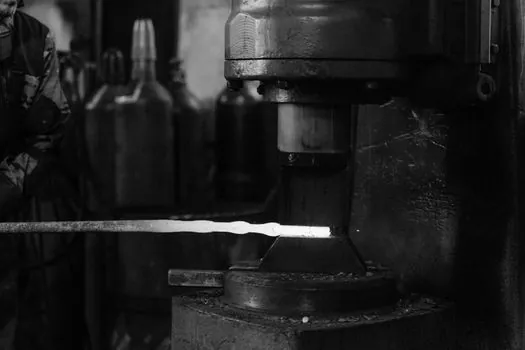
Forged bar stock costs 20–50% more than equivalent rolled bar, with the exact spread driven by alloy content, heat-treatment state, and required ultrasonic testing [S5]. The premium funds three things the buyer actually gets: directional grain flow, internal soundness verified by UT, and a Mill Test Report (MTR) that ties chemistry and mechanical properties to a specific heat [S5]. For procurement, the practical gate is simple: if the part is safety-critical, fatigue-loaded, or subject to NACE/MRO duty, the 20–50% premium is recovered through longer service life and avoided warranty events; if the part is static and dimension-driven, plate or rolled bar is the economical call [S5].
Specifying the Right Heat-Treatment State
Alloy bar and plate are typically supplied annealed or DCF for machinability, then quench-and-tempered by the forge shop to the final hardness specified on the drawing [S4]. Pre-hardened plate such as Toolox 44 skips the post-machining heat treat entirely, which is useful for mold bases and machine frames where distortion from a second heat-treat cycle would be costly [S4]. The alloying elements themselves do not make the steel harder; they increase the depth to which the section can be hardened during quenching, which is why 4140 works for moderate sections while 4340 is chosen for thick, heavily loaded cross-sections [S3][S4].
Comparison Matrix: Bar vs Plate for Forged Components

Use the following four-criterion table to size the decision before opening a quotation: grain-flow direction, typical section thickness, weldability, and cost premium over rolled stock. [S3]
Alloy bar stock: continuous longitudinal grain flow after forging, best for sections up to roughly 12 inches in diameter, generally not welded (4140 needs pre/post-weld thermal treatment to avoid cold cracking), costs 20–50% more than rolled bar [S1][S4][S5]. Alloy plate: multi-axial grain structure, best for flat parts and thicknesses from roughly 0.5 inches upward, 4140 plate can be welded with proper procedure, costs less than forged bar but more than hot-rolled plate [S4]. Cast alloy steel is a third option retained in this comparison only for complex near-net shapes; it carries the residual risk of porosity and shrinkage voids, which is the reason forged bar is preferred for landing gear, propeller shafts, and high-pressure valve bodies [S2].
Recommended Grade-to-Form Mapping
For shafts, pinions, and high-stress studs specify 4140 or 4340 forged bar, quenched and tempered to 28–32 HRC for general service or 34–38 HRC for higher fatigue duty [S3]. For case-hardened gears and pinions where a tough core and hard wear surface are required, specify 8620 forged bar with carburizing and tempering [S3][S4]. For high-vibration shafts and spring-like components, 6150 chrome-vanadium bar is the conventional call, typically bought to chemistry rather than physical-property minimums [S4]. For machine frames, large brackets, and tooling bases, annealed 4140 plate or pre-hardened Toolox 44 plate is usually the right starting stock, with the choice driven by whether the part needs a final through-hardening heat treat [S4].
Limits and Failure Modes to Plan Around

Three failure modes drive the bar-vs-plate decision more than any property chart. First, weld cracking on 4140 plate if pre-heat and post-weld stress relief are skipped, the standard root cause of field failures in fabricated weldments [S4]. Second, insufficient through-thickness hardenability when a thick plate is ordered in a lower-alloy grade and the core never reaches the specified hardness, leaving a soft centerline under the hardened surface [S3]. Third, machined-from-plate fatigue initiation, where cutting through rolled grain on a shaft or lever arm creates a built-in stress riser; this is the failure mode forging is specifically chosen to avoid [S1][S5]. For procurement, each of these is addressed by a single document: the MTR, which must list chemistry, heat-treatment condition, and UT results for the actual heat delivered [S5].
Track these signals on the next RFQ: whether the supplier can deliver UT-verified bar stock to ASTM A388 or equivalent, whether 4140 plate orders include a pre-heat and post-weld stress-relief procedure, and whether the quoted heat-treatment state (annealed versus Q&T versus pre-hardened like Toolox 44) matches the machinability allowance on the drawing [S4][S5]. For related spec work on adjacent components, see expansion anchor selection for fasteners going into these alloy bases and air-hardening vs oil-hardening tool steel for the die-side decision when forging dies are specified.
For component-level specifications, see steel plate, orifice plate flowmeter, and plate heat exchanger.