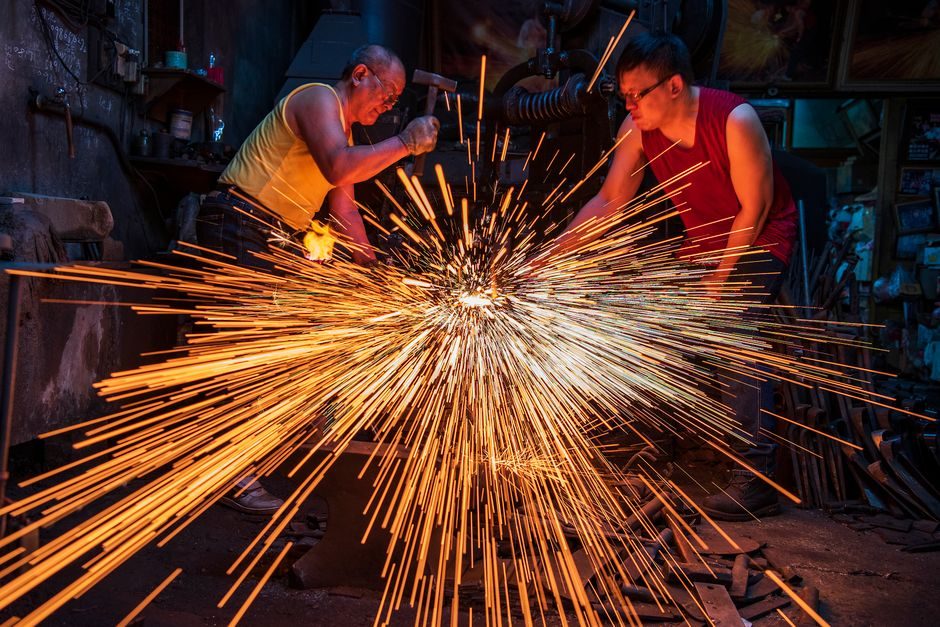
Forging press list prices span roughly US$270,000-300,000 for a 1-piece MOQ Chinese cold forging press [S2] up to seven-figure tags for European CNC screw presses rated 4,100-102,400 kN such as the FICEP DD series [S1].
The price gap of roughly 10x between an entry-level Asian cold header and a top-end European mechanical forging ram is set by nominal force, stroke, drive architecture, and the presence of a kinetic-energy recovery system (KERS), not by chassis weight alone [S1][S2].
Force Class and Price Bands
Forging presses are sold by nominal ram force, and the price curve is steep: a Chinese cold forging press listed at US$270,000-300,000 with 1-piece MOQ and 100 set/month production capacity from a Qingdao supplier [S2] sits at the low end of the market, typically corresponding to sub-2,500 kN class machines aimed at automotive fasteners and small cold-headed parts.
At the top of the range, the FICEP DD mechanical screw press covers 4,100-102,400 kN nominal force with strokes of 350-1,250 mm and rates of 9-42 strokes/min, with FICEP explicitly positioning the DD line as the "industry leader" in direct-drive screw press technology [S1]. A machine in the 8,000-10,000 kN class from a European OEM typically lists in the US$2-5 million band, while a 60,000+ kN open-die forging press from Asian or European builders can run US$8-15 million before installation.
For buyers comparing tonnage, a useful rule of thumb is that each doubling of nominal kN roughly adds 60-90% to the press price, because the frame, bed, ram, and energy storage components scale non-linearly with force.
Mechanical Screw vs Hydraulic vs Hammer
The three dominant architectures — mechanical screw press, hydraulic press, and forging hammer — divide the market by part geometry, tolerance, and production rate. The FICEP DD series is a mechanical screw press with a brushless linear motor applied directly to the flywheel and a KERS module that recovers braking energy for the next stroke, giving "considerable reduction of the cycle time" and "higher impact speed which reduces the contact time with the dies" [S1].
Hydraulic presses, including FICEP's HF and PVX series hydraulic forging and trimming lines, trade raw impact speed for controllable force throughout the stroke, which suits deep-draw and extrusion work where a fixed bottom dead-band is unacceptable [S1]. Hammers remain the cheapest per-tonne option for open-die work but deliver the poorest dimensional tolerance and the highest foundation cost, since an 80 kJ hammer needs hundreds of cubic metres of concrete below it.
A practical decision matrix: pick a screw press for hot forging of symmetric parts at high throughput, a hydraulic press for closed-die work requiring precise force profile, and a hammer for low-volume open-die forging where capex dominates.
Drive, Control and Energy Architecture

The FICEP DD's "ROTATING LINEAR MOTOR" applies permanent magnets directly to the flywheel, which decouples the motor-flywheel assembly from excessive vibration and lets the press deliver rated energy at three-quarters of the ram stroke, not just at bottom dead-centre [S1]. This is the technical reason a direct-drive screw press can replace a larger conventional friction or clutch-driven press on the same part: usable energy per stroke is higher for a given nominal kN.
CNC control, listed as a standard characteristic on the FICEP DD line [S1], allows absolute programming of single- and multi-stroke energy values, which is what makes the press compatible with automated forging cells. Buyers should treat CNC package, servo-driven energy adjustment, and KERS as three separate line items on a quote, because some vendors price the controller as an option while others bundle it.
For buyers new to forging press selection, the broader specification logic for capital equipment follows the same gate-by-gate approach used in Investment Casting Equipment Selection: Four-Gate Spec Map for Foundry Buyers: force, stroke, rate, and energy architecture are the four gates, and skipping any one of them produces a press that is mis-specified for the part.
Total Cost of Ownership Beyond the Sticker
Sticker price is typically 55-70% of the five-year total cost of ownership for a forging press. The remaining 30-45% breaks down across foundation and civil works (8-15%), dies and tool holders (5-10%), installation and commissioning (3-5%), energy (5-12% over five years), and scheduled maintenance (3-6%). A 10,000 kN hydraulic press drawing 400-600 kW continuous on hot forging can consume US$150,000-300,000 of electricity per year at industrial European tariffs. [S1]
Energy recovery changes that math. The DD series' KERS module regenerates braking energy that would otherwise be lost as heat [S1], and combined with the linear-motor drive architecture, the press effectively stores kinetic energy in the flywheel between strokes. Buyers evaluating a KERS-equipped screw press against a clutch-friction press of the same nominal force should price the press on EUR/kWh-of-part, not on EUR/kN-of-ram, because kWh-per-forging is the figure that scales with production volume.
Spare-parts and service contracts are another hidden line item: forging presses with CNC-controlled energy profiling, such as the DD series [S1], require annual calibration of the force and energy sensors, and a typical service contract runs 4-7% of capex per year for the first five years.
Standards, Safety and Compliance
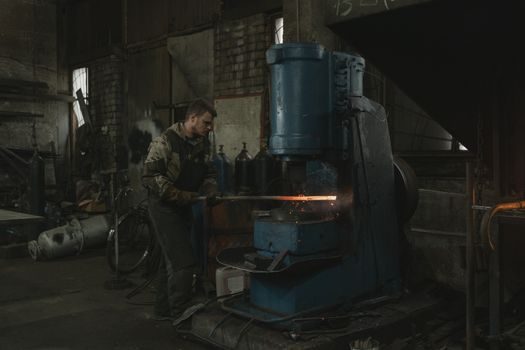
Forging presses above 10,000 kN in the EU typically fall under the Machinery Directive 2006/42/EC for guarding, light curtains, and two-hand control, while hydraulic accumulators above certain volume/pressure thresholds trigger the Pressure Equipment Directive 2014/68/EU. CNC-controlled presses with stored energy, like the DD series with its KERS flywheel [S1], must additionally comply with ISO 12100 risk assessment and ISO 13849 performance-level requirements on the safety-related parts of control systems.
For buyers in process-industry environments, the press's linear guide and crossed-roller guide systems that carry the ram and die slides are not generic machine-tool components — they are rated for the dynamic shock loading of forging, typically 3-5x the static rating, and lubrication intervals shorten from months to weeks in dusty forging atmospheres.
Foundry-grade buyers should also confirm the press's control cabinet's IP rating, since forging cells generate oil mist, scale, and radiant heat that defeat standard IP54 enclosures within a year; IP65 or cabinet air-conditioning is a sensible upgrade.
Sourcing Channels and Lead Time
Three sourcing channels dominate: direct OEM purchase (FICEP, SMS, Lasco, Kurimoto, NHI), Chinese trading-platform procurement (Made-in-China, Alibaba), and used/refurbished press dealers. The Qingdao cold forging press listed on Made-in-China at US$270,000-300,000 with 100 set/month capacity [S2] represents the platform-procurement channel, where price is competitive but pre-sales engineering, installation supervision, and CE/UL certification support vary widely between suppliers.
Lead time is the hidden cost differentiator. A new European CNC screw press in the FICEP DD class typically ships in 9-14 months from order to commissioning [S1], a Chinese cold forging press from a stock-configuration supplier can ship in 60-120 days [S2], and a refurbished 1980s-1990s mechanical press from a European dealer can be on the floor in 30-60 days — but with no warranty on the frame and limited spares for obsolete controls.
Buyers weighing capex against delivery should treat a 6-month shorter lead time as worth roughly 8-12% of press value, because a delayed forging cell starves downstream machining, heat treatment, and assembly lines that each have their own fixed costs. The same capex-vs-throughput logic is visible in adjacent capital-equipment categories, for example the Palletizer Price and Cost Guide 2026: Robot, Collaborative and High-Level Tier Map, where robotic and cobot palletizers are tier-mapped against throughput per hour.
For downstream sealing and fluid-handling hardware that often rides alongside a new press — hydraulic cylinders, valve manifolds, die-cooling circuits — the same MOQ-and-material logic in Oil Seal Price & Cost Guide: Material, Profile and MOQ Map and Bellows Seal Buying Guide 2026 applies: small-lot MOQ pricing is materially higher than bulk, and seal material choice (NBR, FKM, PTFE) drives both price and service interval.
Two trackable signals for the next sourcing cycle: European OEM price-list revisions typically land in Q1 and Q3, so a 2026-07-13 procurement window sits one quarter ahead of the autumn revision and is a sensible moment to lock quotes; and Chinese cold forging press capacity is reportedly running near full utilisation at the 100 set/month tier [S2], which means MOQ-1 pricing for custom tonnage classes will firm if the supplier's order book fills through Q4. Buyers should request written confirmation of CNC control scope, KERS inclusion, and industrial valve manifold certification before signing any press order above 5,000 kN nominal force.