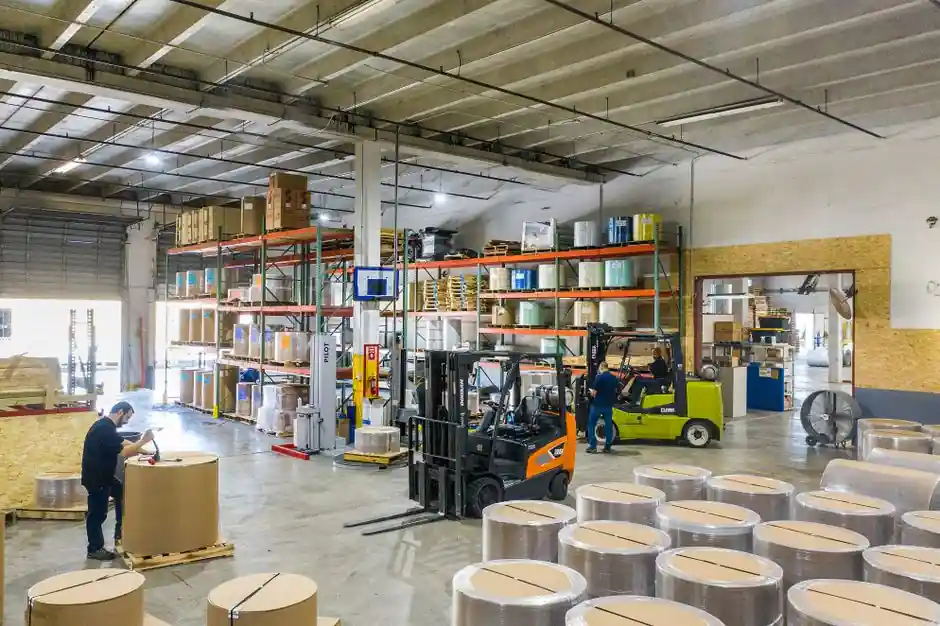
Full free lift raises the forks to the top of the inner mast section before the outer mast extends, making it the stronger choice for low-clearance entrances and trailers [S2][S4].
Free lift describes the initial fork travel before the mast sections extend, while full free lift is a more capable arrangement using a dedicated free-lift cylinder or equivalent mechanism [S1][S2].
Free Lift and Full Free Lift Defined
The decisive difference is the point at which overall mast height begins increasing. With a mast that has no free lift, the mast starts extending as soon as the forks begin rising. A full free lift mast allows the forks to reach the top of the inner section before the mast itself extends upward [S4].
Free lift is measured as the distance through which the carriage can rise while the collapsed mast sections remain stationary [S1]. The resulting fork elevation is called Free Fork Height, or FFH [S2]. In practical terms, free lift protects overhead clearance during the first part of the lift; it does not increase the forklift's final maximum fork height by itself.
The terms used by suppliers are not fully consistent. Some material uses “free lift” and “full free lift” interchangeably for the arrangement that provides meaningful travel before mast extension [S1][S2]. Specification work should therefore request FFH, overall lowered height, overall raised height, and maximum fork height rather than relying on the label alone.
Side-by-Side Selection Criteria
Full free lift is useful in areas where overhead clearance is restricted because the forks can rise before the inner channel extends. A simplex mast has one mast section, offers no free lift, and has a straightforward configuration with fewer moving components to maintain.
A duplex mast has two stages, and one listed mast configuration combines two stages with free lift. A triplex mast has three stages, and adding stages can provide more lift height while allowing a relatively compact lowered profile.
Visibility and maintenance burden then determine whether the extra mechanical complexity is justified.
Where Each Mast Configuration Fits
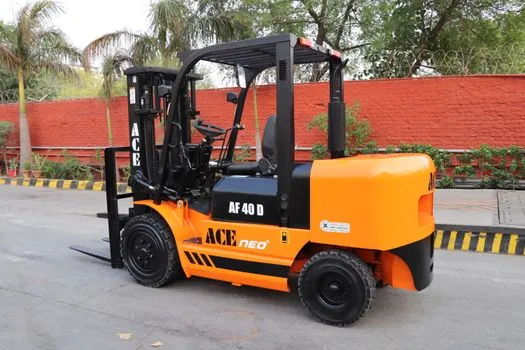
Full free lift is suited to confined spaces, including shipping containers, trailers, and doorways where the truck must enter before the forks are raised. Full free lift is useful where overhead clearance is restricted, including areas where the truck must lift and maneuver loads.
A simplex mast has a simple configuration, and the choice of mast can affect visibility. A quad mast uses four stages, and adding stages can provide more lift height while allowing the mast to collapse into a relatively compact lowered profile.
Clearance, Reach, and Visibility Trade-Offs
Maximum Fork Height, or MFH, is the fork height reached with all mast stages fully extended, while Overall Lowered Height and Overall Raised Height describe the mast top in its collapsed and extended conditions [S2]. These dimensions must be compared independently. A mast can have ample FFH yet lack sufficient MFH, or reach the required shelf while remaining too tall to enter the work area.
One practical sizing rule is to add at least 6 inches to the height of the highest racking shelf when setting the required lift height [S4]. That allowance supports load positioning when the mast is fully extended. It does not replace checking the actual fork, load backrest, overhead equipment, and clearance envelope for the specific truck and attachment.
Full free lift can interfere with the operator's line of sight through the load [S7]. The cylinder arrangement matters. Visibility should be checked with the actual carriage, load backrest, guard, and operator eye position rather than inferred from mast stage count alone.
Hydraulic, Structural, and Service Consequences
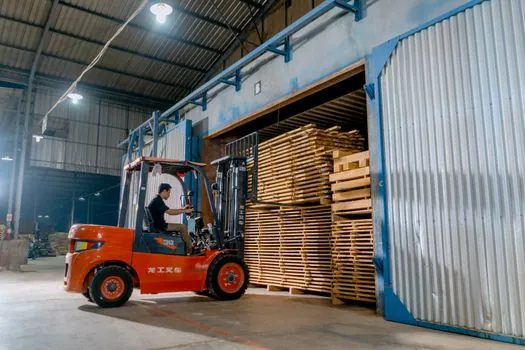
Full free lift allows the forks to rise before the mast sections telescope. By contrast, a simplex mast has one fixed channel and zero free lift, reducing component count and maintenance exposure [S4].
Triplex and quad masts add moving stages and are normally selected when final lift height matters more than minimum mechanical simplicity. A three-stage mast uses an outer rail arrangement with free lift plus two inner sections; a four-stage mast adds another stage for very high stacking and can achieve a shorter collapsed profile at equivalent maximum fork height [S4].
Neither free-lift arrangement should be accepted without checking rated capacity at the required fork height, attachment compatibility, chain or cable condition, cylinder seals, rollers, and the forklift's own data plate. A forklift data plate identifies the model and serial number, which support correct parts and technical-assistance selection [S3].
Specification Checklist for Procurement
A complete mast quotation should state FFH, MFH, overall lowered height, overall raised height, number of stages, free-lift cylinder arrangement, tilt and side-shift functions, and any required load backrest dimensions [S2][S4]. It should also identify whether the mast is simplex, duplex, triplex, or quad, because these names describe construction rather than free-lift performance alone.
Record the lowest overhead opening the forklift must pass, the highest load surface it must reach, and the available distance from the load backrest to the nearest obstruction. Trailer and container work requires the collapsed mast to pass the opening before lift [S2][S4]. High-rack work requires sufficient MFH and a practical positioning margin above the target shelf [S4].
For procurement decisions, specify full free lift when clearance governs the application and low stacking does not justify a triplex or quad mast. Specify a triplex or quad free-lift mast when rack elevation is primary and the collapsed profile still clears the available doors. Retain a simplex mast for low stacks where simplicity, visibility, and reduced maintenance outweigh additional reach.
Track four verifiable signals before approving a mast: the measured entrance clearance, the required shelf elevation, the quoted FFH and MFH, and the operator's line of sight at the target load height.