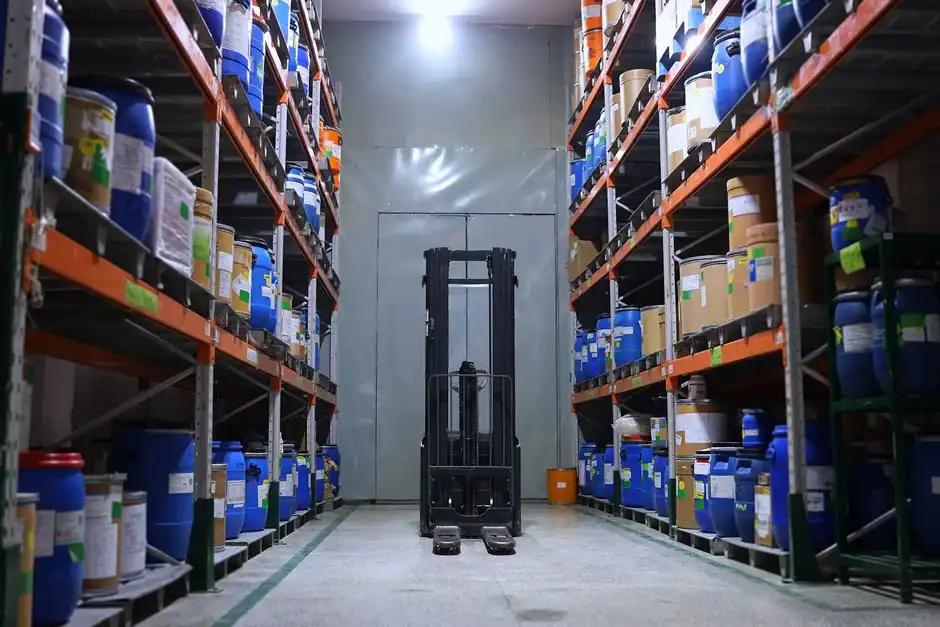
A standard reach truck typically operates in 2.4–3.0 m aisles, while a VNA turret truck can work in aisles as narrow as 1.6 m [S2].
The comparison depends on right-angle stack geometry, pallet footprint, rack clearance, lift height, and operator working conditions rather than turning radius alone [S5][S8].
Turning radius and right-angle stack are different measurements
Turning radius is the circular space needed for a 90° or 180° maneuver, measured from the turn center to the truck’s outermost point [S5]. Right-angle stack describes the space required to enter an aisle, rotate, and retrieve a pallet, so it includes the truck length, load length, and required clearance [S5].
A planning method published on 2026-09-30 adds four quantities: turning radius, load distance, pallet depth, and an allowance for clearance [S8]. The same guide cautions that nominal turning radius is not a complete aisle-width calculation [S8]. For procurement, request the manufacturer’s right-angle stack drawing for the selected capacity, mast height, pallet size, and rack configuration.
Short chassis and short wheelbase generally reduce the swept path, while longer chassis and greater wheelbase increase it [S5]. Rear-wheel steering can produce a tighter path than front-wheel steering, and overhanging loads add clearance beyond the pallet face [S5]. These effects can move the operating envelope even when two trucks receive the same published outside turning radius.
Reach truck, counterbalance forklift, and VNA comparison
A standard reach truck normally requires an aisle width of 2.4–3.0 m, or approximately 8–10 ft, allowing enough room to turn 90° when placing or retrieving a pallet [S2]. A conventional counterbalance forklift generally operates in wider aisles because its larger turning radius makes it less suitable for narrow-aisle use [S1].
The comparison is straightforward on floor-space use. Reach trucks occupy less aisle width than conventional forklifts because their compact chassis and stabilizing legs replace the need for a rear counterweight [S1][S3]. VNA turret trucks go further through a different steering and mast arrangement, but that gain comes with tighter floor, rack, and operating-envelope constraints [S2].
Load geometry can outweigh nominal aisle width
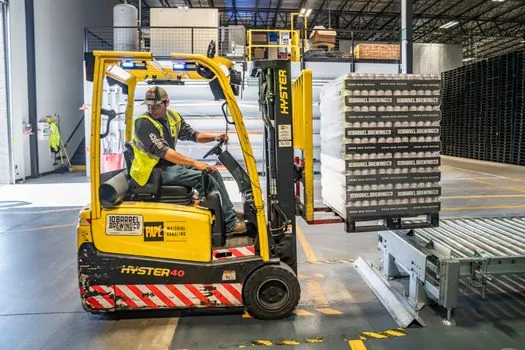
A standard reach truck is optimized for standard pallets and vertical rack storage, whereas a multidirectional forklift is selected when loads are long, bulky, irregular, or outside the usual 1,200 × 800 mm pallet footprint [S4]. Sideways travel and steering geometry can reduce the floor space needed to maneuver these loads [S4].
Long materials such as timber and steel can leave inadequate space for the mast, forks, rack uprights, and load even when the truck itself has a small turning radius [S4]. The comparison should therefore include load width, load overhang, permitted side clearance, and whether the load can be handled without contacting rack protection [S4].
A standard pallet is not specified for every operation. A reach truck with standard forks uses a pantograph mechanism to extend the forks into the rack [S3]. Single-reach, double-reach, moving-mast, and multidirectional configurations provide different combinations of reach, pallet handling, and lateral movement [S3]. For long-load work, a multidirectional forklift may be more suitable than forcing a reach truck into a configuration it was not designed for.
Reach truck selection by operating environment
Reach trucks suit warehouses with narrow aisles, high-level pallet storage, and a need to move between racks and dock areas [S2][S3]. Their 2.4–3.0 m nominal aisle requirement supports compact layouts without the extreme steering demands placed on VNA equipment [S2]. Standard reach trucks rely on two outer stabilizing legs for balance [S2][S3].
Counterbalance forklifts suit open areas, wider aisles, dock work, and general-purpose material handling [S1][S7]. Their rear counterweight balances the front load, while road-vehicle-style controls support familiar operation [S3]. They are also the better starting point when loads exceed the normal working range of a reach truck or when attachments, variable guard heights, and mixed outdoor duties are priorities [S3].
VNA turret trucks suit high-density racking where the smallest possible aisle is commercially valuable. A published comparison states that a VNA setup can add 40–60% pallet positions against standard aisles, and 25–35% against narrow-aisle reach-truck layouts [S9]. Those figures describe storage-layout potential, not a guaranteed increase for every warehouse.
VNA applications carry measurable operating limits
At those heights, the floor must be exceptionally flat because rail guidance, mast alignment, and structural tolerances depend on the vehicle operating within a controlled lane geometry [S2].
Three checks should precede a VNA purchase: confirm the required aisle width at the pallet-handling point, confirm floor flatness and surface condition, and obtain the manufacturer’s right-angle stack for the intended rack pitch and load height [S2][S5]. The narrowest published aisle is not useful if the truck cannot rotate cleanly, place the pallet squarely, or maintain adequate clearance from the rack and load [S2].
Reach-truck turning performance also depends on tires. Cushion tires generally turn more tightly on smooth floors, while pneumatic tires require a somewhat larger path [S5]. Load length and overhang further increase the swept envelope [S5]. These variables explain why a catalog turning radius alone should not be used to approve an aisle design.
Cost, service, and specification closure
Reach trucks and forklifts should be compared on the full operating envelope: aisle width, right-angle stack, lift height, residual capacity at height, load dimensions, floor condition, power source, maintenance access, and attachment needs [S2][S3]. A counterbalance forklift offers broader duty-cycle flexibility, while a reach truck reduces the aisle requirement and supports greater rack density [S1][S7].
For procurement, obtain three drawings from each shortlisted supplier: outside turning-radius geometry, right-angle stack with the proposed load, and the clearances for the proposed mast, fork, rack, and floor condition [S5][S8]. Confirm whether “8–10 ft” refers to the manufacturer’s tested aisle or a general planning range [S2][S5]. The decision should be recorded against the actual pallet footprint, maximum load height, and longest load handled.
The most useful trackable procurement signals are the quoted right-angle stack and the minimum permitted aisle at the intended lift height [S2][S5]. If either is missing, the turning-radius comparison is incomplete and the truck should not be released for layout approval.