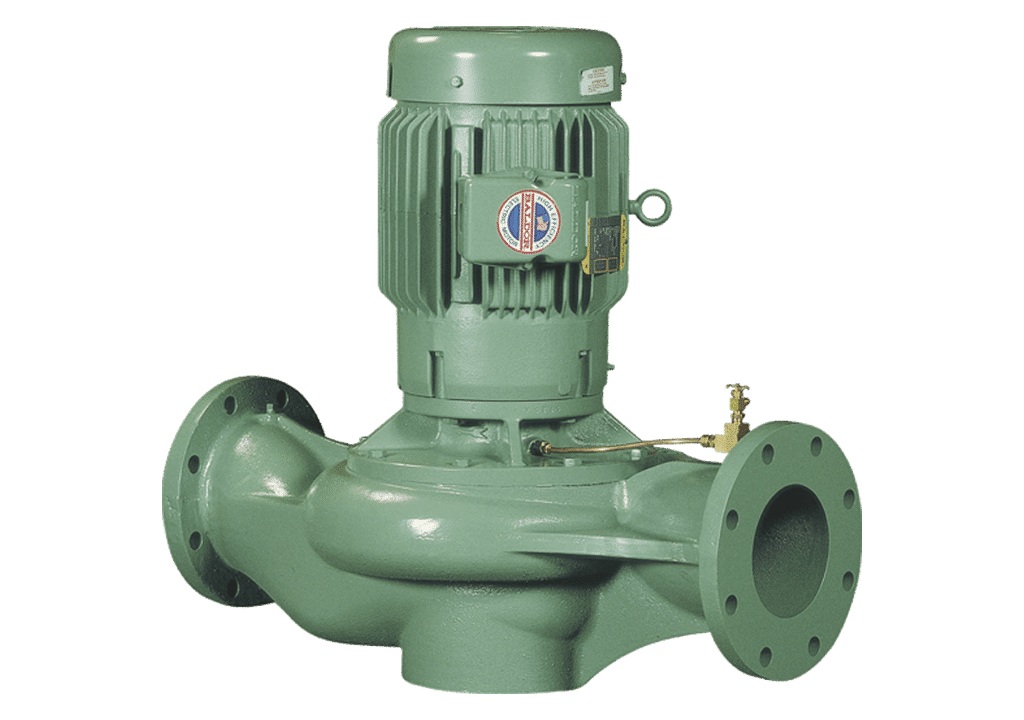
An inline pipeline pump, also called a vertical inline pump, is a single-stage centrifugal pump whose suction and discharge nozzles sit on the same axis, 180 degrees apart, so the unit installs directly into a run of pipe much like an inline valve. This layout removes the separate baseplate and foundation that an end-suction pump requires, shrinking the footprint and simplifying piping. Inline pumps dominate HVAC chilled-water and heating loops, municipal water boosting, fire protection, and, in stainless and alloy form, chemical process duty governed by ASME B73.2 and API 610.
The two governing distinctions are the coupling method (close-coupled with the impeller on the motor shaft, or separately coupled through a flexible spacer coupling) and the material and seal class, which scale from cast-iron HVAC circulators to NACE-compliant alloy process pumps. This guide decodes both.
Photo: wilo se, CC BY-SA 3.0, via Wikimedia Commons
This guide is aimed at industrial purchasing engineers and design engineers. It covers 6 chapters from what an inline pump is, coupling and construction types, hydraulic and drive design, wetted materials, spec-sheet decoding, to selection decisions, with 7 selection FAQs and manufacturer comparisons. All parameters reference public standards including ASME B73.2, API 610 / ISO 13709 (types OH3, OH4, OH5), ISO 5199, ISO 2858, EN 733, EN 12756, and ANSI/HI guidance.
Chapter 1 / 06
What is an Inline Pipeline Pump
An inline pipeline pump is a centrifugal pump in which the suction (inlet) and discharge (outlet) nozzles share a common horizontal axis and face opposite directions, 180 degrees apart. Because the fluid enters and leaves on the same centerline, the pump can be bolted straight into a horizontal or vertical pipe run without changing the pipe routing, behaving structurally like a valve in the line. In the standards literature it is most often called a vertical in-line pump, because the motor and shaft stand vertically above the casing. It belongs to the overhung family of centrifugal pumps, meaning the impeller is cantilevered on the end of the shaft rather than supported between two bearings.
The defining contrast is with the end-suction pump. On an end-suction unit the suction is axial, drawn into the eye of the impeller, while the discharge leaves tangentially at 90 degrees, and the pump sits on a baseplate bolted to a concrete foundation. The inline format eliminates that baseplate and foundation. The casing is supported by the pipe flanges and, in larger sizes, by a small support foot, so the pump occupies almost no floor area. This is the single biggest reason inline pumps are specified in mechanical rooms, packaged skids, district energy plants, and data center cooling, where floor space is scarce and many pumps run in parallel.
Functionally the pump is an ordinary centrifugal machine. Fluid enters the suction nozzle and reaches the rotating impeller; the impeller vanes accelerate the fluid radially outward, raising its velocity, and the surrounding volute casing then converts that velocity into pressure as the flow decelerates toward the discharge nozzle. A low-pressure region forms at the impeller eye, which continuously draws in more fluid. Because a centrifugal pump is not self-priming, the inline pump must be installed below the liquid level or with a flooded suction unless a separate priming arrangement is added.
Inline pumps are almost always single-stage, producing one pressure rise per impeller. Single-stage units cover low to medium head; where higher head is needed in the same compact format, vertical multistage pumps (a different category) stack several impellers. The practical head ceiling of a single-stage inline pump runs from roughly 90 m for building-services ranges such as the Grundfos TP series up to about 116 m (380 ft) for heavy-duty HVAC frames like the Bell and Gossett Series e-80, with API process variants reaching higher with bigger impellers and higher speeds.
The format spans three commercial tiers that share the same geometry but differ sharply in materials, sealing, and certification. The lightest tier is the HVAC and water circulator, typically cast iron and bronze, sealed with a single mechanical seal, rated near 16 bar. The middle tier is the chemical-process inline pump built to ASME B73.2 or ISO 5199 in stainless steel. The top tier is the API 610 / ISO 13709 process pump, types OH3, OH4, and OH5, engineered for refinery and petrochemical hydrocarbon service with a 20- to 30-year design life. A single physical layout therefore serves duties from a chilled-water loop to a hot hydrocarbon line, which is exactly why selection mistakes are common: the housing looks similar across tiers, but the engineering behind it is not.
Chapter 2 / 06
Coupling and Construction Types
The most consequential classification of an inline pump is how the impeller connects to the motor. This single choice drives the price, the maintenance procedure, the achievable power and temperature, and which standard the pump is certified to. Three coupling arrangements dominate, and API 610 / ISO 13709 gives them formal type codes OH5, OH4, and OH3. The table below compares them.
Type
API 610 code
Coupling
Bearings carrying hydraulic load
Typical use
Close-coupled
OH5
None (impeller on motor shaft)
Motor bearings
HVAC, water, lower-power process
Rigidly coupled
OH4
Rigid coupling
Motor bearings
Mid-range, no alignment step
Separately (flexibly) coupled
OH3
Flexible spacer coupling
Integral pump bearing bracket
High power, hot, critical process
Close-coupled (OH5) mounts the impeller directly on an extended motor shaft, so there is no separate pump bearing housing and no coupling at all. The motor bearings carry the hydraulic radial and axial thrust. This is the most compact, lowest-cost, and alignment-free arrangement, and it is the standard for HVAC circulators and most building-services inline pumps such as the Grundfos TP and KSB Etaline. The limitation is that the motor bearings set the load, temperature, and life ceiling, so very large or very hot duties move to a separately coupled design.
Rigidly coupled (OH4) keeps the impeller on its own short stub but joins it to the motor with a rigid coupling, again loading the motor bearings. It removes the field alignment step that a flexible coupling needs while allowing the motor to be detached. It is a middle ground used where a true close-couple is not desired but full bearing separation is not required.
Separately coupled (OH3) gives the pump its own bearing bracket integral with the casing, sized to absorb all hydraulic loads, and connects it to the motor through a flexible coupling, almost always with a spacer. The spacer coupling is the key serviceability feature: it lets the seal and bearing assembly be withdrawn without removing the motor or breaking the pipe flanges, a configuration called back pull-out. OH3 is the choice for higher power, higher temperature, and critical hydrocarbon duty, and it carries the full API 610 design rule of a minimum 20-year service life with at least three years of uninterrupted running, a far more demanding reliability target than a general ISO 5199 process pump is built to.
A second construction axis is the casing and back pull-out arrangement. Most process inline pumps use a back pull-out design with metal-to-metal casing fits, so the rotating element comes out the back while the volute stays bolted in the pipe. This is the inline format's main maintenance advantage and should be confirmed on the data sheet, because a pump without back pull-out forces the whole unit out of the line for a seal change. Building-services pumps may also offer twin-head (twin-pump) versions, such as the Grundfos TPD, which place two pumps in one casing for duty-and-standby or parallel operation in HVAC plants.
Chapter 3 / 06
Hydraulic and Drive Design
Hydraulically the inline pump is a single-stage volute centrifugal pump, and the same performance physics apply as to any centrifugal machine: head, flow, efficiency, and required NPSH are all functions of impeller geometry and speed, captured in the pump performance curve. The duty point is where the pump curve crosses the system resistance curve, and good design places that point near the best efficiency point (BEP). Running well left of BEP causes internal recirculation, raised vibration, and accelerated seal and bearing wear; running well right of BEP raises required NPSH and risks cavitation and motor overload. A practical operating window is roughly 70 to 110 percent of BEP flow.
Drive options separate inline pumps into fixed-speed and variable-speed families. Fixed-speed units run on a standard induction motor at a nominal 2-pole (about 2,900 rpm at 50 Hz, 3,500 rpm at 60 Hz) or 4-pole (about 1,450 rpm at 50 Hz, 1,750 rpm at 60 Hz) speed; the higher 2-pole speed produces more head from a smaller impeller, while the 4-pole speed is quieter and gentler on the seal. Variable-speed units add a frequency converter, either external or integrated into the motor terminal box, as in the Grundfos TPE and Bell and Gossett e-80 IT ranges. A VFD lets one pump follow a varying system curve while staying near BEP, which is the dominant energy-saving measure in modern HVAC and water systems because pump power varies with roughly the cube of speed.
The table below compares the three commercial drive and construction families against the parameters that matter at selection. Values are representative ranges drawn from published manufacturer data and apply to single-stage units; specific models vary.
Family
Typical flow
Typical head
Motor power
Pressure rating
Representative series
HVAC / water close-coupled
Up to ~570 m3/h
Up to ~90 to 116 m
0.37 to 22 kW
16 bar (175 psi)
Grundfos TP, KSB Etaline, B&G e-80
Chemical process (ASME B73.2)
Wide, per size
Up to ~150 m
Per duty
Class-rated flanges
Sulzer, Flowserve, Ruhrpumpen
API 610 OH3 / OH5
Wide, per size
High, per size
To hundreds of kW
High, class-rated
Flowserve HPX-V, Ruhrpumpen SPN, Sundyne
Axial thrust handling is a quiet but critical design point. In a close-coupled OH5 pump the unbalanced axial force from the single overhung impeller is reacted entirely by the motor thrust bearing, so manufacturers either select a motor with adequate thrust capacity or add balance holes and a back wear ring to reduce the load. In an OH3 pump the integral bearing bracket carries this thrust on a dedicated angular-contact or thrust bearing arrangement, which is one reason OH3 tolerates higher power and longer continuous running. Buyers comparing a close-coupled and a separately coupled offer for the same duty should ask how axial thrust is handled, because it directly governs bearing life.
Efficiency is set by hydraulic design, impeller trim, and surface finish. High-efficiency inline ranges advertise hydraulic efficiencies competitive with end-suction pumps of the same specific speed, and regulatory minimum efficiency indices (such as the EU MEI for water pumps) now push manufacturers toward optimized impellers. Because an inline pump installs in a straight pipe run, it avoids the suction elbow losses of an end-suction layout, but a poorly designed suction approach (a tee or short-radius bend immediately upstream) can still distort the flow into the impeller eye and degrade both efficiency and NPSH margin. Provide at least several pipe diameters of straight run upstream where possible.
Chapter 4 / 06
Wetted Materials, Seals and Standards
Material selection on an inline pump follows the same media-compatibility logic as any wetted process equipment: the casing, impeller, shaft, and wear rings must resist the pumped fluid at its actual concentration, temperature, and velocity. For clean water, glycol, and HVAC service the workhorse construction is a grey cast iron casing (commonly EN-GJL-250) with a bronze or stainless steel impeller, rated to roughly 16 bar and the temperature limit of the seal and elastomers. For potable or mildly aggressive water, all-bronze or cast-iron-with-stainless construction is common. For chemical process duty the casing and impeller move to 316/316L stainless steel, duplex stainless such as 2205, or nickel alloys including Alloy 20, Hastelloy, and titanium, chosen against the manufacturer corrosion chart.
Cast iron and bronze remain the default for closed-loop heating and cooling water because the fluid is treated, deaerated, and non-corrosive, so the low material cost is justified. The limitation is open or oxygen-rich water, chlorides, and any process chemistry, where cast iron corrodes and the impeller erodes. 316/316L stainless steel handles a broad band of process fluids, treated water, light hydrocarbons, and food and pharmaceutical service, and is the baseline for ASME B73.2 and ISO 5199 process pumps. It does not tolerate high-chloride media, where duplex, super duplex, or nickel alloys are required.
The mechanical seal is the most failure-prone component on any inline pump, so its specification deserves as much attention as the hydraulics. Clean fluids use a single mechanical seal, ideally a cartridge type that is pre-set at the factory so field installation cannot mis-set the seal faces. Building-services pumps such as the Bell and Gossett e-80 use an internally flushed single seal with an armored flush line from the discharge to cool and lubricate the faces. Hazardous, hot, abrasive, or flashing media call for a double or tandem seal with an external flush or barrier-fluid system, specified through API 682 seal flush plans such as Plan 11 (recirculation from discharge), Plan 32 (clean external flush), or Plan 53 (pressurized barrier fluid). The seal standard EN 12756 governs dimensional interchangeability of European mechanical seals.
The table below summarizes the public standards that govern inline pumps. Knowing which standard a quote cites tells you the tier and the design rigor you are buying.
Standard
Scope
Applies to
ASME B73.2
Vertical in-line centrifugal pumps for chemical process; dimensional interchangeability
North American chemical process
API 610 / ISO 13709
Centrifugal pumps for petroleum, petrochemical, gas; types OH3, OH4, OH5
Refinery, petrochemical, oil and gas
ISO 5199
Technical specification for class II centrifugal pumps
General industrial process
ISO 2858
End-suction / in-line pump dimensions and duties (PN 16)
Mechanical seals, principal dimensions and designation
Seal interchangeability
Note that ASME B73.2 and the EN/ISO dimensional standards exist to make pumps from different makers physically interchangeable: a compliant unit can be dropped into the same flanges and bolt pattern as a competitor's. API 610 is a far more demanding reliability standard, adding requirements on materials, bearing life, vibration, NACE compliance for sour service, and documentation, which is why an API 610 inline pump costs several times a building-services unit of the same flow and head.
Chapter 5 / 06
Key Specification Parameters
Reading an inline pump data sheet is a fundamental skill for purchasing engineers. A single quotation can list dozens of fields, but only a handful drive the selection decision: flow rate, head, NPSHr, efficiency and BEP, motor power and speed, pressure and temperature rating, material and seal class, and connection size and rating. Each is explained below.
Flow rate (Q) is the volume delivered per unit time, given in m3/h, L/s, or US gpm. It is set by the process demand. Head (H) is the energy the pump adds per unit weight of fluid, expressed in metres (or feet) of liquid column, and is independent of fluid density, which is why pump curves use head rather than pressure. The required head is the sum of static lift, friction losses in pipe and fittings, and any terminal pressure. Single-stage inline pumps reach roughly 90 to 116 m of head; higher head needs a multistage pump.
NPSH is the parameter that most often gets a pump into trouble. NPSH required (NPSHr) is a property of the pump, the suction pressure above vapor pressure the impeller needs to avoid cavitation, and it rises with flow. NPSH available (NPSHa) is a property of the installation, set by suction pressure, liquid temperature, and suction line losses. The cardinal rule is NPSHa must exceed NPSHr with a margin, commonly 0.5 to 1 m or the ratio recommended by the Hydraulic Institute. Hot liquids, suction lift, and long suction lines erode NPSHa, so an inline pump on hot condensate or a suction-lift duty must be checked carefully.
Efficiency and BEP define where the pump wants to run. The best efficiency point is the flow at which hydraulic losses are lowest, and the rated duty should sit near it. Motor power and speed follow from flow, head, fluid density, and efficiency; building-services inline ranges use motors from about 0.37 to 22 kW, while API process pumps reach hundreds of kW. Confirm the motor has thrust capacity for a close-coupled design and an adequate service factor for the worst-case duty.
Pressure and temperature rating bound the casing and seal. HVAC and water inline pumps are typically rated 16 bar (about 175 to 232 psi depending on class) with liquid temperatures from around -25 to +140 degrees Celsius for ranges such as Grundfos TP; chemical and API pumps carry class-rated flanges (Class 150, 300, and higher) and can exceed +200 degrees Celsius with appropriate seals and gaskets. Connection size and rating are the flange or thread dimensions, given as DN (with PN pressure class) or NPS (with ASME B16.5 / B16.42 flange class); these must match the existing pipework exactly, which is the whole point of the dimensional-interchangeability standards.
Two further fields are easy to overlook. Seal flush plan (API 682 Plan number) tells you whether the seal is self-flushed or needs an external supply, which affects installation cost. Ingress protection and motor class (IP55 or IP66, insulation class F, and any explosion-proof rating such as ATEX or IECEx for hazardous areas) govern where the pump can legally and reliably operate. For a hydrocarbon or solvent duty an explosion-proof motor and a certified seal plan are not optional extras; they are the gate to a compliant installation.
Chapter 6 / 06
Selection Decision Factors
To turn the preceding five chapters into a specific model, follow the ordered decision sequence below. Most selection errors are not a single wrong number but a decision made at the wrong level, for example choosing materials before the duty point or buying an API-class pump for a simple water loop. These nine steps can serve as a fixed RFQ template.
Duty point and curve: Fix the required flow and head from the process and system calculation, then select a pump whose BEP sits near that point, aiming to run within 70 to 110 percent of BEP flow.
NPSH check: Calculate NPSHa for the installation and confirm it exceeds the pump NPSHr with margin (0.5 to 1 m or the Hydraulic Institute ratio). Re-check at maximum flow, where NPSHr is highest.
Fluid and material class: Identify the fluid, concentration, temperature, and any solids, then choose cast iron / bronze for clean closed-loop water, 316 stainless for general process, or duplex and nickel alloys for chlorides and aggressive chemistry per the corrosion chart.
Standard and tier: Decide the governing standard, namely building-services and water, ASME B73.2 or ISO 5199 chemical process, or API 610 / ISO 13709 OH3, OH4, OH5 for refinery and petrochemical duty. This sets cost and documentation.
Coupling type: Choose close-coupled OH5 for compact, lower-power, alignment-free duty, or separately coupled OH3 with a spacer coupling for higher power, hotter, or critical service that needs back pull-out and a dedicated bearing bracket.
Seal and flush plan: Specify a cartridge single seal for clean fluids, or a double / tandem seal with an API 682 flush plan (Plan 11, 32, 53) for hazardous, hot, abrasive, or flashing media.
Drive and control: Select fixed speed for steady duty, or a VFD (integrated or external) for variable load, since variable-speed control is the dominant energy saving in HVAC and water systems. Confirm motor IP rating, insulation class, and any ATEX / IECEx requirement.
Connection and envelope: Match flange size and rating (DN/PN or NPS / ASME class) to the existing pipework, and check the physical envelope, support foot, and clearance above the pump for motor and seal removal.
Total cost of ownership (TCO): Sum purchase price, energy over the duty profile (often the largest lifetime cost), seal and bearing maintenance, and downtime. A high-efficiency VFD pump frequently repays its premium in energy within a few years on a continuous duty.
One last commonly overlooked dimension is manufacturer serviceability: availability of cartridge seals and bearings as spares, local service and calibration support, the ability to pull the rotating element without breaking the pipe flanges (back pull-out), and documentation quality. These matter little at purchase but determine repair downtime after years of operation. For HVAC and water duty, Grundfos, Wilo, KSB, Xylem Bell and Gossett, and Armstrong have broad service networks; for ASME B73.2 process duty, Sulzer, Flowserve, and Ruhrpumpen are mainstream; and for API 610 OH3 and OH5 service, Flowserve, Ruhrpumpen, Sundyne, and Amarinth supply certified, NACE-compliant units.
FAQ
What is the difference between an inline pump and an end-suction pump?
On an inline pump the suction and discharge nozzles share the same horizontal axis, 180 degrees apart, so the pump drops straight into a run of pipe like a valve. On an end-suction pump the suction nozzle is axial (on the impeller eye) and the discharge is tangential at 90 degrees, so the pump needs a baseplate, a separate foundation, and an elbow on the suction side. The inline layout removes the baseplate and the floor footprint, which is why ASME B73.2 and API 610 type OH5 designs are popular where floor space is scarce. The trade-off is that a close-coupled inline pump carries hydraulic loads on the motor bearings, so very large duties still favor a separately coupled OH3 or an end-suction frame.
What is the difference between API 610 OH3, OH4 and OH5 inline pumps?
All three are vertical in-line overhung single-stage pumps under API 610 / ISO 13709. OH3 is separately coupled: the pump has its own bearing bracket integral with the casing to carry all hydraulic loads, and a flexible coupling with a spacer joins it to the motor, so the motor can be removed without disturbing the impeller. OH4 is the same arrangement but uses a rigid coupling instead of a flexible one. OH5 is close-coupled: the impeller mounts directly on an extended motor shaft, there is no separate bearing housing, and the motor bearings carry the hydraulic thrust. OH5 is the most compact and alignment-free, OH3 is the most serviceable and is preferred for higher power, hotter, or more critical hydrocarbon duties.
What does ASME B73.2 cover for inline pumps?
ASME B73.2 is the dimensional and design specification for metallic vertical in-line single-stage centrifugal pumps in chemical process service. Its core purpose is dimensional interchangeability: a pump of a given standard size designation from any compliant manufacturer must match on mounting dimensions and on the size and location of the suction and discharge nozzles, so a competitor unit can be dropped into the same piping. It references flange standards such as ASME B16.5 and ASME B16.42 and shares a common data sheet with ASME B73.1 horizontal end-suction pumps. B73.2 governs general chemical process duty; for refinery and petrochemical service the stricter API 610 OH3 or OH5 designations apply instead.
How do I size flow and head for an inline pipeline pump?
Calculate the required flow from the process demand and the required head as the sum of static lift, friction losses in pipe and fittings, and any terminal pressure, then pick a pump whose best efficiency point (BEP) sits near the duty point. Aim to run between roughly 70 and 110 percent of BEP flow: running far left of BEP causes recirculation, vibration, and seal wear, while running far right risks cavitation and motor overload. Always confirm that the available NPSH at the suction flange exceeds the pump required NPSH (NPSHr) by a margin, commonly 0.5 to 1 m or the Hydraulic Institute recommended ratio, to avoid cavitation. For variable load systems a VFD lets one inline pump cover a wide range while staying near BEP.
What flow, head and temperature ranges do inline pipeline pumps cover?
Single-stage inline pumps span a wide envelope. Building-services ranges such as the Grundfos TP series reach heads up to about 90 m, liquid temperatures from -25 to +140 degrees Celsius, and 16 bar maximum operating pressure, with three-phase motors up to 22 kW. Heavy-duty HVAC and process units such as Bell and Gossett Series e-80 reach up to about 2,500 US gpm (around 570 m3/h) and 380 ft (about 116 m) of head with a 175 psi cast-iron casing rating. API 610 OH3 and OH5 process pumps extend to higher pressures, temperatures above +200 degrees Celsius, and exotic alloys. There is no single inline pump that covers this whole range, so the duty point drives the casing, material, and coupling choice.
How is the mechanical seal serviced on a close-coupled inline pump?
On a close-coupled OH5 or building-services inline pump, the seal sits between the casing and the motor on the same shaft, so servicing it usually means isolating and draining the pump, then removing the motor and stool to reach the seal chamber. Many modern designs use a back pull-out or cartridge seal so the rotating assembly comes out without breaking the pipe flanges, which is the main maintenance advantage of the inline format. Separately coupled OH3 pumps with a spacer coupling allow the seal and bearing assembly to be pulled while the motor stays bolted in place, shortening downtime. Always confirm the seal is a cartridge type and that the flush plan and barrier fluid are specified before purchase, because field-fitting a component seal on an inline pump is error-prone.
Which manufacturers make inline pipeline pumps for HVAC, water and process duty?
For HVAC, building services, and water, Grundfos (TP, TPE), Wilo, KSB (Etaline), Xylem Bell and Gossett (Series e-80) and Armstrong are the mainstream vertical inline suppliers, typically cast iron or bronze with single mechanical seals and optional integrated VFDs. For chemical process duty to ASME B73.2, Sulzer, Flowserve, and Ruhrpumpen offer stainless and alloy inline pumps. For refinery and petrochemical service to API 610 OH3 and OH5 / ISO 13709, Flowserve (HPX-V), Ruhrpumpen (SPN, IVP-CC), Sundyne, and Amarinth supply certified units with NACE-compliant materials and API seal flush plans. Match the manufacturer tier to the duty: do not buy an API 610 pump for a simple chilled-water loop, and do not put an HVAC circulator on a hot hydrocarbon line.
Inline Pipeline Pump Manufacturers
Source-backed product routes. Open a company dossier for procurement scope and cited evidence.
Taco documents Accu-Flo fixed-port Venturi balancing valves with calibrated presetting and a tamper-resistant memory stop.
Published product fact
Accu-Flo fixed-port Venturi balancing valves with flow measurement independent of stem and ball position, calibrated presetting and a tamper-resistant memory stop.
Published product fact
KV Series vertical in-line pumps with a close-coupled design.