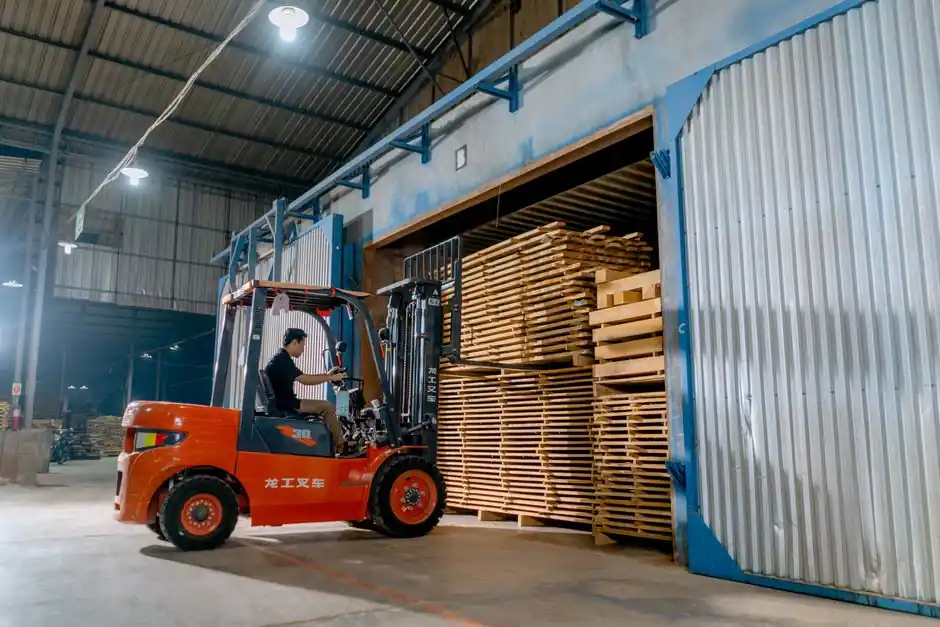
Cushion tires are solid smooth rubber press-ons bonded to a steel band and are sized for flat indoor concrete, while pneumatic tires use deep tread and either air or solid rubber fill for outdoor uneven ground [S2][S4]. Choosing the wrong family accelerates wear on axles and suspension and shortens battery life on electrics by raising rolling resistance [S3].
Both families are produced across the full forklift capacity range, from sub-2,000 lb electrics to 200,000 lb heavy-duty units, so capacity is rarely the deciding factor; surface profile, debris risk, and aisle geometry are [S2].
Tire Construction and Where Each Type Works
Cushion tires are smooth solid rubber molded directly onto a metal band, with no separate air chamber, and they sit close to the ground on a compact chassis [S2][S4]. Pneumatic tires, by contrast, use a deep tread profile similar to a truck tire, with air pneumatics filled with compressed air and solid pneumatics molded as a single thick rubber block on a steel band [S2][S4][S7].
Operationally, cushion tires are specified for loading docks, indoor warehouses, narrow-aisle distribution centers, and manufacturing cells where the floor is sealed concrete or epoxy [S2][S3]. Pneumatic tires are specified for construction sites, lumber yards, railyards, ports, and any mixed-surface yard where gravel, potholes, or debris are routine [S2][S3][S4].
Decision Criteria: Surface, Traction, Turning Radius, Maintenance
Surface dictates the first cut: sealed smooth concrete points to cushion, anything looser than a broom-finished slab points to pneumatic, and operators report cushion trucks will not tolerate gravel surfaces [S8][S9]. Traction follows the same pattern, with pneumatics offering high grip on varied surfaces and cushion tires offering moderate grip limited to smooth floors [S3].
Turning radius is the indoor productivity lever: cushion chassis are lower and shorter, giving a tighter turning radius suited to narrow aisles, while pneumatic chassis are taller and wider for ground clearance [S3][S4]. Maintenance is the inverse of operating environment: pneumatics cost more and require puncture checks and pressure management, while cushions are cheaper to manufacture, easier to maintain, and typically last longer on clean floors [S2][S3][S4].
A side-by-side comparison of the two families on the four decision criteria that actually drive a fleet spec: terrain compatibility, traction, shock absorption, turning radius, and maintenance load [S3].
For an indoor electric fleet, higher rolling resistance from mis-specified pneumatics drains batteries faster across the shift, a hidden cost the spec sheet hides [S3].
Air Pneumatic vs Solid Pneumatic: Choosing Inside the Pneumatic Family
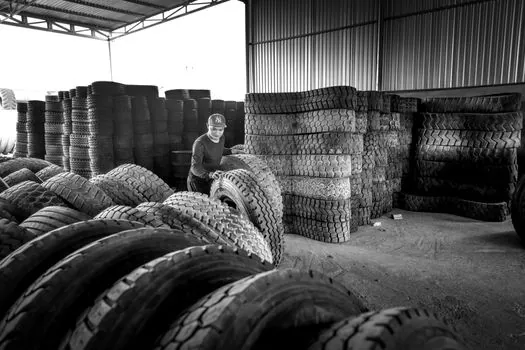
Air pneumatics are air-filled and cheaper to purchase, but they puncture on nails and sharp scrap and need replacement sooner; solid pneumatics are made of solid rubber around a steel band, are puncture-proof, and cost more up front but survive in scrap-heavy yards [S2][S4]. Solid pneumatics give up the soft ride of an air-filled tire because there is no air column to absorb bumps, so operator comfort and load protection fall back on the truck suspension [S2][S4].
For an indoor application, the cushion tire's small footprint keeps the forklift lower and the load closer to the floor, which preserves rated capacity in tight spaces [S3][S4].
Failure Modes and Limits to Respect
Cushion tires cannot withstand as much weight as pneumatic tires at higher load classes and will struggle on rough or uneven terrain because of their limited ground clearance and lack of tread bite [S2][S4]. Air pneumatics fail by puncture in debris-littered yards, and a single flat in a 24/7 operation can idle a truck for a shift while a replacement is sourced [S2].
Pneumatic forklifts also need a larger frame, so they cost more than a comparable cushion unit and need more aisle clearance to maneuver [S4]. Putting a cushion truck onto gravel tears the smooth tread and stalls the truck, a failure mode operators describe as immediate and non-recoverable [S9].
Selection Workflow and Common Mis-Specs

Use a four-question filter before quoting: (1) What is the floor surface, smooth concrete or rough yard, (2) How much debris is present, (3) What is the narrowest aisle and required turning radius, and (4) What is the load capacity class, sub-2,000 lb or up to 200,000 lb [S2]. If the answer to (1) is smooth sealed concrete and (3) is tight, spec cushion; if the answer to (1) or (2) is anything rougher, spec pneumatic and decide air vs solid by debris density [S3][S4].
The most common mis-spec is fitting pneumatics indoors on smooth floors, which accelerates tire wear and inflates long-term cost despite a stronger initial grip story [S3][S4]. For related fleet-side trade-offs such as chassis maneuverability on mixed surfaces, the geometry behind compact loaders is laid out in Why skid steer loaders turn inside their own length: differential drive explained.
Standards, Sourcing, and Service Life
Forklift tire sizing is governed by the Tire and Rim Association (TRA) and the European Tyre and Rim Technical Organisation (ETRTO) standards for industrial tires, with common press-on cushion sizes in the 10x5x6.25 to 22x16x16 inch range and common pneumatic sizes from 5.00x8 to 12.00x20 listed in supplier catalogs [S5]. OSHA 1910.178 requires that industrial trucks be maintained in a safe operating condition, which puts tire integrity, no flat pneumatics, no chunked-out cushions, into the compliance check rather than just a maintenance preference.
Sourcing channels split between OEM replacement through the truck dealer and independent industrial tire suppliers, with press-on cushions typically replaced as a unit once the rubber is worn below the wear line and pneumatics either plugged in place (air) or replaced as a complete wheel assembly (solid) [S5]. Fleet audits typically run tire condition alongside brake and hydraulic checks at 250-hour intervals to catch chunking before it becomes a load-shift risk [S3].
Two trackable signals to watch: (1) the growing share of solid pneumatics in mixed indoor/outdoor fleets as scrap-handling volumes rise, and (2) the shift toward non-marking polyurethane press-ons in food and pharma warehouses where standard black rubber is rejected by audit. For indoor fleets that share space with conveyor-driven pallet flow, the pneumatic conveyor reference explains where compressed-air handling fits next to the lift truck, and the broader forklift entry covers the chassis decision upstream of the tire choice.
The underlying component specifications are covered under dry type transformer.