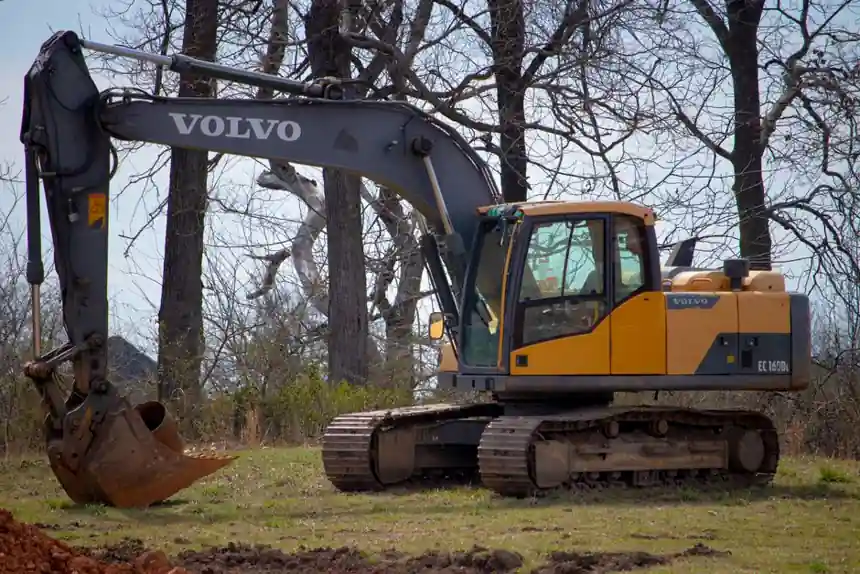
Tracked bulldozers keep the upper hand on soft, uneven, or abrasive ground because a continuous steel belt distributes machine mass across a much larger contact patch than four tires can, keeping ground pressure low and traction high [S3].
That contact patch is the entire reason a 20-ton class dozer can push a full blade load of ripped rock or wet clay without burying itself, while a wheel of equivalent axle load would dig in within seconds on the same surface [S1].
The core physics: contact area vs ground pressure
A wheeled vehicle loads each tire through a small contact patch roughly the width of the tire, so ground bearing pressure spikes at every wheel and the tire sinks into any surface whose bearing capacity is below that local pressure [S1]. A track spreads the same axle load over the full length of the track on the ground, which for a small-to-mid dozer can exceed 2.5 m of grounded steel per side, and on a large crawler can reach 3.0 m or more, reducing average ground pressure to a fraction of a tire's local value [S3]. Lower ground pressure is also why dozers routinely work on muskeg, freshly placed landfill, mine benches after rain, and graded clay subgrade where a wheel would rut and stall [S1]. Operators moving between soft and firm ground often reference the bulldozer track undercarriage in conversation, even though the component is not a valve, because the undercarriage is the working interface that decides whether the machine makes production or gets stuck [S3].
Triangular high-drive layout: why the shape, not just the belt
Bulldozer track frames are not flat rectangles like an excavator's; they are built as a triangle with the drive sprocket raised to the top, which is why operators call the design a "high drive" undercarriage [S2]. Lifting the sprocket and final drives above the ground line keeps the most expensive rotating components out of mud, rock strikes, and impact debris that would hammer a low-slung excavator-style layout [S2]. The triangular geometry also routes the track over a raised front idler, which acts as a built-in obstacle step: when the dozer drives into a stump, boulder, or windrow, the front idler climbs the object and the rest of the track follows over it, rather than the object wedging under a flat frame [S2]. For push-and-carry work, this geometry keeps weight on the grounded portion of the track more evenly, which reduces slip and improves the transfer of engine torque into horizontal push force at the blade [S2].
Track vs wheel on the same dozer class
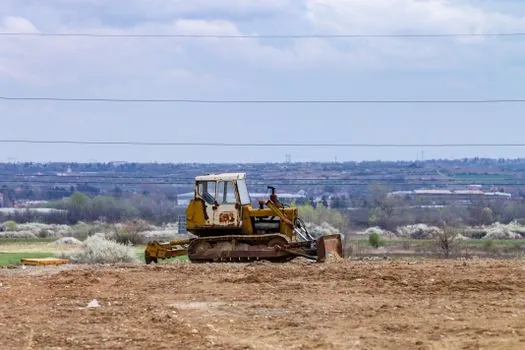
Wheeled dozers exist and are used where ground is firm, distances between cuts are long, and road travel is part of the work cycle, but they trade floatation and traction for travel speed and lower undercarriage wear [S1]. Tracked machines win on soft soils, slopes, and finish grading where any wheel slip cuts production; wheeled machines win on hard, dry haul roads, urban pads, and snow-packed yards where a 40+ km/h roading speed matters more than peak traction [S1]. For a side-by-side look at how tracked and wheeled undercarriages trade travel speed against stability, the wheeled vs crawler excavator comparison walks through the same trade-off on a different machine class, and the conclusions line up: tracks for traction and stability, wheels for cycle speed on prepared ground.
Power conversion: why mass on tracks is a feature
A dozer's push force comes from converting engine power into horizontal force at the blade, and that conversion depends on the machine staying planted while the track drives against the ground [S3]. If the undercarriage slips, flywheel horsepower never reaches the soil, and the operator sees the tachometer rise with no production to show for it; on a wheeled dozer, slip shows up as spinning tires digging ruts, on a tracked dozer it shows up as the track throwing soil backward off the grouser tips [S3]. Higher track-on-ground contact also lets the dozer use its own weight as ballast: with the mass spread along the track, the grousers can bite soil without the machine pivoting on a single tire contact patch, which is the failure mode that ends a wheeled dozer's day in soft ground [S3]. For machines pushing scraper pans or ripping rock, this grip-to-weight relationship is the same reason hydraulic control systems are sized to hold blade load under stall, not just to lift the blade in free air [S3].
Trade-offs you accept when you pick tracks
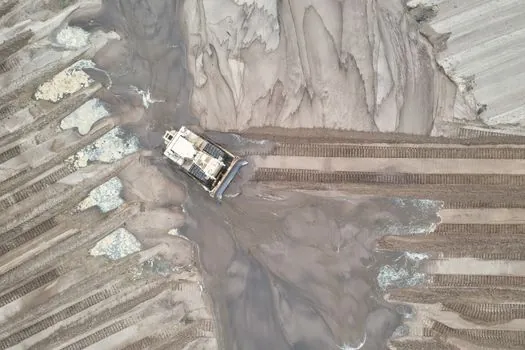
Tracks buy traction and floatation at the cost of speed, noise, vibration, and undercarriage maintenance: a tracked dozer typically tops out near 10-12 km/h, while a wheeled dozer can road at 40+ km/h between cuts [S1]. Track life is finite and is measured in working hours before pins, bushings, or shoes reach wear limits, so the total cost of ownership calculation has to include bushing turn and rail replacement that a wheeled machine avoids [S2]. On rock or frozen ground, the high-drive sprocket position protects the final drives from the worst impact loads, but the track itself still takes abrasive wear on the pins and bushings, which is why many mine sites mandate sealed-and-lubricated undercarriages on production dozers to extend pin and bushing life beyond basic unsealed designs [S2]. Operators also have to watch for track tension: too tight and bushing wear accelerates, too loose and the track can derail off the front idler when reversing up a slope [S2].
Limits and where tracks stop helping
Tracks do not save a dozer on ground that cannot take any pressure at all, such as deep peat or thawing permafrost, where even a low ground pressure dozer will still bridge-fail and punch through into soft subgrade [S1]. They also do not help on finished concrete or asphalt where the operator wants minimal surface damage, which is one of the few jobs where a wheeled dozer with rubber tires is preferred because it can be optioned with less aggressive tread and lower point loads [S1]. On steep cross slopes, a high center of gravity still applies no matter what is on the ground, and operators are limited by the OEM's published side-slope rating rather than by track or wheel choice [S1]. Inside the cab, a tracked dozer is louder and vibrates more at the operator station than a wheeled equivalent, which is part of why many fleet standards require upgraded cab suspension and vibration monitoring on tracked units that spend long shifts ripping rock.
Decision rules a process engineer can hand to a fleet planner
Choose tracked when the work is primarily soft-soil dozing, ripping, slope work, or finish grading on prepared subgrade, and when the dozer will spend more than about 30% of the shift off a hard haul road [S1]. Choose wheeled when the cycle includes long roading between cuts, when the site surface is hard and dry, and when undercarriage maintenance hours are a larger cost line than travel time [S1]. On mixed sites, fleets commonly run both: wheeled dozers on the long-throw production push, tracked dozers on the finish grade, slope work, and any soft-ground push where a wheeled unit would just spin [S1]. This split mirrors the same logic used in choosing pumps and drives for a plant: pick the prime mover by the worst-case duty, not the average duty, and the unit will spend more hours producing and fewer hours parked.
Two signals to watch over the next planning cycle: OEM updates to high-drive undercarriage designs that push final-drive access further outboard for faster field service, and any new electric or hybrid drive dozer that retunes the engine-to-track power path, since the same traction logic still applies but the maintenance math changes [S2].