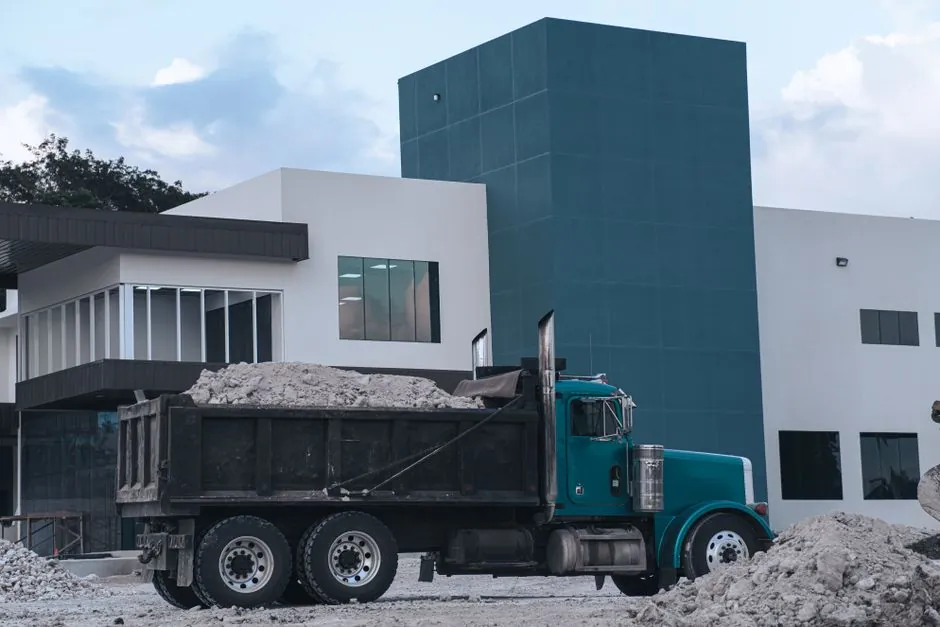
Front-discharge concrete mixer truck packages (mixer plus chassis as one integrated unit) generally cost more than rear-discharge equivalents, with the price delta driven by all-wheel-drive axles, integrated cab controls, and the front-mounted drum geometry [S1].
Both architectures share the same basic revolving-drum mixing principle, but they diverge sharply on wheelbase, ride height, crew size, and chute-control logic, which is why the two formats have stayed split across regional fleets for decades [S1][S3].
Drum Position, Wheelbase, and Maneuverability
Front-discharge mixers carry the drum ahead of the cab and use a shorter wheelbase than comparably sized rear-discharge units, a configuration widely cited for tighter turning and better access to congested or mountainous sites [S3]. Operator reports describe navigating alleys roughly 1.7 sq mi in area with 44,000 residents in Lawrence, MA, conditions that favor the shorter-wheelbase front-discharge layout [S4]. The same operators also note a turning-radius penalty when all-wheel-drive axles are specified; fleets can order without AWD to recover a radius close to a conventional rear-discharge truck [S4].
Rear-discharge mixers, the oldest and most common configuration, keep the drum behind the cab and rely on a longer wheelbase that improves highway stability at the cost of urban maneuverability [S1][S3].
Chute Control, Crew Size, and Operator Visibility
On a front-discharge truck the driver controls the discharge chute directly from the cab, eliminating the second chute operator normally required on a rear-discharge pour [S2][S6]. The Oshkosh S-Series front-discharge redesign enlarged the windshield and side glass specifically to support single-operator placement near foot traffic, finished structures, and other obstacles [S2]. Rear-discharge designs, by contrast, typically position a ground worker behind the truck to direct the chute, which adds labor cost and a struck-by exposure [S1][S2].
Front-displacement ergonomic gains also include less cab entry/exit per pour and a quieter operator-to-finisher handoff, since the driver no longer has to shout over the engine from outside the cab [S4].
Ride Height, Center of Gravity, and Site Conditions
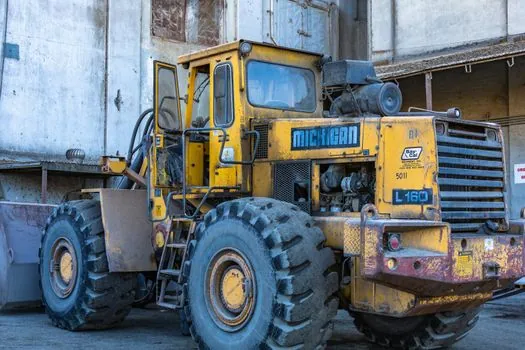
Front-discharge mixers run about 10-14 inches taller than typical rear-discharge units, with one commonly cited Oshkosh front-discharge ride height around 13 ft 3 in, a number that can rule out low-clearance bridges and urban overhangs [S4]. Operators also report a lower perceived center of gravity in the front-discharge format, which helps on muddy sites, steep ramps, and poor-weather pours where rear-discharge trucks are more likely to lose traction [S3][S4].
Where overhead clearance or low-bridge weight limits dominate, the rear-discharge platform's lower silhouette and higher adoption rate (it is the most produced configuration among major OEMs) keeps it the default [S1].
Adoption Geography and the Front-Discharge Origin
Front-discharge concrete mixing technology has existed since the 1970s, and its adoption map tracks state weight laws, chassis cost, and contractor preference rather than any single national standard [S2]. The configuration is widely reported as nearly universal in New England and parts of the Mountain West, and the front-discharge cement mixer is generally attributed to a Utah-based inventor, a fact that helps explain the truck's regional concentration around Park City, UT, where ski-lodge construction favors the shorter wheelbase [S2][S3].
Rear-discharge remains the default in California, the Midwest, and most of Canada, where rear-discharge trucks are still the overwhelming majority of working fleet assets [S1][S3].
Cost, Training, and Chassis Integration

Front-discharge trucks arrive as a total package (chassis plus mixer built together), which simplifies spec but raises acquisition cost versus assembling a rear-discharge mixer on a stock conventional truck chassis [S1]. The Oshkosh S-Series Trainer Cab option adds a full-sized second seat with air-ride suspension, addressing the real-world learning curve that operators consistently describe when first switching from rear-discharge to front-discharge [S2]. Drivers moving to front-discharge also have to relearn weight distribution, since the load sits differently and the driver sits mid-chassis rather than over the front axle [S4].
For high-volume, highway-heavy fleets the rear-discharge format wins on unit cost and parts commonality; for urban, muddy, or finish-quality-driven work, the front-discharge format wins on labor, visibility, and chute control. Operators comparing fleet renewal decisions may also weigh how the new trucks will integrate with concrete pump truck logistics on the same jobsite, since both placements need to share the same approach corridor.
Decision Matrix: Front-Discharge vs Rear-Discharge
Four criteria separate the two formats in practice. Crew size: front-discharge runs a single operator from the cab, rear-discharge typically needs a two-person chute team [S2][S6]. Maneuverability: front-discharge has a shorter wheelbase and lower perceived center of gravity, rear-discharge has a longer wheelbase and better highway tracking [S3][S4]. Cost and integration: front-discharge ships as an integrated package at higher unit cost, rear-discharge is built on a stock conventional chassis at lower cost [S1]. Site conditions: front-discharge is preferred for muddy ground, steep ramps, tight alleys, and precision finishing; rear-discharge is preferred for open highway pours, low-clearance routes, and weight-restricted bridges [S1][S2][S4].
The same trade-off logic that pushes fleets toward all-wheel-drive dump truck chassis on soft ground also pushes them toward front-discharge mixers in the same conditions, while the truck-mounted concrete pump boom often takes over for placement distance on the largest pours, leaving both mixer formats to compete on the short-radius end.
Failure Modes and Selection Pitfalls
Front-discharge owners consistently report three pain points: a longer overall truck length that complicates tight driveways, an AWD-dependent turning radius penalty, and 10-14 in of extra ride height that can clear low bridges and overhead lines [S4]. Operators have also observed a slower driver acceptance curve, with veteran rear-discharge drivers initially resistant before warming up to the new weight distribution and visibility [S4]. One fleet outside Buffalo pulled front-discharge units out of service until a weight-restricted bridge forced reactivation, an instructive case in matching chassis configuration to route constraints [S4].
Rear-discharge failure modes are the older, better-understood set: chute-operator struck-by exposure, limited rear visibility from the cab, and reduced performance on soft or steep ground where the longer wheelbase and higher CoG work against the truck [S1][S2].
Verifiable Signals to Track
Watch the trainer-cab option list on 2027-model front-discharge OEM data sheets, since trainer-cab availability is a leading indicator of fleet onboarding commitments and of how aggressively OEMs are pushing front-discharge into urban markets [S2]. Monitor state-level weight-law amendments in the Mountain West and Northeast, where front-discharge penetration tracks GVBR allowances more than any other variable [S2][S3]. For product spec work, the power mixer and sand mixer reference pages cover the stationary and yard-mixing counterparts that feed into both truck formats.
Background reading: H-beam vs I-beam flange parallelism: how parallel flanges change connection, fit, and.