For outdoor crews, the full brim hard hat's 1.5–2.5 in continuous brim is the single largest spec difference versus a cap-style hat, because the same ANSI/ISEA Z89.1 Type I/II impact rating and Class E/G/C electrical rating apply to both shell shapes [S4].
That brim width is not cosmetic: it channels running water off the back of the neck, drops it past the shoulders, and shades the ears and lateral face where a forward-only bill cannot reach [S1][S4]. For roofers, line workers, highway crews, and oil and gas field personnel working under direct sun and intermittent rain, that 360° coverage is the deciding ergonomic factor between the two shapes.
Shell Geometry: What the 360° Brim Actually Does
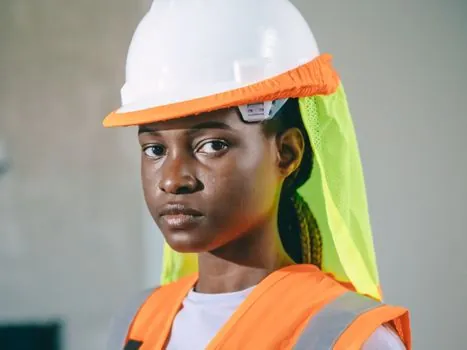
A full brim hard hat has a rigid shell with a brim that extends all the way around the hat, typically 1.5 to 2.5 inches wide on all sides, per current specifier guidance [S4]. The continuous brim blocks sun from the sides of the face, deflects rain off the back of the neck, and adds a small buffer against lateral glancing impacts that an open cap profile would not catch [S4][S5].
A standard cap hard hat has only a partial front-facing brim, sized to deflect small falling debris and shade the eyes [S1][S2]. That single-direction bill is enough for indoor work, shaded sites, and tight overhead spaces where a full brim would catch on scaffolding, ductwork, or machinery [S1][S4]. Both shapes ship in Type I (top impact) and Type II (top and lateral impact) configurations, and both can carry Class E (electrical, up to 20 kV), Class G (general, up to 2.2 kV), or Class C (conductive, no electrical rating) [S4].
Sun and Heat: Where the Full Brim Earns Its Keep
Full brim models are specified for outdoor work in roofing, utility line work, highway construction, oil and gas operations, and agricultural or mining environments where sun exposure is a daily reality [S4]. The 360° brim reduces direct UV on the ears, temples, and back of the neck, areas the cap-style bill leaves exposed [S5][S6]. Defender Safety's 2026 buyer guide repeats the same coverage point: full brim hard hats feature a 360-degree brim that extends around the entire helmet, offering additional coverage beyond standard cap-style [S7].
For purely sun-driven comfort, hiker-side data is informative even though it is not a hard-hat source. Backcountry users report that an open mesh wide-brim hat runs cooler than a closed-top cap with a neck cape, because a closed crown traps radiant heat against the skull [S3]. Translation for hard hats: vented full brim shells (Type I, Class C) move more heat than non-vented full brims, and any full brim will out-shade a cap in the ear and neck zones, but a vented cap may still feel cooler on a still, hot day with no direct overhead sun.
Rain Deflection: Channeling Water Off the Neck

On a cap-style hat, water running off the crown has only one path: down the front brim onto the face and chest, or off the back of the shell straight onto the cervical spine. A full brim hat's continuous edge breaks that flow: water runs off the front, sides, and rear at roughly equal distances, keeping the neck and collar dry through light to moderate rain [S1][S4][S6]. Hard Hat Training's inspection guide is direct on the point: a full brim style provides protection against the sun's rays, heat, humidity, rain, and glare [S6].
This is the single biggest reason utility line work, transmission right-of-way crews, and outdoor electrical contractors default to full brim. A wet neck under a harness or arc-rated rain shell is a comfort and chafing issue that compounds across a 10-hour shift, and it is independent of the electrical Class rating printed on the inside of the shell.
Comparison Matrix: Cap Style vs Full Brim Across Four Criteria
Head-to-head on the four criteria buyers actually weigh: sun coverage is broader on the full brim (face + ears + neck) versus cap (face only); rain deflection is full 360° runoff on the full brim versus front-only drip on the cap; overhead clearance is the cap's win, with a lower profile that fits under scaffolding and tight truss spacing versus a brim that can catch on rebar and formwork; and accessory compatibility is a wash, with chin straps, sweatbands, winter liners, and face shields fitting both shapes via the suspension slots [S4][S6].
Practical example: the Pyramex HP54 Ridgeline, a typical Type I full brim, is built from High Impact ABS at 378 g shell weight, with HDPE/nylon suspension and a polyester/PU sweatband, colors white, red, hi-vis lime, blue, and hi-vis pink [S2]. That same shell can be ordered in cap or full brim variants; the suspension and rating are identical, so weight penalty for switching to full brim is roughly 20–40 g versus an equivalent cap on most product lines.
Selection Criteria: Who Needs the Full Brim, Who Does Not
Specify full brim when the worksite is predominantly outdoors with regular sun or rain exposure: utility line work, transmission and distribution, highway and bridge construction, roofing, oil and gas upstream and midstream, agriculture, surface mining, and railway right-of-way [S1][S4][S6]. Specify cap when the work is indoors, in shaded structures, or in tight overhead spaces: mechanical rooms, indoor electrical rooms, warehouse picking, indoor manufacturing, and any confined-space work where a brim would catch on the entry [S1][S4].
For mixed indoor/outdoor crews, the practical move is to keep both available, since the same ANSI/ISEA Z89.1 rating governs both shapes and shells are interchangeable across crews [S4]. This is also where complementary PPE decisions come in: a face shield, chin strap, or winter liner attaches to the suspension on either shape, so adding a chin strap and sun neck cape is the more cost-effective weather upgrade than swapping every worker's shell [S4].
Limitations and Failure Modes
A full brim is not free. The same 1.5–2.5 in overhang that sheds rain will catch on low-clearance rebar, scissor lift rails, and overhead conduit, and can act as a sail in high wind, pulling the hat off the head if a chin strap is not used [S4]. The brim also adds wind loading on tower and line work, where crews compensate with a chin strap or a suspension with a wider nape strap.
For sun, a full brim does not replace sunscreen on the lower face and the back of the hands; it only blocks direct overhead and lateral UV on the upper face, ears, and neck [S3][S6]. And in still, hot, low-sun conditions, a vented cap may feel cooler than a non-vented full brim, because crown ventilation matters more than brim coverage when radiant load is low [S1][S3]. As one buyer-side spec note puts it, durability is determined more by the shell material and impact rating than by brim style, so do not choose a full brim for impact performance [S4].
Standards, Inspection, and Replacement Timing

Both shapes are certified to ANSI/ISEA Z89.1, the US standard for industrial head protection, with Type I (top impact), Type II (top and lateral impact), and Class E (up to 20 kV), Class G (up to 2.2 kV), and Class C (no electrical rating) [S4][S5]. OSHA 29 CFR 1910.135 and 1926.100 require employers to provide head protection that meets ANSI/ISEA Z89.1 when objects may fall or strike workers, and the same rules apply regardless of brim style. For European sites, EN 397 governs industrial safety helmets and EN 14052 covers high-performance industrial helmets; both allow cap and full brim profiles.
Replacement is governed by the manufacturer's date stamp, typically 5 years from manufacture for the shell and 1 year for the suspension, with any hat that takes a major impact or shows cracking, chalking, or brittleness pulled from service immediately [S6]. A brim does not extend service life; UV damage acts on the entire shell surface, and full brims actually show chalking first along the wider exposed edge.
Sourcing and Vendor Reality Check
Major industrial suppliers (MSA, Honeywell, 3M, Pyramex, Bullard, and ERB) all catalog both shapes in the same Type/Class combinations, so lead time and price are usually the deciding factors at the SKU level [S2][S4]. Custom-printed full brim minimum order quantities start around 6 units from US custom shops, with bulk pricing tiers kicking in at 12 or more, and 1–4 color logo printing or full-color DTF transfers available on the front, back, and side panels [S4]. Standard production lead time is 12 to 20 business days after artwork approval, with FedEx or UPS ground shipping in the continental US [S4]. For crews that move between indoor and outdoor zones, a practical sourcing move is to standardize the suspension and shell type and let brim shape vary by role, which keeps the spare-parts inventory to one SKU per shell size.
Trackable signals to watch over the next two quarters: ANSI/ISEA Z89.1 revision activity around brim projection limits (some proposals have flagged brim width as a snag-hazard concern in confined-space work), and any vendor expansion of vented full brim offerings aimed at the oil and gas and utility segments that have historically defaulted to non-vented shells for spark and electrical safety.
Component reference pages worth checking: microcomputer protection, and protection relay.
Related analysis: Cupola vs blast furnace: charge materials and product output, side by side.