On a truck-mounted telescopic crane, the boom type dictates how sections are extended, how the load chart behaves, and how the operator works every shift. Full-power booms use one hydraulic tele-cylinder per stage and extend proportionally, while pinned (pin-and-latch) booms rely on a single cylinder plus mechanical pins that lock each section at fixed positions [S5].
Both styles show up on the same chassis class. Boom trucks, defined under ASME B30.5 as a rotating crane and boom on a commercial truck chassis, can be ordered with either configuration, while dedicated hydraulic truck cranes almost always ship with a full-power telescopic boom because they target heavier, higher-reach duty [S1].
How the Two Boom Types Mechanically Differ
A pinned boom is restricted to discrete section positions because a single tele-cylinder can only move one section at a time, so the operator runs an inner section to 50% or 100%, drops a pin, then runs the next stage. Working combinations are limited to a small set of locked lengths rather than continuous extension [S3].
A full-power boom dedicates one hydraulic cylinder per section, so every stage can extend proportionally and independently. Larger telescopic cranes get their maximum lift chart not from a single all-out configuration but from selecting the right partial extension of each stage to keep the load close to the centreline, a flexibility the pinned design physically cannot match [S3]. Operating sequence is fixed mechanically: on either design, inner sections must come out first, otherwise the cylinder cannot reach the stage behind them [S3].
Capacity, Reach, and Load-Chart Behaviour
Full-power booms dominate the high-tonnage end. TEREX's T 780 telescopic truck crane pairs a 169 ft (51.5 m) maximum tip height with a 72.6 t nominal lifting capacity, and the smaller T 340-1 reaches 147 ft (44.8 m) at 36.3 t, both on proportionally extended booms [S5]. For comparison, Maxim's boom-truck fleet tops out around 40 US tons, while its hydraulic-truck-crane fleet reaches 140 US tons, again a function of boom design and carrier [S1].
Pinned booms give up that proportional optimisation. Because the section length options are coarse, the rated capacity is computed only for the finite set of pin combinations printed on the load chart. Operators on pinned machines plan lifts around those fixed lengths, and any in-between geometry is simply not on the chart. With a full-power boom, the chart still varies with radius and section position, but the operator is not constrained to a handful of preset lengths [S3][S5].
Operator Workflow, Controls, and Wear

On a full-power boom, changing working radius is usually done by raising and lowering the boom angle while the cylinder holds the sections in place, which puts less cyclic load on wear pads and section guides than repeated telescoping under load. Pinned machines, by contrast, force the operator to retract, re-pin, and re-extend whenever a different combination is required, which adds steps to every lift [S2].
Control station layout is independent of boom type but is part of the operating picture. Telescopic boom trucks typically offer either a fixed lower control station with manual or electro-hydraulic levers, an enclosed cab, or radio remote, all keeping the operator off the ground. That separation is a safety plus when combined with full-power smoothness, because the operator can fine radius in small increments rather than committing to a pinned length before the load is clear [S2].
Decision Matrix: Which Boom Matches the Job
For rental fleets and multi-site utility work (sign installation, HVAC lifts, residential roof deliveries, small concrete pours), pinned booms are often the lower-cost, lower-weight choice. They tolerate infrequent radius changes, and the operator can be trained on a small, fixed set of load-chart entries. For heavier structural steel erection, longer-duration industrial jobs, or any lift where radius and tip height must be tuned continuously, a full-power boom earns its higher price through better chart coverage and faster repositioning [S1][S2][S5].
Specifying engineers should also weigh integration with attachments. A telescopic boom truck with a jib can extend working height to around 207 ft (63 m), useful for personnel lifts on a work platform, while articulated knuckle booms generally stop near 100 ft (30 m) of boom length, a reach gap that further favours full-power telescopic designs on truck chassis [S2]. The same chassis debate shows up across other truck-mounted equipment, for instance in aerial work truck specification, where boom type drives both reach envelope and daily operating cost.
Maintenance, Inspection, and Service Truck Reality
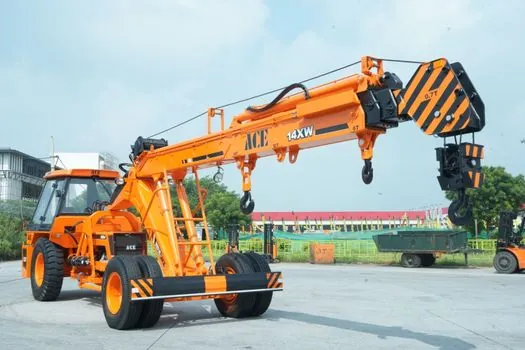
Full-power booms add more hydraulic hardware: one cylinder, hoses, and sequencing valves per stage, so leak points and seal replacement are higher. Pinned booms have fewer hydraulic components but more mechanical hardware: latch pins, dog-bone wear, and section alignment checks at every re-pin. Either way, scheduled inspection of wear pads, telescoping guides, and the boom-extension interlock is mandatory under standard crane-safety practice [S4].
For service-truck and field-repair fleets running smaller machines, Summit's hydraulic crane line covers 6,000 to 14,000 lb (2,720 to 6,350 kg) capacity, with electric/hydraulic models 4416 and 6422 used for roadside and field-service work. These lighter units are almost always full-power because proportional extension matters more than the few hundred pounds of weight saved by a pinned design [S4].
Standards, Safety Envelope, and Sourcing
Any truck-mounted telescopic crane, pinned or full-power, falls under ASME B30.5 for mobile and locomotive cranes, which governs inspection, load-chart testing, and operator certification. Construction-site operation generally requires a certified operator under OSHA crane rules, regardless of boom style [S1]. Procurement specs should therefore call out ASME B30.5 compliance, the boom type (full-power, pinned, or combination), the number of sections, and a rated-capacity chart for the specific chassis and outrigger configuration.
Buyers should also match boom choice to carrier class. A 30 to 40 t boom truck on a commercial chassis usually ships pinned or combination because that capacity class is volume-driven. Above 60 to 70 t on a purpose-built carrier, full-power becomes the default, with manufacturers such as TEREX, Liebherr, and Manitex all offering proportionally extended multi-section booms in that range [S5]. Cross-referencing chassis and upper-structure data against reference concrete pump truck and concrete mixer truck duty cycles is a useful sanity check, because the same hydraulic proportional-control logic appears on placing booms.
For structural steel and wear-plate selection on the boom itself, specifiers comparing material options can refer to HSLA vs Q&T alloy plate selection for guidance on high-stress section fabrication, a recurring concern on multi-stage telescopic designs.
Trackable signals for buyers in 2026: manufacturer datasheets stating "full-power" or "proportional" versus "pin and latch" in the boom-type line, the number of hydraulic tele-cylinders listed in the spec sheet (one per stage confirms full-power), and outrigger-spread versus load-chart notes. If a quotation lists only discrete boom lengths on the chart and a single tele-cylinder, it is a pinned boom, regardless of the marketing name.