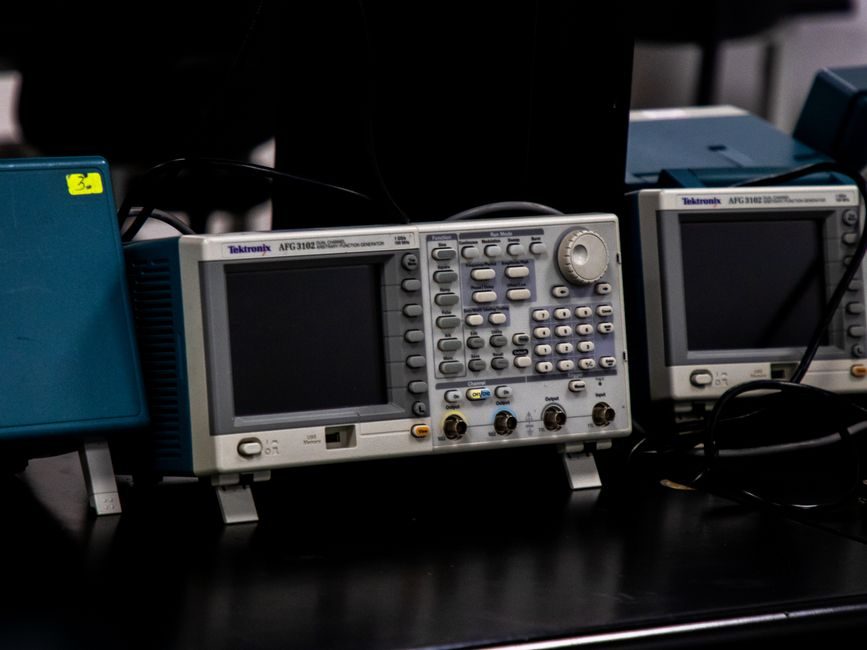
A function generator and a digital multimeter sit on opposite sides of the bench signal chain — one is a stimulus source, the other a readback — and engineers who try to substitute one for the other usually pay for it in lost bandwidth or compromised accuracy [S1][S2].
Source-Measure Units (SMUs) now combine both functions on a single pin, integrating a power supply or function generator, a DMM, a current source, and an electronic load into one synchronized instrument, per the Analog Devices SMU definition [S2].
Core Function: Stimulus vs Readback
A function generator produces defined voltage or current waveforms — sine, square, ramp, pulse, arbitrary — with bandwidth, sample rate, and amplitude as the gating specs; Keysight's product taxonomy lists it under "Waveform and Function Generators" alongside DMMs and oscilloscopes in the "Digital Instruments" family [S1].
A digital multimeter measures a single DC or AC quantity — typically volts, amps, ohms, and sometimes frequency or capacitance — with resolution in counts (e.g., 6.5-digit) and basic DC accuracy as gating specs; Keysight categorises DMMs separately under the same "Digital Instruments" group [S1].
The two instruments share no measurement function in the strict sense: the function generator drives a known signal into a DUT, while the DMM observes an unknown signal from a DUT. When the same pin needs to source and measure simultaneously, an SMU replaces both [S2].
Selection Criteria: 4 Spec Gates
Use these four spec gates to decide whether you need a function generator, a DMM, or both, in roughly the order engineers triage them on the bench: [S2]
<strong>1. Bandwidth and sample rate.</strong> Function generators are spec'd by analog bandwidth (e.g., 30 MHz, 100 MHz, 1 GHz) and, for arbitrary-waveform types, sample rate (200 MSa/s to 5 GSa/s and beyond). DMMs are spec'd by DC accuracy (often 0.0024% to 0.01% of reading) and resolution (6.5 to 8.5 digits), not bandwidth — a DMM with a 1 kHz ACV filter is a precision meter, not a scope [S1][S2].
<strong>2. Signal direction.</strong> If the DUT needs to be excited, you need a function generator (or SMU); if you need to read an existing signal, you need a DMM (or oscilloscope). A bench workflow that only ever reads voltages should not be buying a generator [S2].
<strong>3. Synchronization.</strong> A standalone function generator and DMM cannot source and measure on the same pin simultaneously; an SMU is required for that capability, per the Analog Devices SMU block diagram [S2]. Many ADALM1000-class devices can only run source OR measure at any instant because the output (generator) and input (oscilloscope) share a common pin [S2].
<strong>4. Measurement type.</strong> Function generators handle waveform fidelity (THD, jitter, rise time). DMMs handle absolute DC accuracy, true-RMS AC, and 2-/4-wire resistance. Cross-spec them and you get the worst of both — see the comparison matrix below [S1][S2].
Comparison Matrix: Function Generator vs DMM
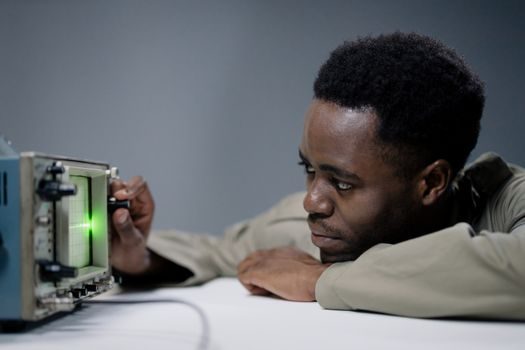
Lining the two up against the criteria a buyer actually uses on a 2026 bench [S1][S2]:
<strong>Primary function:</strong> Function generator = stimulus source; DMM = measurement readback. <strong>Key spec:</strong> Function generator = analog bandwidth / sample rate; DMM = DC basic accuracy (e.g., 0.0024% reading) and digit count. <strong>Typical use:</strong> Function generator = filter response, amplifier stimulus, clock substitution; DMM = bench verification, continuity, power-supply readback. <strong>Source/measure on same pin:</strong> Function generator = no; DMM = no; both = need an SMU [S2]. <strong>Best paired with:</strong> Function generator pairs with an oscilloscope; DMM pairs with a power supply or a function generator for stimulus-plus-readback benches [S1].
Use Cases by Application
<strong>Power-supply validation.</strong> A DMM reads the regulated output to verify voltage accuracy; a function generator is not used unless you are sweeping a load line. For an IV curve, an SMU sweeps voltage and reads current in a single instrument, avoiding the loop-timing problem of two separate boxes [S2].
<strong>Analog-RF and high-speed digital.</strong> A function generator with the right bandwidth (≥3× the highest signal frequency of interest, per Nyquist-margin practice) drives the DUT; the DMM is used for DC bias and supply readback, not for AC waveform verification — that is the scope's job [S1].
<strong>Automated test and long-duration logging.</strong> Where manual read-and-record is too slow or error-prone, programmable instruments are required; SMUs and DMMs with SCPI/IVI drivers replace a function generator when a static or stepped DC stimulus is sufficient [S2].
<strong>Diode and solar-cell characterization.</strong> Both directions of conduction must be measured, so the source must swing negative — a useful rule: if you need to characterize any device with diode-like behavior, the source must cover at least the polarity range you intend to plot. The ADALM1000 example sweeps –5 V to +5 V by pairing two SMU channels in opposition [S2].
Limitations and Failure Modes
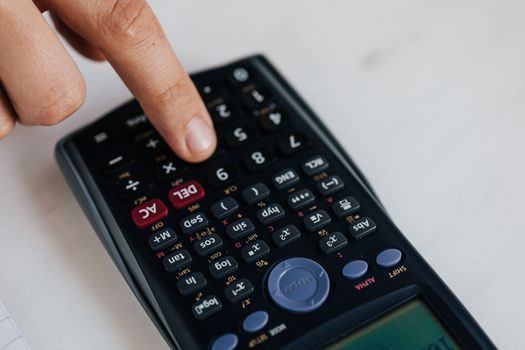
Function-generator failure modes center on waveform integrity at the load: amplitude droop into 50 Ω, aliasing on arbitrary waveforms when the signal frequency exceeds half the sample rate, and trigger jitter on burst or pulse modes. DMM failure modes center on input protection (over-voltage on the current terminals, charged capacitors on resistance ranges) and AC bandwidth vs accuracy trade-offs — a DMM is not a substitute for an oscilloscope on fast transients [S1][S2].
SMU shared-pin architectures trade full-duplex for cost: when the source and measure functions share a common connector, only one can run at a time, which limits time-domain IV captures unless two SMU channels are paired [S2]. Bench plans that need simultaneous source-and-measure must spec a four-quadrant SMU with separate force-and-sense paths, not a shared-pin entry-level unit [S2].
Standards, Sourcing, and Tooling
No single IEC or ISO standard governs the choice between a function generator and a DMM; selection is driven by the DUT's stimulus and readback requirements plus in-house calibration traceability. For buyers shortlisting specific models, Keysight's 2025 product catalog organizes "Waveform and Function Generators" and "Digital Multimeters" as sibling subcategories under "Digital Instruments," which is a workable taxonomy for sourcing RF and bench test gear [S1].
For wider sourcing context on selecting a function generator — bands, sample rate, modulation, and channels — see the 2026 function generator buying guide, and for the deeper selection criteria, the function generator selection criteria reference. For labs that sit closer to process instrumentation than RF, the signal calibrator selection guide covers overlap with DMM-class readback.
Trackable follow-on signals for the next review cycle: Keysight's 2026 catalog refresh under the same "Digital Instruments" taxonomy, vendor disclosures on SMU four-quadrant source-measure bandwidth, and any IEC 61010-031 update affecting DMM probe/lead safety ratings for bench use.
For component-level specifications, see digital panel meter.