Selection of a gas fire suppression system for confined space entry is dominated by one rule: the suppression envelope and the entry envelope share the same air, so the design concentration that extinguishes a flame also has to keep the entrant's breathing atmosphere within OSHA thresholds, namely 19.5%–23.0% O₂ and LEL under 10% before any ignition source is introduced [S1][S3].
For permit-required confined spaces under OSHA 29 CFR 1910.146, pre-entry gas testing must confirm oxygen, flammable gases, and toxics in that order, every time, with continuous monitoring throughout the work [S4][S5]. A suppression system that disturbs that envelope (CO₂ flooding, for example) cannot be discharged while personnel are inside; an agent that does not deplete O₂ below 19.5% can be, provided its own PEL is respected.
Atmospheric Thresholds That Drive Agent Choice
Safe oxygen range for entry is 19.5% to 23.0%, with 16% already producing impaired judgment and below 10% causing unconsciousness within minutes [S1]. LEL must read below 10% for general entry, and below 5% LEL is the widely cited gate for any hot work inside the space; H₂S is treated as IDLH at 100 ppm and CO at 1,200 ppm, both with 8-hour OELs of 10 ppm and 25 ppm respectively [S1]. These numbers, not the agent datasheet, set the hard floor for any fire safety plan that mixes suppression discharge with human presence.
NFPA notes that confined spaces can become oxygen deficient or accumulate toxic gases in minutes, which is why pre-entry testing alone is insufficient once hot work begins: the same oxidation that drives welding also consumes O₂ and can push the atmosphere past 23.0%, widening the flammable band [S6]. Continuous monitoring with a calibrated 4-gas instrument (O₂, LEL, H₂S, CO) is the minimum spec in most provincial and U.S. federal guidance [S1][S3].
Agent Chemistry vs. Confined Space Profile
Three agent families compete for the confined space slot, and they trade off against the entry atmosphere very differently. Halocarbon clean agents (FK-5-1-12, HFC-227ea, HFC-236fa) extinguish by chemical interruption at design concentrations typically 4.5%–10% by volume, leaving O₂ at near-normal levels and allowing occupied-space release when their own cardiac sensitization PELs (roughly 1,000–10,000 ppm depending on agent) are respected. CO₂ at 34% minimum design concentration will not support life and is therefore excluded from any occupied confined space; it remains a valid option for unoccupied enclosures, transformer vaults, and similar gas fire suppression applications where entry is locked out during discharge. [S1]
A criteria-based comparison for confined space work:
<strong>O₂ displacement at design concentration:</strong> inert gases 12%–14% (occupancy excluded), CO₂ below 12% (occupancy excluded), halocarbons near 20.9% (occupancy permitted within PEL). <strong>Design concentration range:</strong> inert gases 38%–43%, halocarbons 4.5%–10%, CO₂ 34%–50%. <strong>Discharge hold time:</strong> ISO 14520 requires a minimum 10-minute hold for unoccupied spaces, with 30 seconds specified for occupied systems to allow personnel egress; NFPA 2001 mirrors this for the U.S. <strong>Storage footprint:</strong> halocarbons store as liquid at moderate pressure (25–70 bar) in compact cylinders that fit a 200–300 mm manway; inert gases need high-pressure 200–300 bar cylinders or large banks of 150 bar storage, which is the dominant reason confined-space retrofit projects in ships, switchgear rooms, and CNC pits favor halocarbons [S1][S3].
Where Each System Type Fits, and Where It Does Not
Halocarbon clean agents (FK-5-1-12 in particular) are the default for occupied confined spaces: control rooms, marine engine room modules, CNC machine enclosures, and analyzer shelters where the same room is both the asset and the workplace. Inert gas systems are the right pick for unoccupied but frequently accessed enclosures where electronics must survive without residue: data halls, substation control rooms with battery banks, and archive vaults. CO₂ local application remains common in engine crankcases, paint spray booths, and outdoor transformer bays, all of which are locked out during discharge. [S1]
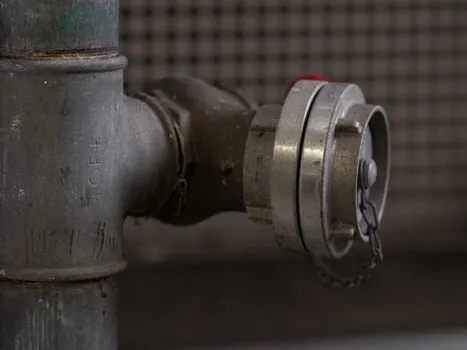
The systems are NOT interchangeable: an inert gas system will asphyxiate anyone inside during discharge, and a halocarbon system will not satisfy a 60-second extinguishing requirement in a deep, slow-leak enclosure if the cylinder count was sized for an open room. Fire hydrant or fire extinguisher backup is typically required at the entry point regardless of fixed system choice, sized to the largest single hazard in the space [S2]. A common spec gate is the electrical fire monitor for any switchgear or battery room, which pairs with a clean agent total flood rather than water to avoid short-circuit escalation.
Sizing, Envelope, and Cylinder Placement
NFPA 2001 and ISO 14520 both size the agent mass to the net volume of the space, with deductions for permanent non-flooded voids and additions for unclosable openings. For confined space work the dominant gotcha is leakage: a typical 2 m × 2 m manhole with a 600 mm opening has a discharge hold-time penalty that often forces an extra cylinder or a faster discharge nozzle, and the only way to verify is a room integrity test (door-fan or blower-door) showing leakage area below the value assumed in the calculation. [S1]
Cylinder storage belongs outside the confined space whenever the manifold run allows it. A 2-meter run into a manhole is acceptable; a 10-meter run through a 600 mm opening is not, because the pipework becomes a maintenance liability and the bottle change requires confined space entry itself, which defeats the purpose. Practical retrofit practice, reflected in the gas fire suppression for food processing spec path, is to locate cylinders in an adjacent service corridor or on the entry platform where they can be swapped without re-entering the protected volume.
Limitations, Failure Modes, and Pre-Discharge Logic
The most common failure mode in confined space suppression is not the agent but the release sequence: a hot-work spark ignites a vapor cloud already at 9% LEL, the suppression system floods, the entrant cannot egress through the 600 mm opening within 30 seconds, and the alarm sequence has not been pre-announced. OSHA data cited in JSA templates puts rescuers at over 60% of confined space fatalities, with most of those deaths traceable to unscheduled, unannounced entry into a hazardous atmosphere [S4].
Pre-discharge logic for occupied confined spaces must therefore include: a 30-second pre-warning with two abort paths (manual abort at the entry and a timed abort on the control panel), a primary agent bottle count that achieves design concentration within 10 seconds, and a reserve bottle count sized to hold concentration for the full minimum hold time, with O₂ and LEL sensors in the space cross-wired to inhibit discharge if the entry atmosphere is already out of spec. CO₂ systems, by contrast, are typically interlocked with the entry door so the system cannot discharge while the door is open, an interlock logic that is mandatory for any occupied-side CO₂ application and is the single most-cited violation in industrial audits [S1][S5].
Selection Workflow and Trackable Signals
A defensible selection runs in this order: classify the space under OSHA 29 CFR 1910.146, confirm occupancy during discharge, measure leakage area, choose the agent family against the 19.5%–23.0% O₂ floor and the LEL 10%/5% gates, size cylinders to net volume plus leakage margin, and locate cylinders outside the entry. This mirrors the gate-by-gate spec path used in adjacent industries, for example the gas suppression for mining agent/enclosure/hazard map, which uses the same envelope and hold-time logic but adds methane-specific design concentrations. [S4]
Two trackable signals to watch over the next two quarters: NFPA 2001 next-cycle updates on minimum hold time for occupied enclosures, and the slow phase-down of HFC-227ea and HFC-236fa under continuing F-Gas revisions, which is already pushing European food, pharma, and switchgear retrofits toward FK-5-1-12 or inert gas alternatives. Both are pre-existing regulatory pressures, not speculative timelines, and either will force a re-spec of any installation currently on a phase-out agent. Verify the agent's current regulatory status in your jurisdiction before committing to a cylinder count, and treat any specification older than 24 months as stale until re-checked against the latest manufacturer SDS and the local fire code adoption cycle.