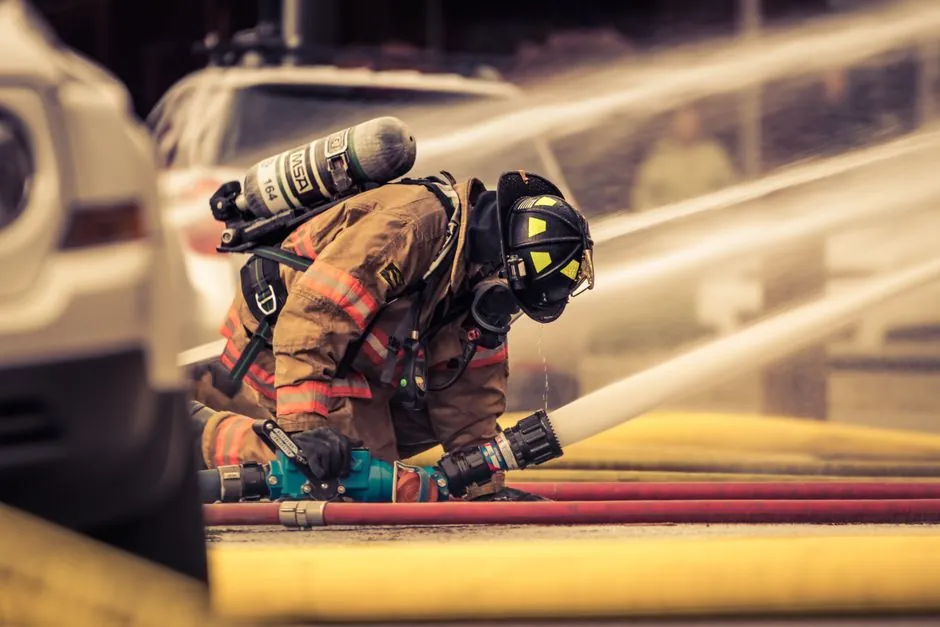
Gas fire suppression systems for laboratories are sized around three decisions: agent chemistry (halocarbon vs inert), cylinder pressure (25/42 bar low-pressure halocarbon vs ~300 bar high-pressure inert), and room integrity to hold the design concentration for the required soak time [S1][S2][S5].
Laboratories sit in the same water-sensitive risk envelope as server rooms and archives, so the standard reference set is NFPA 2001 (clean-agent design), the ISO 14520 series (agent properties and design concentrations), and the regional equivalents AS 4214 (Australia) and SANS 14520 (South Africa) [S2][S5]. Halocarbon clean agents (FM-200 / HFC-227ea and Novec 1230 / FK-5-1-12) extinguish by heat absorption and chemical chain interruption, while inert gases (IG-100, IG-55, IG-541) suppress by lowering oxygen from ~21% to roughly 12–14% [S1][S5].
Clean-Agent Halocarbon Systems: FM-200 and Novec 1230
FM-200 (HFC-227ea) is the workhorse for budget-sensitive and legacy lab retrofits, typically stored at 25 bar (low-pressure) or 42 bar (high-pressure), with a knock-down time inside 10 seconds and zero residue on sensitive instruments [S1][S2][S3]. A representative laboratory SKU, the XQQW6/1.6-XL-03 hanging FM-200 unit, runs at 1.6 MPa storage pressure (≈16 bar) and 2.5 MPa (≈25 bar) maximum working pressure at +50°C, with a 0–50°C operating envelope and total-flooding enclosed discharge [S3]. The same product line triggers at 68°C via a thermal element, supports triple activation (auto / manual / mechanical emergency), and is rated to protect up to 8 hazard zones per manifold in a piping-free suspended layout, which keeps installation cost down in retrofit labs [S3].
Novec 1230 (FK-5-1-12) targets the same hazard profile but with a sustainability-led profile: GWP ≈ 1, ODP = 0, and an atmospheric lifetime of roughly 5 days, and it is normally stored at 42 bar with verification of room integrity and hold-time to the design concentration [S1]. The trade-off is real: FM-200 still shows a higher GWP than FK-5-1-12 and is increasingly restricted by insurer and corporate environmental policy, while Novec 1230 demands tighter enclosure sealing, so envelope leakage testing is non-negotiable before sign-off [S1].
Inert Gas Systems: IG-100, IG-55, IG-541
High-pressure inert systems are stored at approximately 300 bar, delivering high-velocity discharge through solenoid-actuated cylinder manifolds and dropping oxygen into the 12–14% band that supports combustion but stays tolerable for evacuation [S5]. IG-100 is pure argon, IG-55 is a 50/50 argon/nitrogen blend (Aragonite) with the highest cylinder density per m², and IG-541 is 52% N₂ / 40% Ar / 8% CO₂ (Inergen), where the CO₂ fraction slightly stimulates respiration for occupied rooms [S1][S5].
For laboratories that must remain occupiable during discharge (instrument rooms, vivarium support spaces, control rooms), IG-541 and IG-55 are the default; for unoccupied plant rooms and switchgear enclosures, CO₂ remains an option but requires dedicated safety interlocks because concentrations that suppress flame are asphyxiating to humans [S1][S2]. Inert gases score GWP ≈ 0 and ODP = 0, are accepted under Kyoto Protocol reporting and commonly specified for LEED-aligned projects, and leave zero residue, which is the reason archives and cultural-heritage spaces are also covered by the same SANS 14520 envelope [S5].
Comparison of Main Gas Suppression Options for Labs
Four options cover roughly 95% of lab applications: FM-200, Novec 1230, IG-55, and IG-541. Decision criteria for laboratory risk panels usually come down to four axes: environmental policy, room-integrity burden, occupancy, and footprint/pressure class [S1][S2][S5].
On environmental policy, Novec 1230 (GWP ≈ 1, ~5-day atmospheric lifetime) and the inert gases (GWP ≈ 0) are the cleanest, while FM-200 carries the highest GWP and is the most likely to be flagged in insurer and ESG reviews [S1]. On room integrity, FM-200 and IG systems are more forgiving of moderate leakage than Novec 1230, which demands a verified hold-time to maintain the design concentration across the soak period [S1]. On occupancy, IG-541's 8% CO₂ component is the preferred physiological choice for rooms people may enter during or just after discharge, while halocarbon clean agents are also used in occupied spaces but require the no-oxygen-depletion design assumption [S1][S2][S5]. On footprint, 25/42 bar halocarbon cylinders are markedly more compact than 300 bar inert manifolds, which is decisive in dense lab retrofits where mechanical-room floor area is limited [S1][S5].
Selection Criteria and Lab-Specific Risk Drivers
Lab risk differs from a server room: flammable solvents, gas cylinders, Bunsen / hot-plate ignition sources, and biological hazards all sit in the same room as precision balances, mass specs, and freezers, so the suppression choice has to protect both occupants and irreplaceable samples. Detection is the upstream gate: aspirating smoke detection, cross-zoned optical/heat detectors, and flame detectors are integrated with HVAC shutdown, door release, and alarm sequencing per AS 1670.5-style logic, so a gas system is judged not only on its cylinder bank but on its ability to fire a clean, two-stage cross-zoned release [S2][S10].
Five selection criteria consistently drive lab specification: (1) agent toxicity class and NOAEL/LOAEL margin for occupied rooms; (2) room-integrity test result (typically a door-fan or blower-door test to verify leak area and hold time); (3) cylinder pressure class (25/42 bar halocarbon vs ~300 bar inert) and the resulting manifold room footprint; (4) environmental policy alignment (GWP/ODP/atmospheric lifetime, plus regional F-gas reporting); and (5) maintenance regime: periodic cylinder pressure verification, valve actuation test, and re-commissioning after any discharge, all of which SANS 14520 and NFPA 2001 require at defined intervals [S1][S2][S5].
For ceiling-concealed or under-bench protection where piping would be impractical, hanging (suspended) FM-200 units such as the XQQW6/1.6-XL-03 fit a single hazard zone per cylinder, with 1.6 MPa storage and 2.5 MPa working pressure, 68°C thermal actuation, and 0–50°C ambient rating, an architecture well matched to small enclosures inside larger labs [S3]. For multi-room labs above ~50 m² of combined hazard, a 42 bar FM-200 or Novec 1230 manifold or a 300 bar IG-541 system with engineered room integrity is the typical step up [S1][S3][S5].
Standards, Maintenance, and Code Alignment
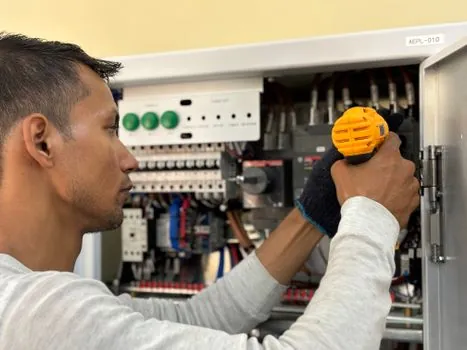
The clean-agent design basis is NFPA 2001, which defines minimum design concentrations, soak times, and the safety factor between extinguishing concentration and the no-observed-adverse-effect level (NOAEL) for occupied spaces; the ISO 14520 series underpins the agent physical-property tables referenced by most regional codes [S1][S2]. In Australia the equivalent package is AS 4214 (system design, install, maintenance), AS ISO 14520 (agent properties), and AS 1670.5 (detection and alarm integration) under the NCC and WHS framework; in South Africa the same role is filled by SANS 14520 [S2][S5].
Maintenance is a scheduled-discipline activity, not an on-call one: certified technicians perform periodic inspections, cylinder pressure checks, valve actuation tests, and full re-commissioning after any discharge, with detailed records retained for the authority having jurisdiction [S4][S5]. A typical 50–200 m² server-room-equivalent install runs 5–10 working days end to end, including design submission, authority sign-off, and final integrity testing, which is a useful planning benchmark when a lab retrofit is being scoped [S5]. For cross-discipline specification work that includes adjacent mechanical, electrical, and packaging lines, the engineering logic for matching pressure class, service factor, and sealing to a real operating envelope is the same logic used in slewing drive selection for packaging lines, where torque, ratio, and sealing drive the spec rather than brand. For cleanroom-adjacent sub-floors and tank farms sitting under or beside a lab, the modified bitumen membrane selection for cleanroom sub-floors spec path is a useful reference for choosing containment membranes that pair with gas-system discharge envelopes. Reference grounding for the wider system family sits in the gas fire suppression encyclopedia entry, with the suppression and detection chain cross-referenced from the fire safety hub.
Limitations, Failure Modes, and Common Misconceptions
Three failure modes account for most lab gas-system under-performance: (a) room integrity below the agent's design hold-time, which lets concentration decay before the soak period ends and allows re-ignition; (b) detection that is not cross-zoned or is set with the wrong sensitivity class for the lab's smoke profile, leading either to nuisance discharge or to a release that fires too late; and (c) cylinder banks that have been pressure-checked on a lapsed schedule, so a cylinder is at 80% of nominal pressure on the day of discharge and fails to reach design concentration [S1][S5].
Two misconceptions still show up in lab project briefs. First, CO₂ is not a substitute for halocarbon or inert agents in occupied labs: the extinguishing concentration and the human exposure limit are far too close together, so authorities require interlocked, normally-unoccupied enclosures [S1][S2]. Second, FM-200 is not automatically the cheapest option once the full lifecycle is counted: its higher GWP can trigger F-gas reporting, insurer surcharges, and end-of-life recovery costs that close the gap with Novec 1230 on a 10–15 year horizon, especially in jurisdictions tracking the Kigali Amendment phase-down [S1][S3]. The other constant guard-rail: gas suppression does not replace the fire extinguisher and fire hydrant provisions required by the local building code; it supplements them for the specific room or enclosure, with the fire door assembly and HVAC shutdown completing the integrated fire-safety sequence. The standalone electrical fire monitor reference covers the upstream detection side that any gas system depends on.
Trackable next signals: updated ISO 14520 agent-concentration amendments, any tightening of F-gas / Kigali phase-down schedules that affect HFC-227ea, and the next round of insurer ESG questionnaires on halocarbon GWP, each of which will shift the cost line between FM-200, Novec 1230, and the IG family within the next two budget cycles [S1][S2][S3].