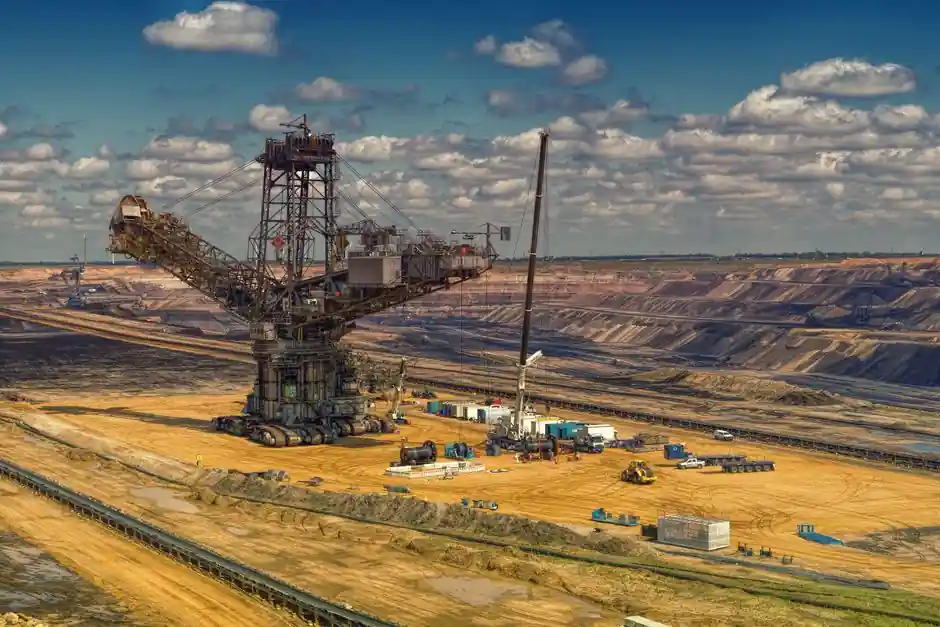
Gas fire suppression in mining is not one decision, it is three stacked gates: match the agent to the fire class, prove the room will hold the agent long enough, and verify the detection chain fires before the fire does [S4].
The 2026 selection problem is split between sealed electrical enclosures (where clean agents and inert gases dominate) and open or semi-enclosed process hazards like conveyor galleries, lube rooms, and bulk fuel farms (where foam, dry chemical, and water mist still carry the load) [S4][S5]. Underground workings add a third constraint: smoke and toxic-gas confinement means the suppression choice must not displace breathable air in occupied headings [S1].
Clean agents vs inert gases: the switch-room decision
Clean agents such as FM-200 (HFC-227ea) and Novec 1230 (FK-5-1-12) extinguish by absorbing heat and interrupting the chemical chain reaction, leaving no conductive residue on HV switchgear or server racks after discharge [S2][S5].
Clean agents store as liquid and discharge in 6-10 seconds, which suits smaller sealed rooms under 500 m3, while inert systems require larger cylinder rooms and 60-90 second discharge windows but impose no atmospheric decay concerns in occupied spaces during commissioning [S2]. Acoustic nozzles are specified on server-adjacent rooms to keep the high-pressure release below the vibration threshold that damages spinning hard drives [S4]. For a side-by-side on the four most common classes used in mining electrical rooms, see the clean-agent comparison in our gas suppression primer.
Fire class mapping for mining hazards
Class B (flammable liquids: diesel, hydraulic oil, solvents) and Class C (energized electrical: switchgear, MCCs, VFDs, server rooms) drive 80% of mining suppression spend, with Class A (conveyor belt, timber, cable trays) a persistent secondary risk [S5][S4]. Coal-pile and ore-pile spontaneous combustion is a separate problem: it is a slow smoulder, not a flash fire, and gas systems are not the right tool there; foam blanket or water injection is the standard answer [S3].
For Class C switchgear, only electrically non-conductive agents are acceptable; water-based delivery is excluded from energized rooms to prevent phase-to-phase shorting and arc-flash escalation, and dry chemical powder is rejected where post-discharge corrosion of copper busbars would force a multi-million-dollar rebuild [S3][S4]. Foam concentrate (AFFF or AFFF-AR for alcohol-bearing fuels) at a 3% or 6% proportioning ratio remains the workhorse for diesel bunds and loading bays because the aerated blanket suppresses vapour release for 20-30 minutes after application [S4].
Detection logic and double-knock interlock
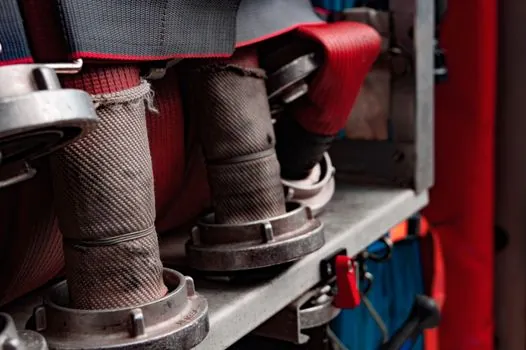
Mining-grade detection chains pair cross-zoned smoke (photoelectric or aspirating) with heat or flame detectors, and require two independent detectors to trip before the pre-discharge sequence starts, the so-called double-knock interlock [S2]. Pre-discharge delays of 30 seconds are common, paired with audible horns and visual strobes, to give the last person out time to evacuate the protected enclosure [S4].
Hold buttons at the egress door abort the discharge for a configurable window (typically 30-60 seconds) and are mandatory on occupied rooms; without them a spurious trip during shift handover can flood a control room with FK-5-1-12 and force a 24-48 hour ventilation re-entry [S2][S4]. Aspirating smoke detection (ASD) is increasingly specified for crusher motor control cabinets and conveyor drive stations because conventional point detectors fail in the dust-laden air common to mineral processing [S2].
Enclosure integrity: the gate that most often fails
Gas suppression only works if the protected room holds the design concentration for the full soak period, typically 10-15 minutes for clean agents and up to 30 minutes for some inert blends, which is why annual room integrity testing is a hard requirement under Australian standard AS 1851 and equivalent mining-site protocols [S4]. The test pressurises the room with a calibrated fan, measures equivalent leakage area (ELA) in square metres, and rejects the room if ELA exceeds the maximum value on the system design sheet.
Common failure modes are unsealed cable penetrations after retrofit work, failed door seals on frequently-accessed electrical rooms, and new HVAC penetrations cut for inverter cooling; each one is a leak path that lets the agent escape and lets oxygen back in [S4]. For adjacent fire-separation context, see our fire door integrity reference. If the room cannot pass integrity, no amount of agent specification will save it: switch to a localized application system, dry chemical, or water mist, and re-scope the engineering [S4].
Selection criteria: who needs gas and who does not
Gas suppression is for sealed or near-sealed enclosures with high-value, low-tolerance-for-residue assets: HV switchrooms, server and control rooms, PLC cabinets, and battery energy storage enclosures [S2][S4]. It is not for open conveyor galleries, vehicle refuelling bays, transformer compounds with oil bunds, or any space where the room cannot be made tight; those hazards belong to foam, water mist, or dry chemical systems [S3][S4].
For mine-site bulk fuel farms, high-expansion foam generators (expansion ratio 200:1 to 1000:1) fill large process sheds from floor to roof in minutes, while low-expansion foam (expansion ratio 6:1 to 12:1) is the correct pick for open diesel bunds and loading bays where wind would strip a high-expansion blanket [S4]. Conveyors carrying combustible carryback (rubber belt, lagging, oil-soaked dust) sit in a third category: linear heat detection paired with a water-mist or dry-chemical spray line is the engineered answer, not a gas flooding system [S3].
Limitations, safety floors, and re-ignition risk
Clean agents do not cool the fuel below its ignition temperature, so a hot surface in a switchroom can re-ignite once the agent dissipates if the upstream electrical fault is not cleared within the soak window [S5]. Inert gases lower oxygen to a level unsafe for human occupancy, and AS 1851 / NFPA 2001 require a 30-second pre-discharge warning with evacuation interlock to prevent asphyxiation in any room that can be entered during a discharge [S2][S4].
Dry chemical powder is effective across Class A, B, and C fires but is corrosive to copper, silver, and copper alloys, leaves a cleanup burden measured in days not hours, and provides no cooling, so re-ignition risk is real if the fuel source is not isolated before discharge [S5]. For occupied underground headings, suppression must never rely on agents that displace breathable air; water mist or targeted foam at low expansion is the constrained set [S1]. Refer to our mining dump truck selection guide for context on how haul-cycle equipment is protected on the surface, and to the gas-suppression for oil and gas facilities spec map for the parallel selection logic in flammable-fluid facilities.
Sourcing, standards, and verification trail
Specifying mining-grade gas suppression requires the system to be listed to a recognized extinguishing-agent standard (FM Approved, UL Listed, or VdS) and the installer to hold current manufacturer certification for the specific agent and cylinder range [S6][S9]. Documentation should include the room integrity test certificate, the agent quantity calculation per ISO 14520 or NFPA 2001, the detection-and-control panel cause-and-effect matrix, and the maintenance log keyed to the monthly visual, semi-annual cylinder pressure, and annual discharge-functional checks [S2][S4].
On a real procurement file, the four signals worth tracking are: agent quantity vs room net volume at design temperature, equivalent leakage area measured at the last integrity test, last cylinder pressure gauge reading versus the green-band threshold, and the cause-and-effect matrix for the room (which two detectors trip, what the pre-discharge delay is, and which outputs are inhibited during the hold-button window) [S4][S2]. If any of those four is missing on the data plate, the system is not yet a real engineered system; it is a partial install waiting for a discharge to expose the gap. For broader fire-safety planning across a mining lease, see our fire safety overview.